Website Policy Generator in 2026: What It Can Draft, What It Cannot Prove, and 7 Live Checks
The real value in website policy generator shows up when you debug it like a live system. A banner can render perfectly and still leak requests, misfire tags, or drift after the next plugin or theme update.
The useful test for website policy generator is whether the live stack behaves correctly before consent, after consent, and after the next deployment. That is how hidden leaks and timing mistakes show up.
That is not the safe answer.
The safer answer is to treat the generator as a drafting shortcut, then test whether the generated policy pages still match the live site, the live collection points, the live cookie behavior, the live vendor stack, and the live rights path users actually get.
That is still where the official sources point. California’s current CCPA regulations, effective January 1, 2026, say the purpose of the privacy policy is to provide consumers with a “comprehensive description” of a business’s online and offline information practices, and they require a conspicuous online link using the word privacy. California’s Department of Justice still says notice at collection must appear “at or before” the point where personal information is collected. GDPR Article 12 still requires privacy information in a concise, intelligible, easily accessible form using “clear and plain language.” The ICO still says that before drafting privacy information you should “know what personal data you have” and what you do with it, and it says published privacy information must remain “accurate and up to date.” The FTC is also still blunt that a “surreptitious, retroactive amendment” to a privacy policy or terms of service can be unfair or deceptive.
That combination is what makes a website policy generator a live-systems question in late 2026, not only a copywriting question.
If you want the nearest companion reads first, start with these guides to website privacy policy generator, cookie policy generator, and website security policy generator. This page stays broader. It is the website policy generator review I would use this week before publishing any generated legal or compliance page on a live site.
If your team is trying to get website policy generator under control without adding a heavyweight privacy stack, DataShyre can help. DataShyre focuses on consent and preference management that are easier to implement, easier to operate, and easier to trust on a live site. Start with DataShyre’s consent and preference management or book a demo.
If your team already has generated policy pages but they drift every time the product, marketing stack, or rights workflow changes, DataShyre can help with data mapping, consent management, and DSR automation. The expensive failure is rarely we had no draft. It is the published draft stopped matching reality.
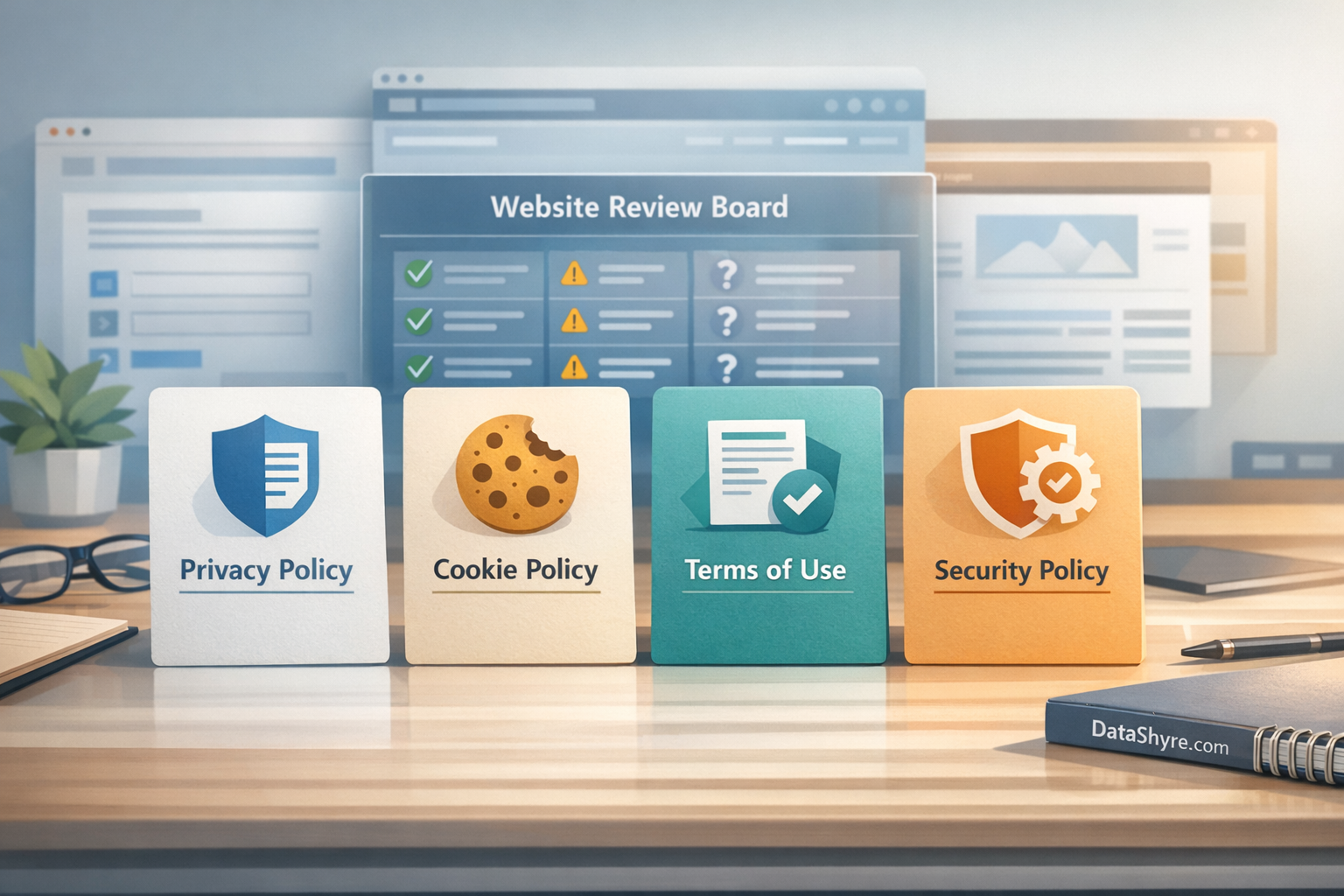
1. Decide which website policy the generator is actually drafting
The first website policy generator mistake is assuming every policy page does the same job.
It does not.
A privacy policy, cookie policy, terms page, and security page may all live in the footer, but they answer different questions:
- the privacy policy explains collection, use, sharing, retention, and rights;
- the cookie or preference policy explains tracking technologies, purposes, providers, and controls;
- the terms page explains account, service, billing, and usage rules;
- the security page explains safeguards and response posture at a high level.
That distinction matters because official privacy and consent sources are specific about what belongs in each layer.
So before you trust a website policy generator, decide what page you are asking it to create.
If the output tries to blend all four jobs into one giant legal page, it usually becomes vague in the wrong places and overconfident in the risky ones.
2. Answer the prompts from a live inventory, not from memory
This is where many generated pages start going wrong before anyone edits a sentence.
The ICO’s current drafting guidance still points to the right first step: know what personal data you have, what you do with it, who you share it with, and how long you keep it.
That means a real website policy generator workflow should begin with the live site:
- forms, checkouts, bookings, demos, and support flows;
- newsletter, account, and preference-center journeys;
- analytics, advertising, chat, scheduling, payment, and embedded tools;
- tag-manager logic, scripts, pixels, and app-market add-ons;
- request, opt-out, and withdrawal paths users can actually reach.
If that inventory is incomplete, the website policy generator will still produce polished language.
It just will not be describing the real website.
That is also why generator output is often weaker than it looks. The tool can only draft from the facts it is given. It cannot watch the runtime for you.
3. Check whether the privacy layer appears where collection really happens
This is one of the clearest website checks in 2026.
California’s Department of Justice still says notice at collection must be provided at or before the point where the business collects personal information. The CPPA’s current regulations also still require a privacy policy to be posted online and accessible through a conspicuous link using the word privacy.
That means a serious website policy generator review should confirm more than the generator gave us a page.
It should confirm that:
- the privacy policy has a stable public URL;
- the footer or navigation includes a visible link using the word
privacy; - forms and collection screens route people to the policy at the right moment;
- mobile users can find the page without hunting;
- app or logged-in surfaces expose the same layer where they need to.
If the draft looks solid but the live site hides it until after submission, the drafting job is not finished.
4. Keep consent and cookie choices separate from contract acceptance
This is where many generator workflows get sloppy.
GDPR and ICO consent guidance still push in the same direction: consent requests should be clearly distinguishable, in plain language, and separate from other terms and conditions.
So when reviewing website policy generator output, watch for bundled language like:
By using this site, you agree to our terms, privacy policy, cookies, and marketing updates.
That sentence is trying to do too many jobs at once.
A stronger live pattern is:
- terms acceptance is handled as contract acceptance;
- the privacy policy explains data practices and rights;
- cookie or similar tracking controls have their own visible control path;
- optional marketing consent is collected separately when consent is the right basis.
If the generated page blurs those lines, the website policy generator is still producing a placeholder rather than a finished compliance layer.
5. Review vendor, cookie, and preference-center claims against the live runtime
This is usually where the generated page becomes least trustworthy.
Many website policy generator tools flatten the runtime into phrases like trusted partners, website analytics, or service providers.
That is not enough if the real site loads a larger chain of tools.
So for this keyword, I would run a separate branch of checks for:
- cookie and tracker categories;
- analytics, advertising, and embedded recipients;
- chat, payment, scheduler, CRM, and support vendors;
- the preference-center or withdrawal path;
- whether the policy still matches what the browser actually loads.
This is also where generator buyers often compare branded tools like OneTrust or Cookiebot. Those tools may help with the preference layer, but they still need to be aligned with the live policy text, the actual vendor list, and the real rights workflow. If your team wants help connecting that layer to the runtime instead of just the banner, DataShyre can help implement and verify the full flow.
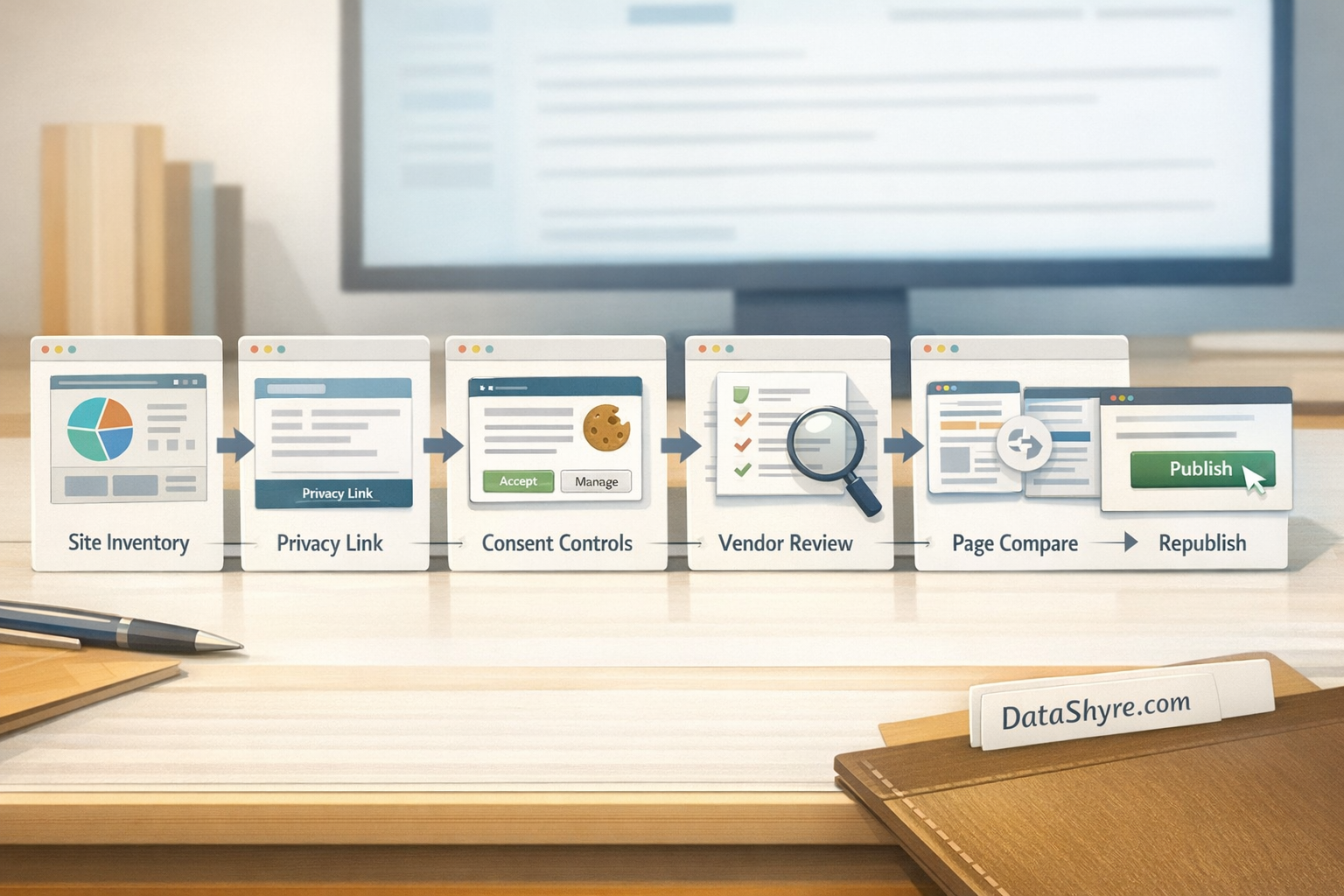
6. Read all generated pages together for contradictions
This is the most overlooked website policy generator test.
The FTC’s current guidance matters here because a site can create risk when its policy promises change quietly or when important disclosures are effectively buried.
That matters because contradictions often appear across pages, not inside one page.
Examples:
- the terms page sounds broad enough to allow uses the privacy page does not clearly explain;
- the privacy page says users can exercise rights, but the request route is missing or hard to find;
- the cookie page says users can withdraw choices, but the preference link is broken;
- the security page sounds stronger than the operational reality behind forms, vendors, or admin access.
So one of the best website policy generator checks is to review the generated pages side by side and ask a simple question:
would a normal user come away with one coherent understanding of what the website collects, what it shares, what they can control, and what rules apply?
If the answer is no, the generated set is still weak even if each page looks professional by itself.
7. Add re-review triggers before the generated policy starts lying by accident
The long-term problem is almost never the first draft.
It is drift.
The ICO still says privacy information should be reviewed regularly so it remains accurate and up to date, and updated before new processing begins. California’s current framework also still expects a maintained privacy policy, not a forgotten page.
That means a website policy generator should be judged partly on whether your team can realistically revisit the output when the website changes.
Set a re-review trigger whenever you:
- launch a new form, checkout, or onboarding step;
- install a new analytics, ad-tech, support, or payment tool;
- change the cookie banner, preference center, or California choice route;
- add a new app, embed, or custom code block;
- start using data for a new purpose;
- change the terms, refunds, subscriptions, or account rules.
If the generator makes updates painful, the page will age into fiction faster than the team expects.
A practical 7-step review for this week
If I were approving website policy generator output today, I would use this order:
- define which policy page or set of pages the tool is drafting;
- map the live forms, vendors, trackers, and request paths first;
- verify notice-at-collection and privacy-link placement on the real site;
- separate consent and cookie choices from contract acceptance;
- compare the generated text against live vendors, cookies, and preference controls;
- review privacy, cookie, terms, and security pages together for contradictions;
- set clear re-review triggers before the next release.
That order usually exposes the real gaps faster than another pass at the headline copy.
FAQ
Is a website policy generator the same as a privacy policy generator?
No. A website policy generator is usually broader. It may cover privacy, cookies, terms, or security pages. A privacy policy generator is only one branch of that work.
Is a website policy generator enough on its own?
No. It can speed up drafting, but it cannot verify live collection points, cookie behavior, vendor disclosures, rights routes, or contradictions between generated pages and the runtime.
What is the biggest risk with a website policy generator?
The biggest risk is not that the copy looks bad. It is that the copy looks finished while the live website quietly says something different.
Bottom line
The best website policy generator in 2026 is not the one that publishes the fastest legal page.
It is the one your team can turn into a truthful set of live documents that still match the real forms, vendors, trackers, controls, and account rules after the next release.
If those checks hold up, the generator helped.
The fastest way to judge website policy generator is to test it the way a broken deployment would expose it: before consent, after consent, and again after a stack change.
Sources
- California Privacy Protection Agency, CCPA regulations effective January 1, 2026: https://cppa.ca.gov/regulations/pdf/ccpa_statute_eff_20260101.pdf
- California Department of Justice, California Consumer Privacy Act (CCPA): https://oag.ca.gov/privacy/ccpa
- California Department of Justice, How to Read a Privacy Policy: https://oag.ca.gov/privacy/facts/online-privacy/privacy-policy
- EUR-Lex, Regulation (EU) 2016/679, Article 12: https://eur-lex.europa.eu/eli/reg/2016/679/oj/eng
- ICO, How to write a privacy notice and what goes in it: https://ico.org.uk/for-organisations/advice-for-small-organisations/privacy-notices-and-cookies/how-to-write-a-privacy-notice-and-what-goes-in-it
- ICO, Should we test, review and update our privacy information?: https://ico.org.uk/for-organisations/uk-gdpr-guidance-and-resources/individual-rights/the-right-to-be-informed/should-we-test-review-and-update-our-privacy-information/
- ICO, How should we obtain, record and manage consent?: https://ico.org.uk/for-organisations/uk-gdpr-guidance-and-resources/lawful-basis/consent/how-should-we-obtain-record-and-manage-consent/
- FTC, AI (and other) Companies: Quietly Changing Your Terms of Service Could Be Unfair or Deceptive: https://www.ftc.gov/policy/advocacy-research/tech-at-ftc/2024/02/ai-other-companies-quietly-changing-your-terms-service-could-be-unfair-or-deceptive