Web Cookies in 2026: What They Do, Which Ones Need Consent, and 7 Live Checks
The real value in web cookies shows up when you debug it like a live system. A banner can render perfectly and still leak requests, misfire tags, or drift after the next plugin or theme update.
The useful test for web cookies is whether the live stack behaves correctly before consent, after consent, and after the next deployment. That is how hidden leaks and timing mistakes show up.
It is also too small for the real review.
In late 2026, a useful web cookies review has to answer at least four questions at once:
- what the cookie actually does;
- whether it is necessary or optional;
- whether another company gets access to the resulting data; and
- whether consent, opt-out, or browser controls really change the live behavior.
If you want the adjacent explainers first, start with browser cookies, third party cookies, and what is cookie consent. This page stays broader. It is the web cookies review I would use this week before telling a team that the site is under control.
If your team is trying to get web cookies under control without adding a heavyweight privacy stack, DataShyre can help. DataShyre focuses on consent and preference management that are easier to implement, easier to operate, and easier to trust on a live site. Start with DataShyre’s consent and preference management or book a demo.
The timing matters. The UK’s ICO finalized its storage-and-access-technologies guidance on April 29, 2026, making clear that the practical compliance review now extends beyond classic cookies to pixels, fingerprinting, scripts, tags, web storage, and related techniques. The California Department of Justice still describes Global Privacy Control as a “stop selling or sharing my data switch.” And on October 22, 2026, France’s CNIL fined FNAC DARTY companies 7 million euros over cookie and tracking-device failures in a mobile-app context.

1. Start with what web cookies actually are
At the protocol level, web cookies are still straightforward.
MDN’s current HTTP references say a server can send a Set-Cookie header in a response, and the browser can later send stored cookie values back in the Cookie request header. This is why web cookies became such a common building block for websites.
They can help a site:
- keep a user signed in;
- remember language or display preferences;
- preserve a shopping cart;
- remember a consent or notice choice; and
- support analytics or advertising workflows.
The mechanism itself is neutral.
The real question is what purpose the cookie serves.
2. Separate necessary web cookies from optional tracking cookies
Most web cookies questions are not really about the definition.
They are about purpose.
A practical review usually separates web cookies into groups like:
- necessary or security cookies for login, fraud prevention, checkout continuity, or load balancing;
- preference cookies for language, region, or remembered settings;
- analytics cookies for measuring visits or behavior; and
- advertising or profiling cookies for attribution, audience building, or cross-context recognition.
The FTC’s consumer guidance still uses this broader everyday framing. It explains that websites and apps may use cookies, pixels, or device fingerprinting to remember preferences, gather analytics, or show personalized advertising.
This is why the useful web cookies question is not only Is there a cookie?
It is Why is it there, and does the user expect that purpose?
3. Do not let first-party versus third-party be the only test
People often explain web cookies by splitting them into first-party and third-party categories.
That is helpful, but incomplete.
The FTC says first-party tracking happens when the site you visit tracks you, while third-party tracking happens when that site lets another company track you. That difference still matters because third-party tracking can follow people across sites.
But the operational review should go one step further.
For web cookies, ask:
- who sets the cookie;
- who receives the resulting data;
- whether the cookie supports security, convenience, measurement, or profiling;
- whether the site still works without it; and
- whether another storage or access technology is achieving the same outcome anyway.
If you stop at the label alone, you can miss the real tracking path.
4. Remember that web cookies are only one part of the tracking stack
This is where older articles about web cookies usually go stale.
The ICO’s finalized 2026 guidance is explicit that PECR applies more broadly to storage and access technologies, not just classic cookies. The guidance covers cookies, tracking pixels, link decoration and navigational tracking, device fingerprinting, web storage, and scripts or tags.
That matters because a site can look cleaner in a cookie table while still sending user data through other tracking paths.
So when someone asks whether web cookies are under control, I would not stop at the named cookies in the browser.
I would also inspect:
- network requests before any choice is made;
- tag-manager behavior;
- embedded chat, video, and social widgets;
- local storage and similar client-side persistence; and
- whether vendors start receiving identifiers before the user has made a real choice.
5. Treat consent and opt-out as regional branches, not one global answer
This is one of the biggest practical mistakes teams make with web cookies.
There is no single worldwide rule.
EU and UK branch
The European Commission’s consent guidance still says valid consent must be freely given, informed, specific, and given through a clear affirmative action. It also says the request should use “clear and plain language” and that withdrawal should be “as easy to use as giving consent.”
The ICO’s current guidance adds the browser-facing rule that organisations should not use non-essential storage and access technologies unless an exemption applies or the user has given valid consent first.
For many EU- or UK-facing web cookies setups, that means optional analytics, advertising, and profiling technologies should not start by default.
California branch
California often changes the practical question.
The California DOJ says businesses that sell or share personal information must offer methods for consumers to opt out, and that a user-enabled Global Privacy Control can function as a “stop selling or sharing my data switch.”
So for California-facing web cookies reviews, the core test is often not Do we have an EU-style banner?
It is:
- whether the notice at collection is accurate;
- whether an opt-out of sale or sharing exists where required;
- whether GPC is honored where applicable; and
- whether downstream advertising or sharing behavior actually changes.
Copied banner design is not enough if the runtime path does not change.
6. Security settings still matter for the non-marketing cookies
Not every web cookies issue is a consent issue.
Some are basic security issues.
MDN’s current secure-cookie guidance still points teams toward Secure, HttpOnly, deliberate SameSite settings, and tighter Domain or Path scope. It also recommends cookie name prefixes such as Host- and Secure- where appropriate.
Chrome’s current DevTools cookie view is useful here because it surfaces the fields that matter operationally, including expiry, HttpOnly, Secure, SameSite, and a partition key for cookies with independent partition state.
So if web cookies are supporting sessions, account state, or sensitive workflows, I would check at least:
- whether
Secureis present; - whether
HttpOnlyis present where it should be; - whether
SameSiteis deliberate rather than accidental; - whether the scope is broader than necessary; and
- whether the lifetime fits the actual risk.
Weak session-cookie hygiene and weak privacy hygiene often show up together.
7. Test live browser behavior instead of trusting the policy page
The strongest web cookies review is not a policy review and not a cookie spreadsheet alone.
It is a runtime test.
Firefox’s current Total Cookie Protection support materials say Firefox maintains a separate cookie jar for each website. Chrome’s current tools still let you inspect and edit cookies directly. Together, those browser views are a reminder that the real behavior can vary by browser and setting.
That means a serious web cookies review should test:
- the no-choice path;
- the reject path;
- the accept path;
- the later-withdrawal path;
- California opt-out and GPC behavior where relevant;
- more than one browser; and
- what happens again after the next deployment.
That is how hidden leaks and timing problems show up.
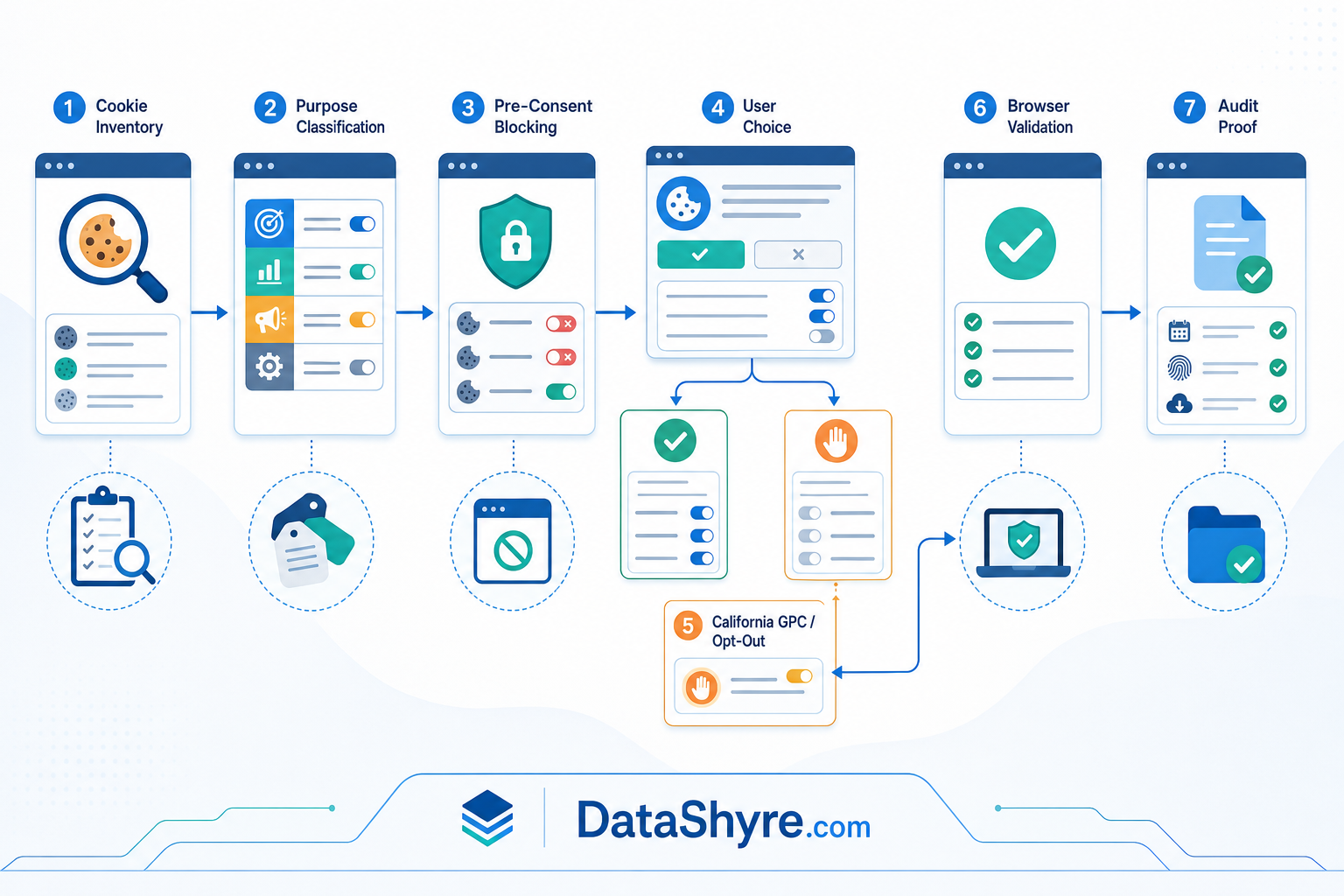
A practical 7-step web cookies review
If I were auditing web cookies this week, I would use this order:
- list every cookie and adjacent storage or access technology that appears before user choice;
- classify each item as necessary, preference, analytics, advertising, or embedded-third-party behavior;
- identify which vendors receive data and which tools write identifiers;
- test reject, accept, category-level choices, and later withdrawal;
- test California opt-out and GPC behavior if sale or sharing is in scope;
- review security settings on session and account cookies; and
- compare the live findings against the notice, privacy policy, and consent interface.
That sequence usually reveals more truth than a policy rewrite alone.
FAQ
Are web cookies the same as browser cookies?
Usually, yes in everyday usage. Web cookies is the broader plain-English phrase. Browser cookies emphasizes the browser-storage mechanism. In real deployments, people often mean the same underlying technology.
Do all web cookies need consent?
No. Some cookies are exempt because they are strictly necessary for the service the user requested. The higher-risk branch is usually optional analytics, advertising, profiling, or similar tracking behavior.
Can a site reduce visible web cookies and still keep tracking?
Yes. The ICO’s current guidance is explicit that the review is broader than cookies alone. A site can reduce visible cookies while still using pixels, scripts, web storage, or fingerprinting to pursue similar tracking outcomes.
Bottom line
The safest way to think about web cookies in 2026 is not tiny files that only matter to banner lawyers.
It is one browser-level memory mechanism inside a broader runtime, security, and compliance system.
If you know what each cookie does, who receives the data, what changes after consent or opt-out, how other storage technologies interact with it, and whether the browser configuration is sound, you are much closer to the truth.
The fastest way to judge web cookies is to test it the way a broken deployment would expose it: before consent, after consent, and again after a stack change.
Sources
- MDN, Set-Cookie header: https://developer.mozilla.org/en-US/docs/Web/HTTP/Reference/Headers/Set-Cookie
- MDN, Cookie header: https://developer.mozilla.org/en-US/docs/Web/HTTP/Reference/Headers/Cookie
- MDN, Secure cookie configuration: https://developer.mozilla.org/en-US/docs/Web/Security/Practical_implementation_guides/Cookies
- Firefox Help, Introducing Total Cookie Protection in Standard Mode: https://support.mozilla.org/en-US/kb/introducing-total-cookie-protection-standard-mode
- Chrome for Developers, View, add, edit, and delete cookies: https://developer.chrome.com/docs/devtools/application/cookies/
- FTC Consumer Advice, How Websites and Apps Collect and Use Your Information: https://consumer.ftc.gov/articles/how-websites-and-apps-collect-and-use-your-information
- European Commission, Legal grounds for processing data: https://commission.europa.eu/law/law-topic/data-protection/information-business-and-organisations/legal-grounds-processing-data_en
- ICO, Final storage and access technologies guidance published: https://ico.org.uk/about-the-ico/media-centre/news-and-blogs/2026/04/final-storage-and-access-technologies-guidance-published/
- ICO, Guidance on the use of storage and access technologies: https://ico.org.uk/for-organisations/direct-marketing-and-privacy-and-electronic-communications/guidance-on-the-use-of-storage-and-access-technologies/
- California Department of Justice, California Consumer Privacy Act (CCPA): https://oag.ca.gov/privacy/ccpa
- CNIL, Cookies and mobile application: 7 million euros fine against FNAC DARTY PARTICIPATIONS ET SERVICES and FNAC DIRECT: https://www.cnil.fr/en/sanction-app-cookies-fnac
Published: October 29, 2026. Updated using current official regulator, browser-platform, and consumer-protection materials available at publication time.