Privacy Policy Example for Website in 2026: A Live Example and 7 Checks Before You Publish
The real value in privacy policy example for website shows up when you debug it like a live system. A banner can render perfectly and still leak requests, misfire tags, or drift after the next plugin or theme update.
The useful test for privacy policy example for website is whether the live stack behaves correctly before consent, after consent, and after the next deployment. That is how hidden leaks and timing mistakes show up.
That distinction matters. California’s Department of Justice still says a business privacy policy should be “updated at least once a year.” The FTC still says that if a company makes privacy promises, it must “live up to those claims.” GDPR Article 12 still requires privacy information in a concise, transparent, intelligible, and easily accessible form using “clear and plain language.” The ICO’s drafting guidance still says to “know what personal data you have” before writing privacy information. The CPPA FAQ still says covered businesses must post the privacy policy through a homepage link using the word “privacy”.
So a strong privacy policy example for website pages is not just about filling sections. It is about making sure the page matches the actual forms, cookies, analytics, vendors, and consumer-rights workflow running on the site today.
If you want related context first, start with these guides to privacy policy template, online privacy policy, and website privacy policy generator. This page stays narrower. It is a privacy policy example for website teams that need a realistic model they can adapt this week.
If your team is trying to get privacy policy example for website under control without adding a heavyweight privacy stack, DataShyre can help. DataShyre focuses on consent and preference management that are easier to implement, easier to operate, and easier to trust on a live site. Start with DataShyre’s consent and preference management or book a demo.
If your policy draft does not line up with the live stack behind the site, DataShyre can help with data mapping, consent management, and DSR automation. The hard part is rarely writing paragraphs. It is proving those paragraphs still match the real collection and sharing behavior after the next vendor, tag, or campaign change.
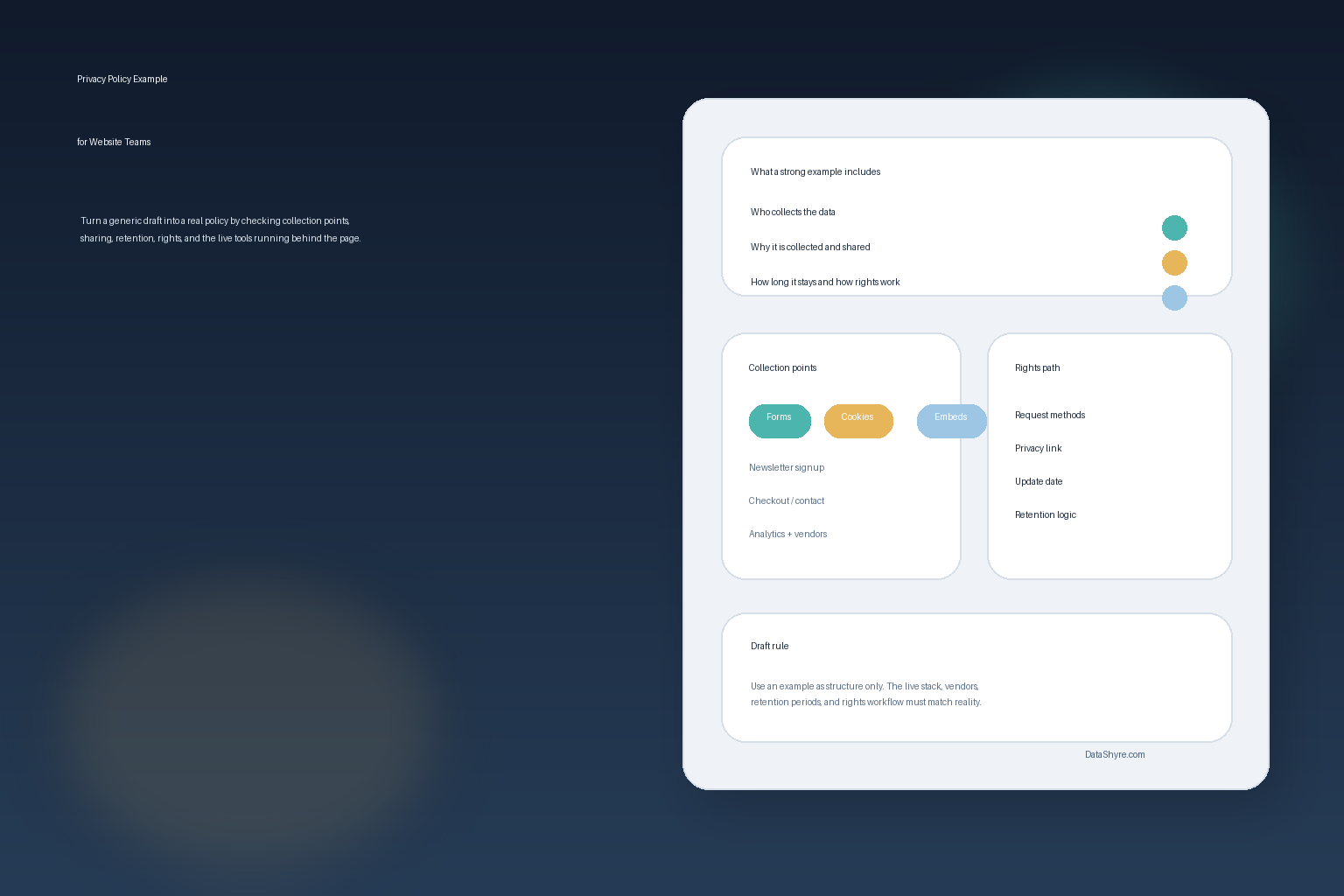
A practical privacy policy example for website teams
Here is the structure I would use for a modern privacy policy example for website page:
- who operates the website and how to contact the business;
- what personal information the website collects;
- how that information is collected, including forms, cookies, pixels, embedded tools, and service providers;
- why the information is used and, where relevant, the legal basis or business purpose behind the use;
- who receives the information or categories of recipients;
- how long the information is retained or how the retention period is determined;
- what rights apply to visitors and how they can exercise them;
- how visitors can manage cookies, advertising preferences, or browser-based signals where relevant;
- whether information is transferred across borders or into third-party platforms; and
- when the policy was last updated and what events should trigger the next review.
That outline is useful because it matches the recurring themes across official guidance: collection, purpose, sharing, retention, rights, access, and accuracy.
A short example section you can adapt
Below is the kind of plain-language opening a privacy policy example for website page might use:
We collect information you choose to provide through our forms, information generated when you browse our site, and information received from the vendors that help us run analytics, communications, scheduling, payments, and support. We use this information to operate the site, respond to requests, improve services, protect the business, and meet legal obligations. Depending on where you are located, you may have privacy rights related to access, deletion, correction, opt-out choices, or consent withdrawal. You can contact us using the privacy methods listed below.
That sample works as a starting point because it is understandable and flexible. It still needs real details filled in for categories of information, specific purposes, recipients, retention, regional rights, and request methods.
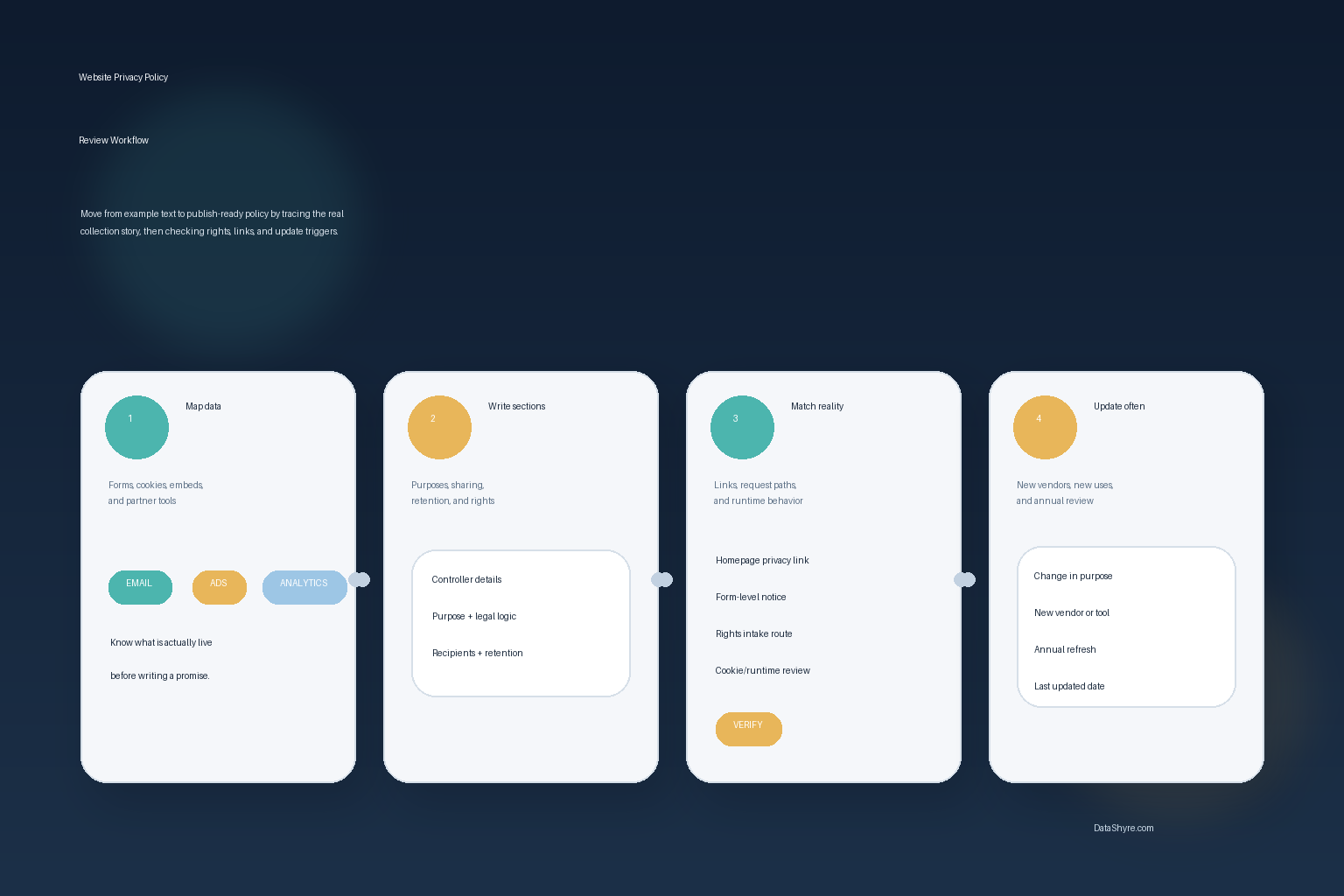
1. Start with the live data map before you borrow any example
The fastest way to ruin a privacy policy example for website page is to start with the example instead of the site.
The ICO’s drafting guidance still gives the right first step: “know what personal data you have” before you write the notice. In real deployments, that means mapping the real website first:
- forms for leads, support, downloads, demos, or newsletters;
- analytics and advertising tags;
- consent banners and preference tools;
- embedded video, chat, scheduling, or map tools;
- payment or checkout integrations;
- CRM, email, and marketing-automation syncs; and
- any vendors that receive visitor data behind the scenes.
If the data map is wrong, the policy example becomes fiction before it is even edited.
2. Use an example as a section model, not as a truth source
A privacy policy example for website pages should show structure, not manufacture truth.
That means you can borrow the order of sections, but every section still needs to be rewritten around what your site actually does.
For example, a realistic collection section might say that the site collects names, emails, company details, support messages, analytics identifiers, cookie preferences, and device-level metadata when a visitor browses, submits a form, or interacts with embedded third-party content.
That may be right for one B2B website and badly wrong for another.
A small editorial site may not need the same vendor list or rights workflow as a SaaS platform. A U.S.-only website may not present the same legal logic as a site targeting UK or EU visitors. The point of the example is to help you ask the right questions, not to answer them without evidence.
3. Make the page match the collection points people actually use
The most common privacy policy example for website mistake is treating the footer page like the whole notice.
California’s current CCPA guidance still says the privacy policy must include information on privacy rights and how to exercise them. The ICO’s delivery guidance also says you should not restrict privacy information to a single page and that form-level or just-in-time notices can be appropriate when information is collected online.
So a stronger website policy review asks:
- does the homepage or relevant page clearly link to privacy information;
- do forms give users timely notice or a clear route to the policy;
- do cookie and preference tools match what the policy says happens;
- are embedded tools and third-party content described honestly; and
- can a visitor find the rights path without digging through the footer.
If the website collects data in one place and explains it somewhere users rarely see, the example still needs work.
4. Spell out sharing, recipients, and retention in plain language
One reason teams look for a privacy policy example for website content is that these sections are easy to make vague.
They should not be.
GDPR Article 13 still requires notice of recipients or categories of recipients when applicable, and ICO guidance still says to tell people who you share personal data with and how long you keep it.
That means your example should not hide behind lines like we may share data with trusted partners as needed.
A clearer version would explain the types of providers involved, such as hosting, analytics, email delivery, payment processors, scheduling tools, customer support tools, and consent platforms. It should also say whether retention is fixed, event-based, account-based, or driven by law, contract, or dispute-handling needs.
Vagueness here is risky because users, regulators, and buyers all care about the same question: where does the data go after the form submit or page view?
5. Make the rights section usable instead of ceremonial
Many weak privacy policy example for website pages can name rights but cannot route a real request.
That is backwards.
California’s current guidance still points users to the privacy policy for instructions on how to submit requests. The CPPA FAQ still says covered businesses must post the privacy policy through a link using the word privacy on the homepage and other webpages. GDPR Article 13 also still includes the right to lodge a complaint with a supervisory authority among the information that must be provided where relevant.
So a practical example should tell users:
- what rights apply in the relevant jurisdiction;
- what request methods are available;
- what the business may need for identity verification;
- where opt-out or preference controls appear;
- whether browser signals such as GPC are honored where applicable; and
- what happens after a request is submitted.
If the page lists rights but the business cannot process them cleanly, the policy is acting like decoration instead of an operating document.
6. Keep promises aligned with the live stack
This is the FTC rule that cuts through a lot of fluff.
If your company makes privacy promises, it must “live up to those claims.”
That turns a privacy policy example for website review into an evidence check. Compare the page against:
- the tags that actually fire;
- the vendors that actually receive data;
- the forms that actually collect information;
- the retention periods teams can actually enforce;
- the cookie choices and browser signals the site actually respects; and
- the rights inbox or workflow the company will actually operate.
A site that says we do not share your information except to provide services you request while also running remarketing, partner pixels, or embedded tools that pass identifiers is not protected by polished wording.
7. Tie policy review to changes, not only to annual cleanup
The California DOJ still says the policy should be “updated at least once a year.”
That is the minimum.
The more useful operating rule is to review the page whenever the collection story changes:
- a new form or lead capture flow goes live;
- a new analytics, ads, or consent tool is added;
- a new processor or embedded service starts receiving data;
- retention or security workflows change;
- the business expands to a new region; or
- the rights process changes.
That is how a privacy policy example for website page stays true after launch instead of becoming a stale artifact.
A simple example outline you can adapt this week
If I were drafting a privacy policy example for website page today, I would build it in this order:
- identify the controller and contact path;
- list the site’s real collection points and data categories;
- explain the purposes and sharing tied to each major flow;
- name the rights and request methods that actually work;
- describe cookies, preference controls, and browser signals where relevant;
- state retention logic in plain language; and
- add a real last-updated date plus update triggers tied to product and marketing changes.
That order produces a better outcome than starting with generic prose and hoping it fits.
FAQ
Can I copy a privacy policy example for website text word for word?
You can copy structure for drafting speed, but the final page still needs to match your live forms, vendors, cookies, sharing, retention, and rights workflow.
Does every website need the same privacy policy sections?
No. Core notice themes recur, but the right detail depends on what the website collects, who it targets, where users are located, and which vendors receive data.
Is posting the page once enough?
No. The page needs review when the collection story changes, and California guidance still says the privacy policy should be updated at least once a year.
Bottom line
The best privacy policy example for website content in 2026 is not the longest example.
The fastest way to judge privacy policy example for website is to test it the way a broken deployment would expose it: before consent, after consent, and again after a stack change.
Sources
- California Department of Justice, “How to Read a Privacy Policy”: https://oag.ca.gov/privacy/facts/online-privacy/privacy-policy
- California Department of Justice, “California Consumer Privacy Act (CCPA)”: https://oag.ca.gov/privacy/ccpa
- California Privacy Protection Agency, “Frequently Asked Questions (FAQs)”: https://cppa.ca.gov/faq
- EUR-Lex, Regulation (EU) 2016/679, especially Articles 12 and 13: https://eur-lex.europa.eu/eli/reg/2016/679/oj/eng/
- ICO, “How should we draft our privacy information?”: https://ico.org.uk/for-organisations/uk-gdpr-guidance-and-resources/individual-rights/the-right-to-be-informed/how-should-we-draft-our-privacy-information/
- ICO, “What privacy information should we provide?”: https://ico.org.uk/for-organisations/uk-gdpr-guidance-and-resources/individual-rights/the-right-to-be-informed/what-privacy-information-should-we-provide/
- ICO, “What methods can we use to provide privacy information?”: https://ico.org.uk/for-organisations/uk-gdpr-guidance-and-resources/individual-rights/the-right-to-be-informed/what-methods-can-we-use-to-provide-privacy-information/
- FTC, “Privacy and Security”: https://www.ftc.gov/business-guidance/privacy-security