Opt-In Consent in 2026: When Explicit Permission Is Required
The real value in opt-in consent shows up when you debug it like a live system. A banner can render perfectly and still leak requests, misfire tags, or drift after the next plugin or theme update.
The useful test for opt-in consent is whether the live stack behaves correctly before consent, after consent, and after the next deployment. That is how hidden leaks and timing mistakes show up.
Sometimes you need explicit permission before you place non-essential tracking, send marketing by email or text, or sell or share a minor’s data. In other situations, the real legal model is opt-out, not opt-in. That difference is what separates a defensible control from a banner or checkbox that only looks reassuring.
Current official guidance still points in that direction. The European Commission says valid consent must be based on an affirmative act, use “clear and plain language,” and be withdrawable in a way that is as easy as giving it. The EDPB’s 2026 consent summary keeps the same core test: people need a genuine choice, and scrolling or swiping through a page is not enough. In the UK, the ICO’s 2026 guidance updates also keep prior-permission rules front and center for key tracking and electronic marketing scenarios. In California, the adult framework is still mainly about opt-out rights for sale or sharing, including Global Privacy Control, while minors create an important opt-in branch.
For adjacent context, start with these guides to GDPR marketing consent, cookie consent requirements, and CCPA who does it apply to. This page stays narrower. It is the practical decision framework I would use this week for opt-in consent on a live stack.
If your team is trying to get opt-in consent under control without adding a heavyweight privacy stack, DataShyre can help. DataShyre focuses on consent and preference management that are easier to implement, easier to operate, and easier to trust on a live site. Start with DataShyre’s consent and preference management or book a demo.
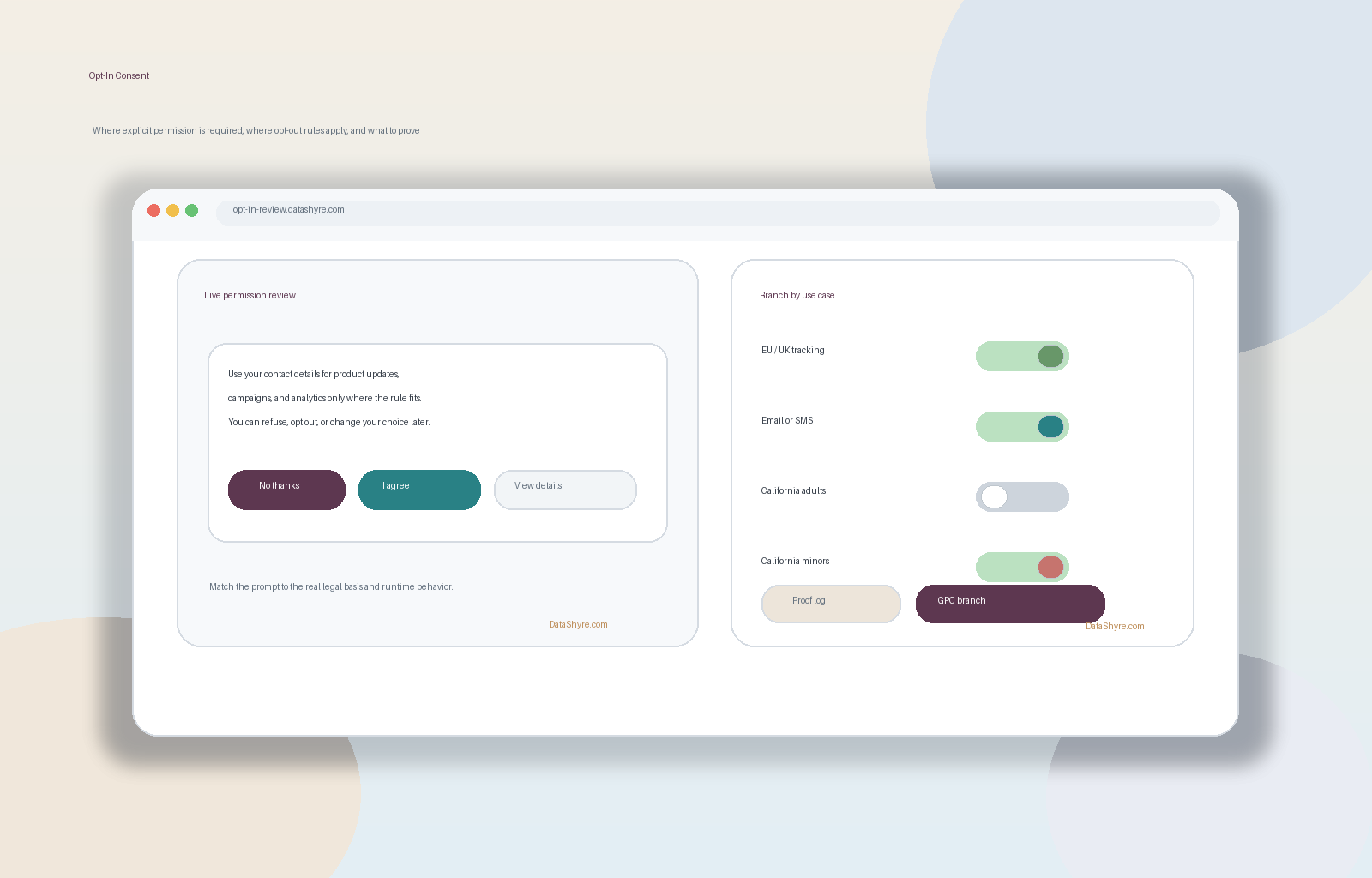
1. Start by deciding whether you truly need opt-in consent
Strong opt-in consent starts before the banner, form, or checkbox appears.
The European Commission still presents consent as one legal basis among several. That matters because teams often ask for consent out of habit, even when the harder and more important question is whether consent is actually the right legal basis for that purpose.
So the first check is not visual. It is structural:
- what personal data is involved;
- what exact purpose is being pursued;
- whether explicit permission is required before that purpose starts; and
- whether the person can refuse without losing something that should not be conditional on consent.
If a team cannot explain why opt-in consent belongs in a flow, the resulting prompt is usually weak even before a regulator looks at it.
2. For EU and UK website tracking, prior consent is still the working default for non-essential technologies
This is where opt-in consent remains most familiar.
The ICO finalized its storage-and-access-technologies guidance on April 29, 2026, and that guidance now expressly covers scripts and tags alongside cookies, pixels, and device fingerprinting. That matters because many implementations still act as if the cookie table is the whole review. It is not. A modern tracking stack often starts with tags, embedded tools, measurement scripts, and third-party calls that need to respect the choice before optional processing begins.
The EDPB’s current consent materials also keep the same practical boundary: consent must involve a “clear affirmative action,” and passive behavior like scrolling is not enough. Cookie walls and bundled choices remain the wrong pattern because they undercut genuine choice.
For a live website, that means opt-in consent should usually translate into runtime behavior such as:
- non-essential tags not firing before the person decides;
AcceptandRejectpaths being comparably usable;- optional purposes being split clearly instead of bundled into one vague yes; and
- withdrawal staying available after the first choice.
If the site asks first but loads optional technologies anyway, the interface is promising opt-in while the browser is doing something else.
3. For UK electronic marketing, consent is still the rule unless a soft opt-in actually fits
This is another area where people casually say opt-in consent when they really mean “some kind of marketing permission.”
The ICO updated its detailed guidance on direct marketing using electronic mail on April 28, 2026. The current rule remains straightforward: if you are sending unsolicited email or text marketing to individual subscribers, you “must have consent” or satisfy all the requirements of a soft opt-in.
That is a narrower exception than many teams assume.
A soft opt-in does not mean a business can market to any contact it has collected. It applies only in limited circumstances, such as messaging existing customers about similar products or services while meeting the required notice and easy opt-out conditions. It does not rescue bought lists, vague form copy, or broad downstream reuse of contact details.
So when reviewing opt-in consent for email or SMS, I would check whether:
- the sign-up language is specific to the channel being used;
- the message type matches what the person was actually told;
- any claimed soft opt-in is documented against the ICO’s conditions; and
- withdrawal works as easily as the original sign-up.
That is the difference between a marketing list that looks large and one that is actually usable.
4. In California, adult consumer flows are usually about opt-out, not blanket opt-in
This is where a lot of US teams overcorrect.
For adults, the current California model is generally not a universal prior-permission standard for online tracking. The California Department of Justice still frames the core right as the right to opt out of sale or sharing, including through a user-enabled Global Privacy Control signal. Its consumer guidance even describes GPC as a “stop selling or sharing my data switch.”
That means an adult California flow can fail even when the design looks polished. If the business says it honors opt-out choices but identifiers still keep flowing into ad-tech tools, the problem is operational. If the opt-out path is hard to find or hard to use, the problem is both legal and practical.
California’s recent enforcement still reinforces that point. In the Attorney General’s February 11, 2026 Disney settlement announcement, Rob Bonta said opting out “should not be complicated or cumbersome.” That is a useful operational standard for opt-in consent reviews too, because it reminds teams not to use explicit permission flows as a substitute for working opt-out controls where opt-out is the real rule.
5. California minors create one of the clearest opt-in branches
California does still contain an important explicit-permission path.
The California Department of Justice says businesses can sell or share the personal information of a child they know is under 16 only if they first get affirmative authorization. The CPPA’s current regulations also require businesses with actual knowledge that they sell or share the personal information of consumers aged 13 to under 16 to establish and follow a process that allows those consumers to opt in, while younger children require parental or guardian authorization.
So if your product has age-gated flows, teen accounts, or child-directed features, opt-in consent stops being a generic UX question and becomes a concrete sales-and-sharing control question:
- how age is collected or inferred;
- whether age screening is neutral and defensible;
- whether sale-or-sharing logic is separated for minors;
- whether parental authorization is handled where required; and
- whether the business can prove the downstream ad-tech or sharing behavior changed.
This is one reason “one global banner for everyone” is rarely enough.
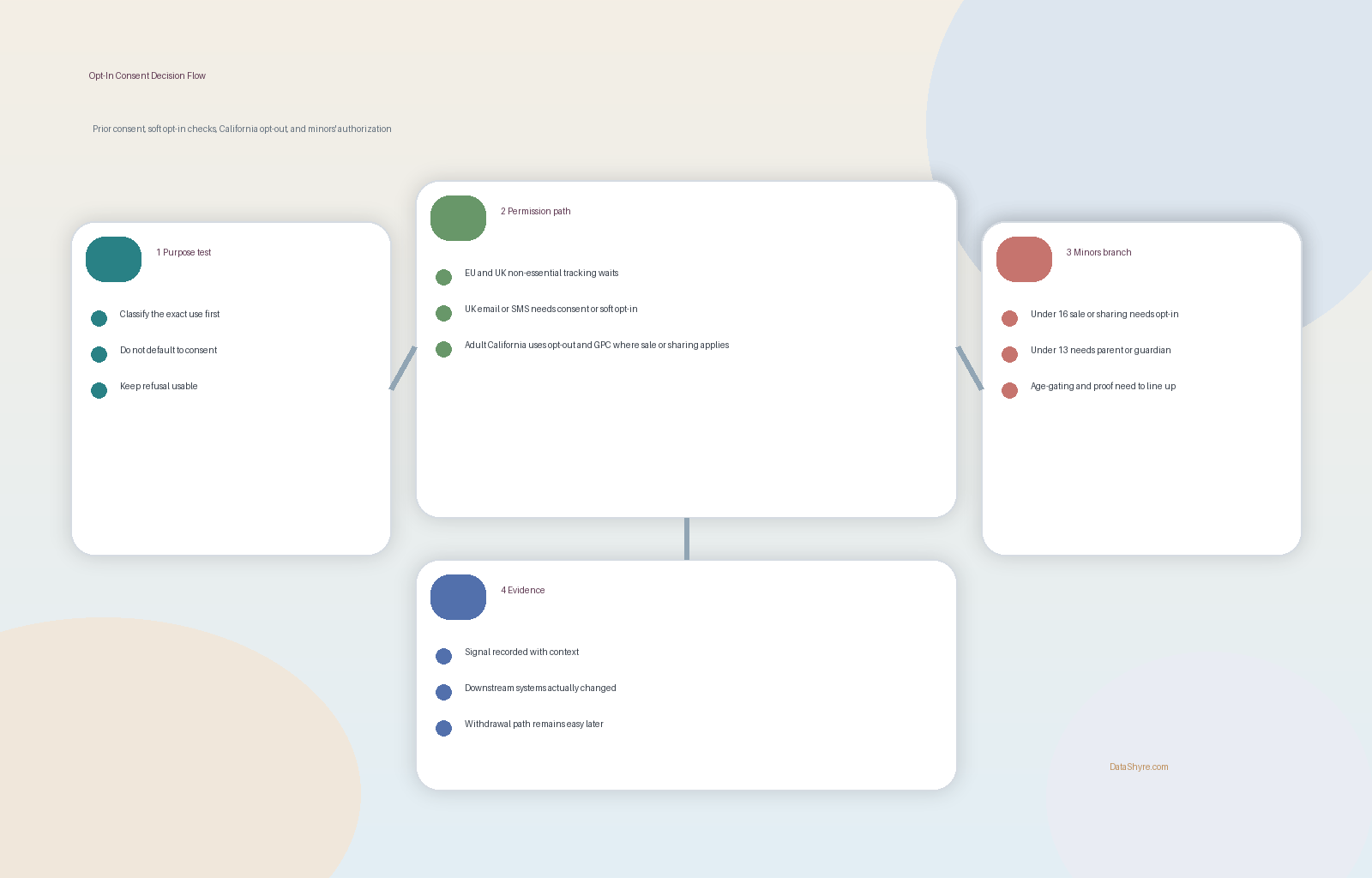
6. Make the recorded proof as strong as the prompt itself
The most useful opt-in consent record is not just a timestamp.
It should show:
- what the person saw;
- what purposes were offered;
- what they chose;
- which jurisdictional branch applied;
- what systems changed because of that choice; and
- how the person can withdraw or change the decision later.
That matters because weak implementations often record a yes or no while failing to connect that signal to live behavior. A CMP may say rejected, while a parallel tag, plugin, SDK, or embed still behaves as if consent were granted. When that happens, the log becomes evidence of a mismatch rather than evidence of compliance.
7. A practical decision sequence for this week
If you were reviewing opt-in consent on a live site or product this week, use this order:
- classify the exact purpose first instead of defaulting to consent;
- separate EU or UK prior-consent cases from California opt-out cases;
- isolate any minors’ branch that truly requires affirmative authorization;
- test whether optional technologies, messages, or sharing actually wait for the required signal;
- verify that withdrawal or opt-out is as usable as the original path; and
- save proof that the signal changed real downstream behavior.
That order usually surfaces the real risk faster than another round of copy edits.
FAQ
Is opt-in consent always required for privacy compliance?
No. Opt-in consent is required in some situations, but not all. The right model depends on the jurisdiction, the purpose, and the processing activity involved.
Does California generally require opt-in consent for adults?
No. For adults, California usually focuses on opt-out rights for sale or sharing, including GPC handling, rather than a blanket opt-in rule for every privacy scenario.
Can a soft opt-in replace consent for all email marketing?
No. The ICO treats the soft opt-in as a limited exception with specific conditions, not a general replacement for consent.
Bottom line
The safest way to think about opt-in consent in 2026 is to stop treating it like the default answer everywhere.
The fastest way to judge opt-in consent is to test it the way a broken deployment would expose it: before consent, after consent, and again after a stack change.
Sources
- European Commission, Legal grounds for processing data: https://commission.europa.eu/law/law-topic/data-protection/information-business-and-organisations/legal-grounds-processing-data_en
- European Data Protection Board, Summary: Consent under GDPR, when to act and what to do (PDF): https://www.edpb.europa.eu/system/files/2026-04/edpb-summary-consent_en.pdf
- UK Information Commissioner’s Office, Guidance on the use of storage and access technologies: https://ico.org.uk/for-organisations/direct-marketing-and-privacy-and-electronic-communications/guidance-on-the-use-of-storage-and-access-technologies/
- UK Information Commissioner’s Office, Guidance on direct marketing using electronic mail: https://ico.org.uk/for-organisations/direct-marketing-and-privacy-and-electronic-communications/guidance-on-direct-marketing-using-electronic-mail/
- UK Information Commissioner’s Office, How do we comply with the PECR electronic mail marketing rules?: https://ico.org.uk/for-organisations/direct-marketing-and-privacy-and-electronic-communications/guidance-on-direct-marketing-using-electronic-mail/how-do-we-comply-with-the-pecr-electronic-mail-marketing-rules/
- California Department of Justice, California Consumer Privacy Act (CCPA): https://oag.ca.gov/privacy/ccpa
- California Department of Justice, Global Privacy Control: https://oag.ca.gov/privacy/globalprivacycontrol
- California Department of Justice, Attorney General Bonta announces $2.75 million settlement with Disney: https://oag.ca.gov/news/press-releases/california-wont-let-it-go-attorney-general-bonta-announces-275-million
- California Privacy Protection Agency, CCPA statute effective January 1, 2026 (PDF): https://cppa.ca.gov/regulations/pdf/ccpa_statute_eff_20260101.pdf