General Data Privacy Regulation in 2026: If You Mean GDPR, Start With These 7 Checks
The real value in general data privacy regulation shows up when you debug it like a live system. A banner can render perfectly and still leak requests, misfire tags, or drift after the next plugin or theme update.
The useful test for general data privacy regulation is whether the live stack behaves correctly before consent, after consent, and after the next deployment. That is how hidden leaks and timing mistakes show up.
That wording matters because the job is not only to sound close to the law. It is to understand what the law actually covers, when it applies, what rights it gives people, and what your team has to prove when the privacy page, consent flow, or vendor map gets tested against reality.
There is also a live reason to keep the basics straight this year. On March 19, 2026, the European Data Protection Board launched its 2026 Coordinated Enforcement Framework action on compliance with the GDPR’s transparency and information obligations. That means the practical review is not whether the policy sounds professional enough. It is whether your collection points, notices, lawful-basis decisions, and rights workflows still match the live system.
If you want the deeper companion guides first, start with our posts on general data protection regulation, gdpr requirements, and gdpr compliant. This page stays focused on the search phrase general data privacy regulation and the operational checks most teams should run this week if they really mean GDPR readiness.
If your team is trying to get general data privacy regulation under control without adding a heavyweight privacy stack, DataShyre can help. DataShyre focuses on consent and preference management that are easier to implement, easier to operate, and easier to trust on a live site. Start with DataShyre’s consent and preference management or book a demo.
If your team needs help turning that review into a working program, DataShyre can help with data mapping, consent management, DSR automation, and implementation support that ties the notice layer back to the live stack.
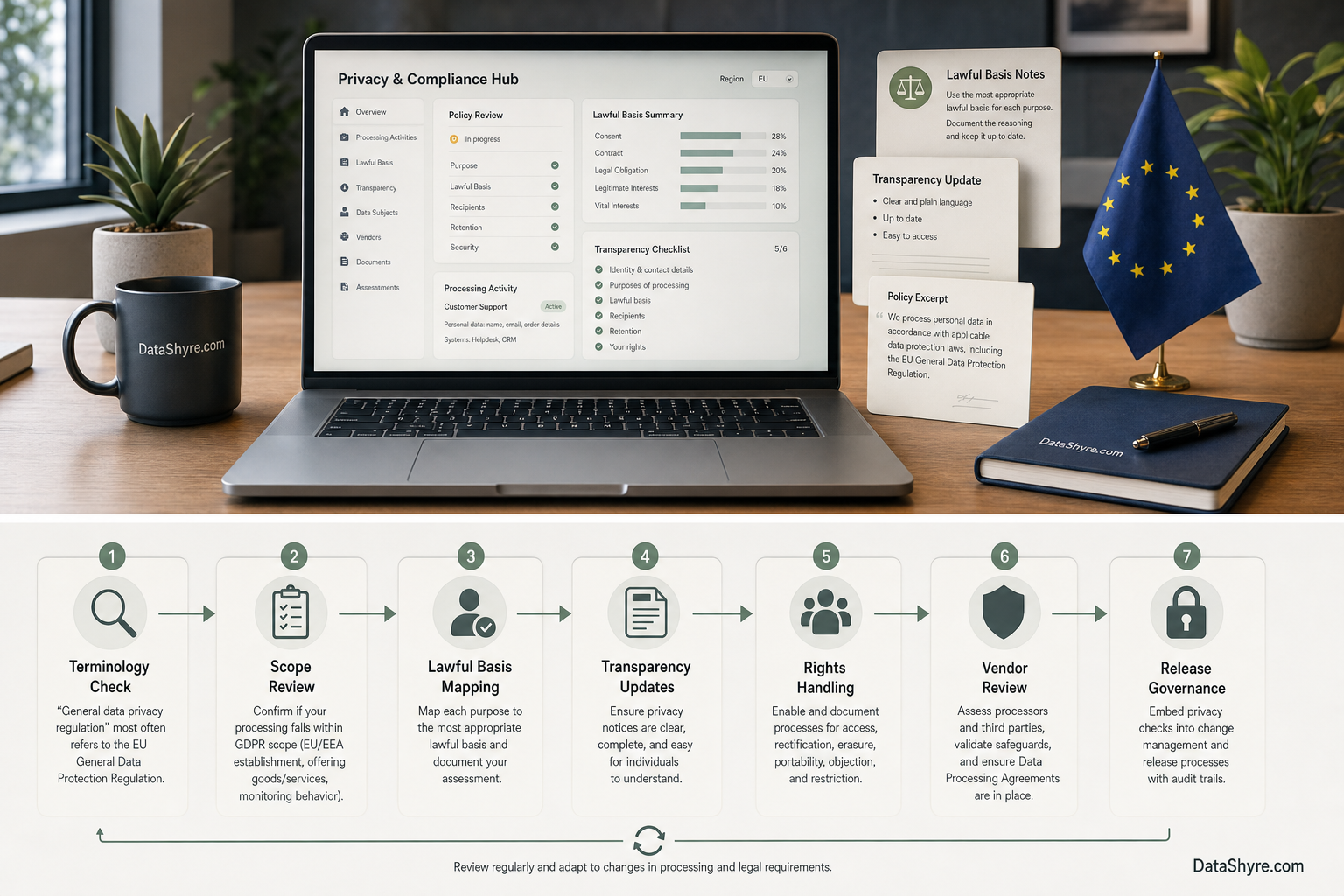
1. Use the official name and stop treating terminology like a detail
The first general data privacy regulation mistake is assuming the wording does not matter.
It does, because the official rule is Regulation (EU) 2016/679, the General Data Protection Regulation. If your policy, vendor intake form, or internal training uses loose terminology, the confusion usually carries into the harder parts of the work too.
That confusion tends to show up as:
- teams mixing GDPR rules with country-specific cookie rules without separating them;
- people assuming GDPR is only about banners and policy pages;
- projects talking about compliance in broad terms without naming the exact rights, duties, and evidence paths involved.
So the first cleanup step is basic but useful: call the law by its real name, then map your obligations to the actual GDPR concepts instead of to internet shorthand.
2. Confirm whether the GDPR applies to the way your business actually operates
Many searches for general data privacy regulation are really scope questions.
The European Commission’s business guidance says the GDPR can apply when a company or organisation processes personal data in the context of an EU establishment, offers goods or services to people in the EU, or monitors their behaviour in the EU.
That means the useful question is not are we an EU company.
The useful question is whether your live product, site, app, ad stack, support flow, or analytics setup creates GDPR exposure.
For a practical check, review:
- where your users are located;
- whether your site or product is actively aimed at EU users;
- whether you track user behaviour in ways that go beyond strictly necessary service delivery;
- which forms, embeds, tools, and vendors collect personal data before your privacy team sees it.
The Commission also says GDPR application does not depend only on company size. Small teams can still be in scope if the activity brings them there.
3. Match each processing purpose to the lawful basis you actually rely on
Another recurring general data privacy regulation problem is using consent as a catch-all label even when the team is really relying on something else.
The European Commission’s GDPR guidance lists six lawful bases:
- consent;
- contract;
- legal obligation;
- vital interests;
- public task; and
- legitimate interests.
That matters because sloppy lawful-basis logic creates sloppy implementation.
You see it when:
- marketing teams call every email or measurement workflow
consent-based; - product teams assume legitimate interests needs no balancing or documentation;
- privacy notices list several uses but never explain which basis supports which use;
- withdrawal flows only work on paper.
If you searched general data privacy regulation because the work feels fuzzy, this is often the section to audit first. If the lawful-basis map is weak, the rest of the program usually is too.
4. Treat transparency as a runtime control, not a writing task
This is one of the main reasons the phrase general data privacy regulation leads teams into the wrong work.
They think the answer is to rewrite the policy page.
Sometimes the real problem is that the policy, banner, forms, CRM routing, analytics tags, or support flows no longer tell the same story.
The GDPR’s transparency duties in Articles 12, 13, and 14 are exactly what the EDPB’s 2026 coordinated enforcement action is testing. So a serious review should check whether people are told, in a clear and accessible way:
- what data is collected;
- why it is used;
- who receives it;
- how long it is kept or how retention is determined;
- what rights the person has;
- how to exercise those rights.
The important operational point is timing. Those explanations should appear where the collection actually happens, not only in a footer page the user has to hunt for after the fact.
5. Make rights usable within the real workflow, not only in the policy
If you use general data privacy regulation as a broad search term, this is where the concept becomes real.
The European Commission’s guidance on dealing with requests from individuals says organisations must respond to rights requests without undue delay and in principle within one month of receipt.
That changes what a decent program looks like.
A practical rights review should confirm:
- there is a working intake path for access, deletion, correction, objection, and related requests;
- identity verification is proportionate and does not become an obstacle course;
- the operations team knows which systems and vendors have to be checked;
- consent withdrawal and objection paths connect to the actual processing they are supposed to stop;
- rejected requests are explained properly when rejection is lawful.
If the policy page names rights but the team cannot find the data, trace the vendors, or close the request on time, the compliance story is still unfinished.
6. Review processors, transfers, records, and security before they become cleanup work
Many weak general data privacy regulation articles stop at notices and consent.
That misses the machinery that usually creates the real risk.
The GDPR expects accountability. In real deployments, that means your team should be able to show who processes personal data, why they process it, where it goes, how long it stays, and what security measures protect it.
For a live review, check:
- your processor and vendor list;
- whether the vendor list matches the real stack, not last quarter’s spreadsheet;
- where personal data leaves your primary environment;
- what records of processing you keep where required;
- who owns retention, deletion, and security decisions for each major system.
This is often where privacy drift becomes visible. The page says one thing, but the live stack includes extra form tools, extra pixels, extra SaaS integrations, or inherited vendors no one has reviewed in months.
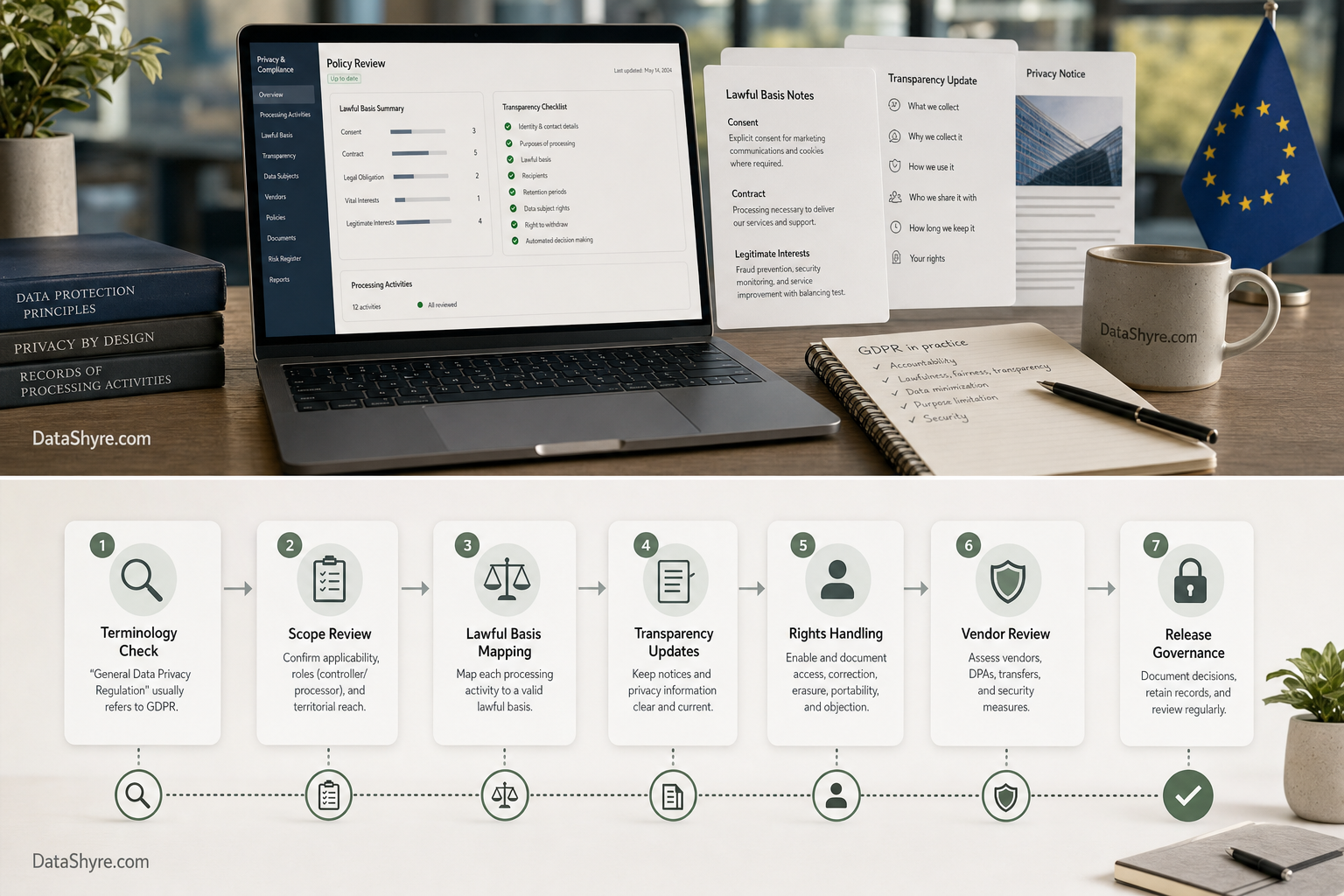
7. Add release discipline so new processing does not outrun the notice layer
The most practical way to think about general data privacy regulation in 2026 is that compliance can drift faster than documentation.
New analytics tags, new CRM forms, new onboarding questions, new ad tools, new embedded media, and new vendor connections can all change the processing picture.
So the review should not end at policy published.
It should also answer:
- what changes trigger a privacy review;
- who signs off before a new vendor or tracking purpose goes live;
- how notice updates are linked to release work;
- where evidence of review is stored;
- how the team catches shadow changes after launch.
This is where DataShyre usually adds the most value. Most organisations do not fail because they cannot write a page. They fail because the live environment changes faster than the compliance process.
A practical review order for this week
If I were auditing general data privacy regulation exposure today, I would use this order:
- replace the shorthand with the official GDPR framing;
- confirm whether establishment, offering, or monitoring triggers scope;
- map the main processing purposes to the lawful basis actually used;
- compare notices and collection points against the live site or product;
- test the rights-request path end to end;
- inspect vendors, transfers, records, retention, and ownership;
- add a release gate so new processing cannot bypass review.
That sequence exposes more truth than a policy rewrite by itself.
FAQ
Is general data privacy regulation the same thing as GDPR?
Usually people mean the GDPR when they search for general data privacy regulation, but the official name is General Data Protection Regulation.
Does the GDPR only matter if my company is in Europe?
No. The GDPR can also apply when a non-EU organisation offers goods or services to people in the EU or monitors their behaviour there.
Is a privacy policy enough for GDPR compliance?
No. A privacy policy is one layer. The live collection points, lawful bases, rights workflow, vendor setup, retention logic, and evidence trail still have to match the story the policy tells.
Bottom line
If you searched for general data privacy regulation, the most useful answer is not just a definition.
It is this: if you mean GDPR, use the official term, then test the real operating model behind it.
The fastest way to judge general data privacy regulation is to test it the way a broken deployment would expose it: before consent, after consent, and again after a stack change.
Sources
- EUR-Lex, Regulation (EU) 2016/679 (General Data Protection Regulation): https://eur-lex.europa.eu/eli/reg/2016/679/oj
- EUR-Lex summary, General data protection regulation (GDPR): https://eur-lex.europa.eu/EN/legal-content/summary/general-data-protection-regulation-gdpr.html
- European Commission, Application of the GDPR: https://commission.europa.eu/law/law-topic/data-protection/information-business-and-organisations/application-gdpr_en
- European Commission, Principles of the GDPR: https://commission.europa.eu/law/law-topic/data-protection/information-business-and-organisations/principles-gdpr_en
- European Commission, Legal grounds for processing data: https://commission.europa.eu/law/law-topic/data-protection/information-business-and-organisations/legal-grounds-processing-data_en
- European Commission, Dealing with requests from individuals: https://commission.europa.eu/law/law-topic/data-protection/information-business-and-organisations/dealing-requests-individuals_en
- European Data Protection Board, CEF 2026 on transparency and information obligations: https://www.edpb.europa.eu/news/cef-2026-edpb-launches-coordinated-enforcement-action-on-transparency-and-information_en