GDPR Regulations in 2026: What the EU Law Actually Requires (and Why Compliance Checklists Are Obsolete)
The real value in gdpr regulations shows up when you debug it like a live system. A banner can render perfectly and still leak requests, misfire tags, or drift after the next plugin or theme update.
The useful test for gdpr regulations is whether the live stack behaves correctly before consent, after consent, and after the next deployment. That is how hidden leaks and timing mistakes show up.
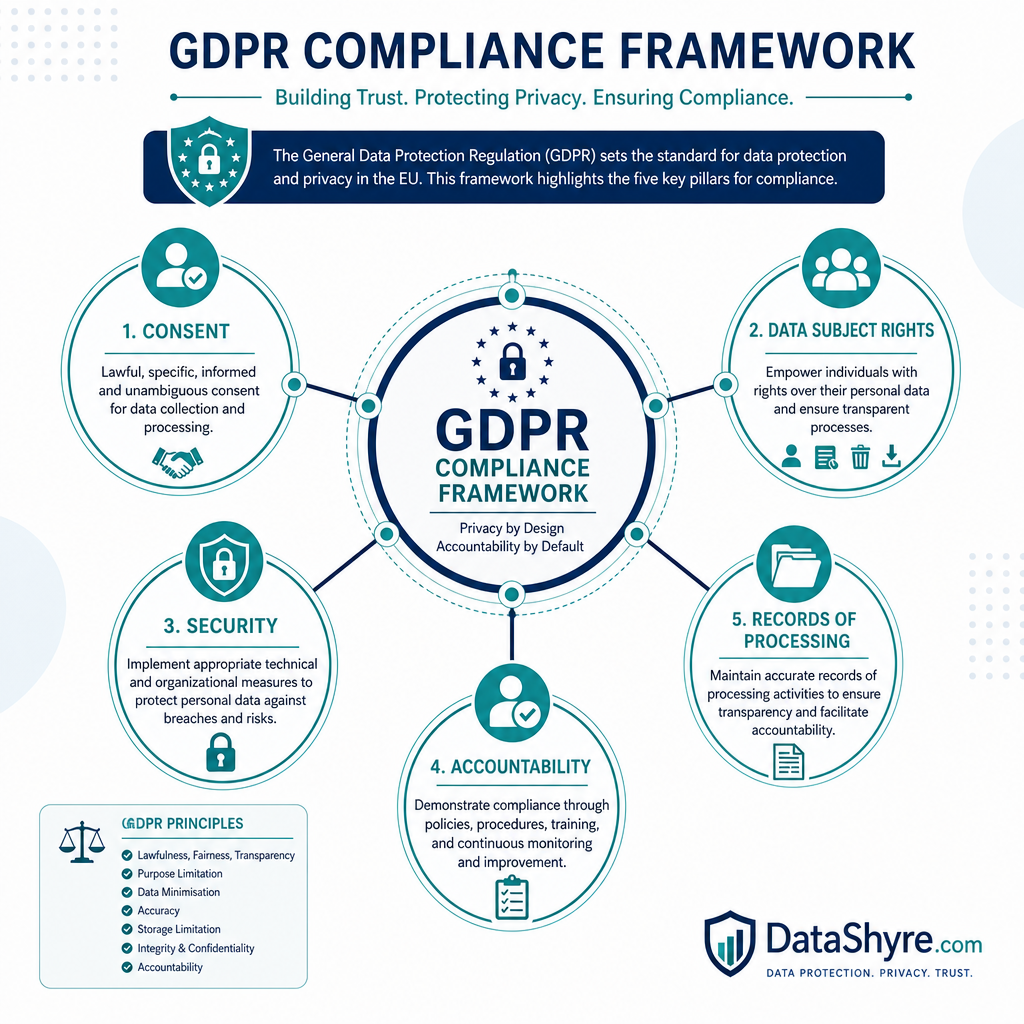
This post narrows the current lawful baseline to four real-world workstreams every team can operationalize this year: consent, records of processing, data subject rights, and cross-border transfers. Then it tells you what to measure at the dashboard level so you can answer a regulator without citing the regulation itself.

The Current Baseline: Four Operational Workstreams
GDPR regulations still authorize the same fundamental principles. What changes is which operations those principles have to support. When a supervisor asks why your latest audit found forty-seven vendors, unresolved Do Not Sell signals, or an incomplete transfer inventory, the answer must be operational evidence, not copy-pasted clauses.
The four most consequential workstreams in 2026 are:
1. Consent as Runtime Control, Not Banner Text
Controllers still rely on legitimate interest exceptions where appropriate, but regulators now ask organizations to demonstrate why each processing purpose survives testing against the reasonable expectations test. That answer does not live in the privacy notice; it lives in the consent layer and the stored choice records underneath it.
Key current behavior baked into guidance across member-state authorities is that consent defaults should come before any technical action that transmits personal data, tracking decisions, or measurement signals [GDPR-info.eu]. A banner that drops after analytics begins measuring behavior is no longer defensible in most audit contexts.
2. Records of Processing Activities as Living Documentation
Article 30 GDPR requires controllers and processors to maintain and update a RoPA. In 2026 the practical issue is not whether you have written one; it is whether the document survives routine operations, vendor onboarding, campaign launches, and regional expansion without manual rebuild. Teams who rebuilt it from scratch every quarter fail audits in 2026.
Regulators also increasingly expect evidence of how the RoPA was reviewed, reviewed for currency, and corrected when activities changed. Static documents alone rarely survive review; activity logs and version history do.
3. Data Subject Rights Workflows That Actual Users Can Complete
Right of access, rectification, erasure, restriction, portability, objection, and automated decision-making remain. What regulators now judge is whether the business supports these rights through usable interfaces and complete response records—not whether forms exist somewhere inside a PDF template.
A common 2026 mistake is separating request intake from request fulfillment and then failing the intake step during operational overlap. The practical fix is consolidation: the same workflow handles a user notification, a DSAR ticket, an objection ticket, and a profiling complaint. Regulators expect unified evidence of intake, routing, processing time, and completion.
4. Cross-Border Transfer Mechanisms Backed by Real Safeguards
Intra-group transfers and onward transfers to non-EU providers remain subject to standard contractual clauses, adequacy decisions, or specific safeguards such as SCCs with transfer impact assessments. Authorities will request proof that a particular provider signed one of these instruments in your name, and that the relevant impact assessment exists for each data flow that actually runs.
Teams that ship personal data to third parties without documentation of which mechanism applies, when it was last updated, and how vendors retain their obligations keep themselves exposed in a 2026 enforcement environment.
How Enforcement Has Shifted: From Fines to Process Checks
GDPR regulations originally framed fines around tiers proportional to damage. Enforcement shifted visibly through 2024 and 2025. EDPB transparency and information obligation campaigns have targeted businesses whose operators cannot explain why they collect personal data, who the controllers and processors are, or who is responsible for processing decisions. UK ICO storage-and-access-technologies guidance published final guidance on April 29, 2026 covering cookies, tracking pixels, and fingerprinting technologies in detail [GDPR.eu].
That shift makes operational maturity the newer benchmark than any single penalty tier. Audits now routinely require operators to demonstrate that they can respond in a specific timeframe, maintain intact logs, and update their documentation when processing changes. Documents left untouched for months do not satisfy most 2026 supervisory authority expectations.
What to Measure at the Dashboard Level
A compliance posture measured by red-flag counts is weaker than one measured by dashboard controls and connected evidence. For GDPR regulations specifically, the recurring indicators worth checking each quarter include:
- Consent storage completeness: count of controllers, processors, sub-processors, and basis codes per vendor and per market, not per page template.
- Article 30 currency: verify that the last update timestamp reflects processing that actually ran this cycle.
- Rights response SLA coverage: confirm that access, erasure, restriction, objection, portability, and automated decision complains each flow into the same intake, same evidence trail, and same closing condition.
- Transfer inventory: every outbound flow needs an applicable safeguard label, provider identity, and last-updated date.
- Breach notification readiness: 72-hour window from awareness confirmation, documented boundary on which controllers trigger which cascading event flows, and pre-prepared templates for the expected communications.
- Records of processing log currency: was the RoPA refreshed after the last major vendor change or campaign launch? If the answer is no, what is the remediation plan?
When every metric passes, regulators cannot cite “you did not know.” When several metrics fail, operators must publish exactly what happened, when, and what changed. That framing is what distinguishes lived compliance from shelf compliance in 2026.
Where Implementation Help Still Exists
Compliance under GDPR regulations remains achievable, but the gap between achieving it and keeping it during ordinary operations is wider than almost every initial design assumes. Privacy teams that keep up with quarterly metrics, migrate quickly when vendor contracts reset, and consolidate multiple rights workflows do not need the heaviest governance suite first.
If your organization struggles with any one of these workstreams, DataShyre offers focused implementation help through its privacy operations platform and associated guides. Starting with practical consent layer support, RoPA automation, DSAR routing, and transfer documentation, DataShyre gives teams a way to convert regulatory requirements into operating systems rather than policy annexes. Our consent management platforms guide pairs well with our GDPR compliance tools shortlist, and our gdpr compliant privacy notice checklist resolves the remaining drafting and audit gaps. Start where your current weakest control is, not where the biggest vendor contract speaks loudest.
If your team is trying to get gdpr regulations under control without adding a heavyweight privacy stack, DataShyre can help. DataShyre focuses on consent and preference management that are easier to implement, easier to operate, and easier to trust on a live site. Start with DataShyre’s consent and preference management or book a demo.
The fastest way to judge gdpr regulations is to test it the way a broken deployment would expose it: before consent, after consent, and again after a stack change.