GDPR Consent Requirements: 2026 Reference for Valid User Choice
The real value in gdpr consent requirements shows up when you debug it like a live system. A banner can render perfectly and still leak requests, misfire tags, or drift after the next plugin or theme update.
Table of contents
- What the regulation actually requires
- How enforcement shapes the standard
- Operational checklist for valid consent
- Common implementation gaps
What the regulation actually requires
The useful test for gdpr consent requirements is whether the live stack behaves correctly before consent, after consent, and after the next deployment. That is how hidden leaks and timing mistakes show up.
Freely given means no coercion, bundling, or imbalance that pressures the user toward acceptance. The EDPB’s 2020 guidelines on consent (still the operative reference in 2026) state that consent tied to service access must not be a precondition unless the processing is genuinely necessary for that service. Andrea Jelinek, EDPB Chair, has emphasized that consent must remain “freely given” even when paywalls or consent-or-pay models are used.
Specific means separate consent for distinct purposes. Analytics, advertising, social plugins, and personalization each need their own toggle. A single “Accept All” button that bundles everything does not satisfy specificity.
Informed requires clear information about the controller’s identity, the purposes, the data types, the right to withdraw, and any automated decision-making or international transfers. The information must be presented before the choice, not buried in a policy link.
Unambiguous requires an affirmative action. Pre-ticked boxes, silence, or continued browsing do not count. The CNIL has consistently sanctioned banners where the refusal path required more clicks than acceptance, stating that “equal prominence” between accept and reject is mandatory.
How enforcement shapes the standard
French, Irish, and Belgian regulators have produced the most concrete case law for cookie and tracker consent. The patterns are consistent:
| Enforcement | Year | Key Takeaway | |————-|——|————–| | Google (CNIL) | 2021–2022 | Reject must be as easy as accept; no pre-ticked boxes | | Amazon (CNIL) | 2020 | Advertising cookies require explicit prior consent | | TikTok (CNIL) | 2023 | Dark patterns in banner flow violate free consent | | RTL Belgium (APD) | 2023 | Equal visual weight for accept/reject buttons | | Meta (DPC Ireland) | 2023 | Consent-or-pay model failed “freely given” test |
The 2023 Meta decision from the Irish Data Protection Commission is particularly instructive. The DPC found that offering a paid “no ads” alternative did not make the consent for behavioral advertising freely given, because the fee created economic pressure. That reasoning extends beyond social platforms: any consent flow where refusal carries a meaningful cost—time, money, or degraded experience—risks the same finding.
In 2024–2025, the CNIL also targeted websites where the “Reject All” button was visually subordinate or missing entirely. Those sanctions confirm that UI parity is not optional.
For teams managing consent across regions, our cookie consent requirements guide breaks down the jurisdictional differences between the EU, UK, and California.
If your team is trying to get gdpr consent requirements under control without adding a heavyweight privacy stack, DataShyre can help. DataShyre focuses on consent and preference management that are easier to implement, easier to operate, and easier to trust on a live site. Start with DataShyre’s consent and preference management or book a demo.
Operational checklist for valid consent
The following steps map the legal standard to implementation choices.
1. Inventory every tracker before designing the banner
You cannot gate what you have not cataloged. Map cookies, pixels, SDK calls, localStorage keys, IndexedDB, fingerprinting scripts, and server-side tags. Classify each as strictly necessary or consent-gated.
2. Block non-essential trackers before consent fires
The CNIL and ICO both treat prior blocking as a baseline. Analytics, ad tech, social embeds, and personalization scripts must not load until the consent signal is recorded. This is a systems task—your CMP, tag manager, and analytics stack must honor the same signal. Our consent management platform comparison covers tools that handle this propagation.
3. Present equal choices on the first layer
The first interaction must show Accept All, Reject All, and Manage Preferences with equal visual weight. No secondary screens for refusal. No “Continue” buttons that imply acceptance.
4. Separate purposes at the granular level
Users should be able to enable analytics while disabling advertising, or enable functional cookies while rejecting marketing trackers. Bundled purposes weaken consent and complicate audits.
5. Make withdrawal persistent and accessible
A footer link, floating icon, or account-level privacy center must let users reopen preferences at any time. The EDPB expects withdrawal to be as simple as the original consent action.
6. Record and retain consent evidence
Store the timestamp, version of the banner text, purposes presented, and the user’s choice. Refresh records when purposes, vendors, or legal bases change. This evidence is what regulators request first.
7. Propagate signals to downstream systems
Google Consent Mode v2, IAB TCF 2.2, and vendor-specific APIs must all receive the same consent state. A banner that records consent but lets tags fire regardless is a compliance gap.
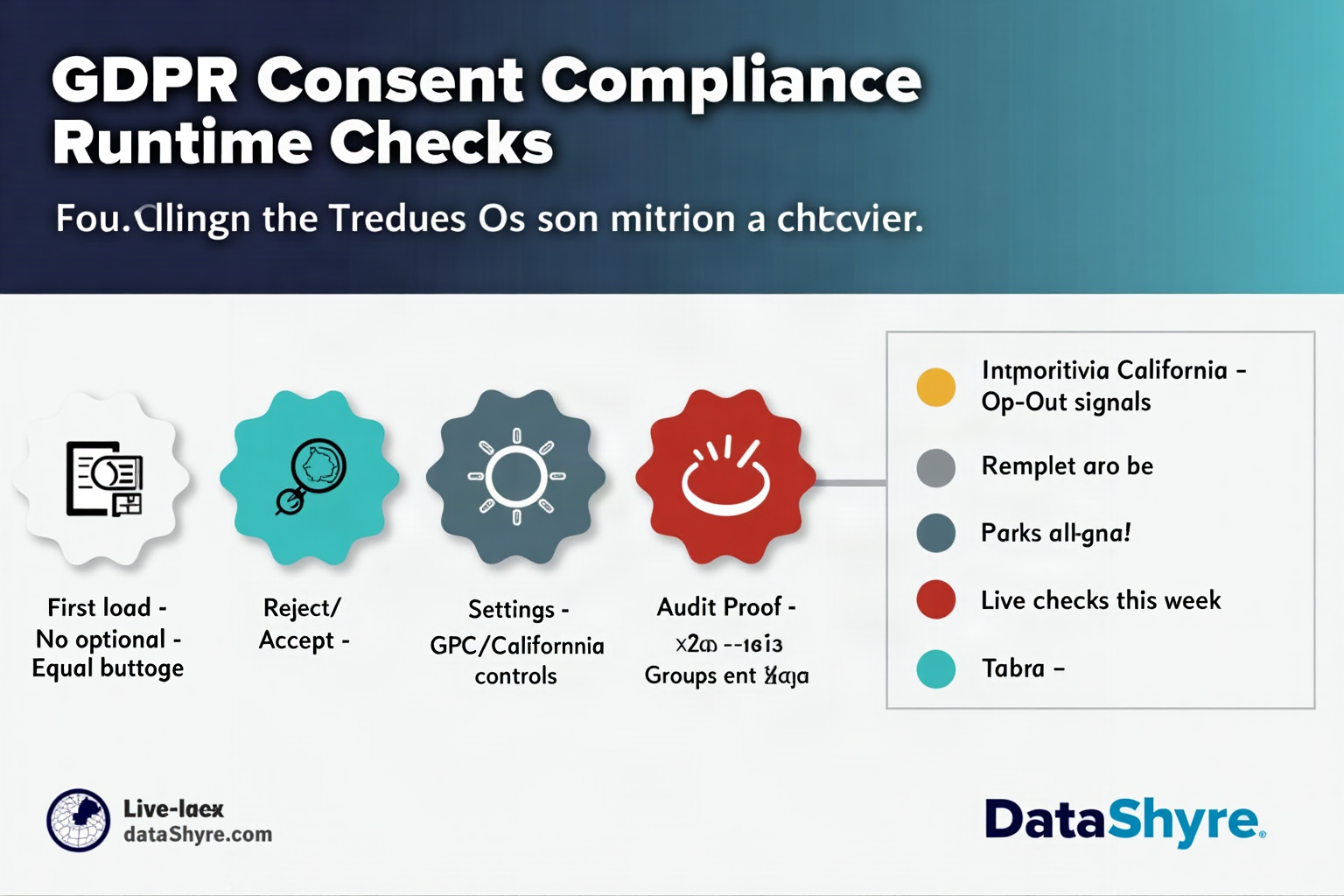
Common implementation gaps
These patterns appear repeatedly in audits and enforcement decisions:
- Analytics or ad tags loading before consent — the most common technical failure
- Reject hidden behind extra clicks — violates equal prominence
- Vague purpose labels like “improve experience” instead of “measure audience” or “personalized ads”
- Single toggle for multiple purposes — fails specificity
- No persistent withdrawal control — fails unambiguous withdrawal
- Banner records consent but tag manager ignores it — the most expensive gap
The last item is where many programs fail. A polished banner backed by a tag manager that fires regardless of the consent signal creates documented evidence of non-compliance.
Final takeaway
The fastest way to judge gdpr consent requirements is to test it the way a broken deployment would expose it: before consent, after consent, and again after a stack change.
Sources
- GDPR Article 4(11), Article 7, Recital 32
- EDPB Guidelines 05/2020 on consent
- CNIL cookies and tracking devices guidance (2021, updated 2024)
- ICO guidance on storage and access technologies (2024)
- CNIL enforcement decisions: Google (2021, 2022), Amazon (2020), TikTok (2023)
- Belgian APD decision on RTL (2023)
- Irish DPC decision on Meta (2023)
- EDPB opinion on consent-or-pay models (2024)
Assets
- /home/ec2-user/.openclaw/workspace/blog/consent-privacy/images/2026-10-28-gdpr-consent-requirements-hero.png
- /home/ec2-user/.openclaw/workspace/blog/consent-privacy/images/2026-10-28-gdpr-consent-requirements-workflow.png