GDPR Compliant in 2026: 7 Practical Checks for Sites, Apps, and Forms
The real value in gdpr compliant shows up when you debug it like a live system. A banner can render perfectly and still leak requests, misfire tags, or drift after the next plugin or theme update.
The useful test for gdpr compliant is whether the live stack behaves correctly before consent, after consent, and after the next deployment. That is how hidden leaks and timing mistakes show up.
It is the condition where your collection points, lawful bases, notices, vendors, rights handling, security controls, and records all line up well enough that you can explain and defend the system.
That is also the angle regulators are still reinforcing. On March 19, 2026, the European Data Protection Board launched its 2026 Coordinated Enforcement Framework action on compliance with the GDPR’s transparency and information duties in Articles 12, 13, and 14. So if a team says it is gdpr compliant, one of the first questions in 2026 is still whether people are actually being told, clearly and on time, what happens to their data.
If you want adjacent background first, start with these guides to general data protection regulation, gdpr requirements, and privacy policy for website. This page stays practical. It is the seven-check review I would use this week before calling a site, app, or form flow gdpr compliant.
If your team is trying to get gdpr compliant under control without adding a heavyweight privacy stack, DataShyre can help. DataShyre focuses on consent and preference management that are easier to implement, easier to operate, and easier to trust on a live site. Start with DataShyre’s consent and preference management or book a demo.
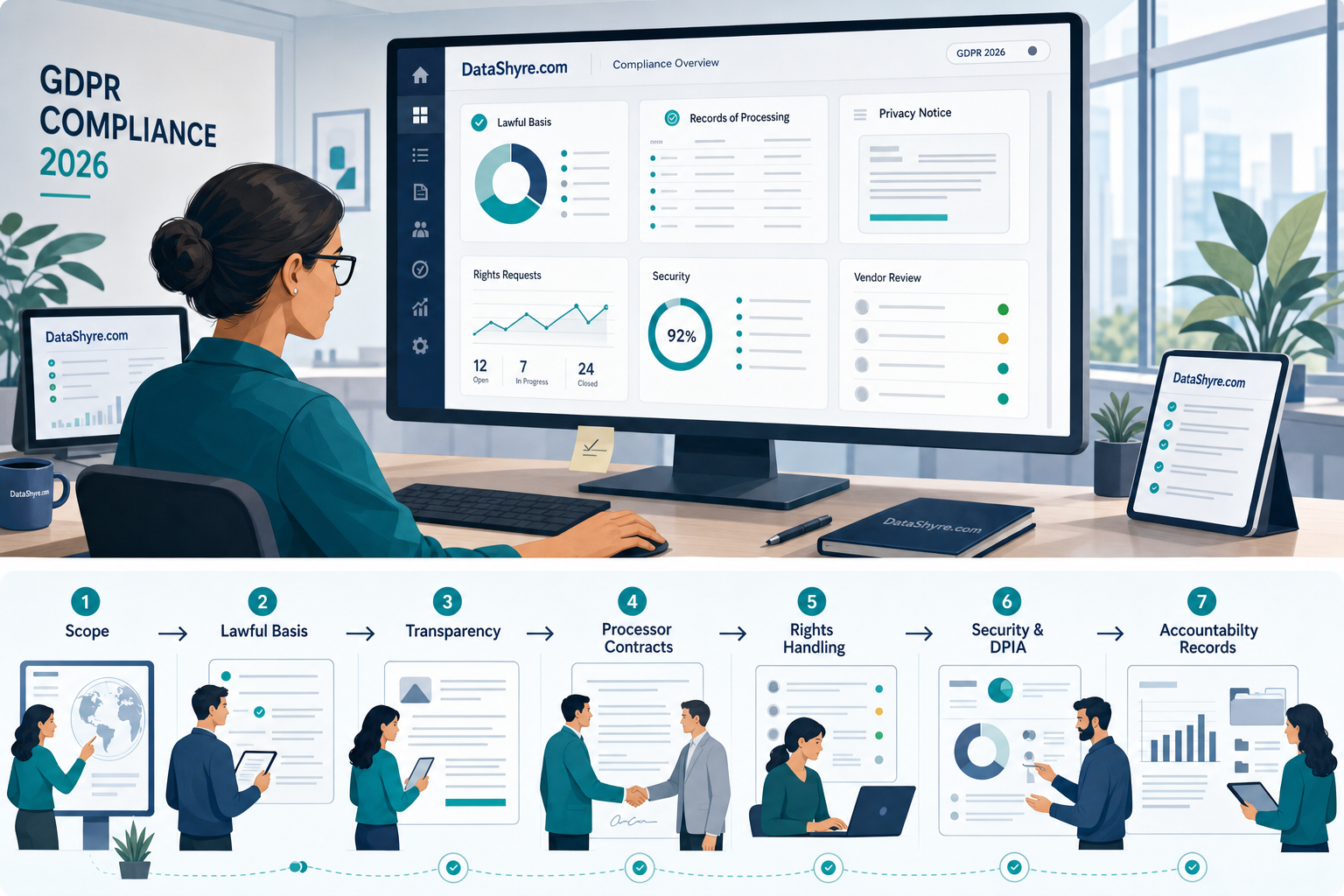
1. Confirm the GDPR actually applies and identify your role
The first gdpr compliant mistake is assuming the law only matters if your company is physically inside the EU.
The European Commission’s current guidance says the GDPR applies not only to organisations established in the EU, but also to organisations outside the EU when they offer goods or services to people in the EU or monitor their behaviour there.
That means the scope question should be settled before anyone starts polishing wording or buying tooling.
At the same time, identify your role in each processing activity:
- controller;
- joint controller; or
- processor.
If your product team, marketing stack, and customer-success tooling blur those roles together, your contracts and notices are usually already behind reality.
This is also where smaller organisations often overcorrect. SME status does not remove GDPR coverage by itself. Some obligations vary by risk, scale, and context, but the first question is still whether you process personal data in ways the GDPR covers.
2. Match each processing purpose to a real lawful basis
Another common gdpr compliant error is treating consent as the default answer to every data use.
It is not.
The GDPR requires a lawful basis for processing. In real deployments, that means your team should be able to explain which basis supports each major purpose, such as account creation, fraud screening, support delivery, analytics, recruitment, or marketing.
This is where compliance stories often break down. A company says it is gdpr compliant, but cannot answer:
- what each processing purpose is;
- which lawful basis supports it;
- why that basis fits better than the alternatives; and
- what changes if the basis is consent, contract, or legitimate interests.
The consent branch still deserves special discipline. The EDPB’s current small-business guidance says consent must be “freely given, specific, informed and unambiguous”, require a clear affirmative action, and be easy to withdraw without negative consequences.
So if your flow uses pre-ticked boxes, bundles unrelated choices together, or makes withdrawal harder than opt-in, the issue is not only banner design. It is that the legal basis may be wrong.
3. Make the privacy information clear, timely, and tied to the real collection point
Many teams use gdpr compliant as shorthand for we have a privacy policy.
That is far too thin.
Article 12 GDPR says information for individuals must be concise, transparent, intelligible, easily accessible, and use “clear and plain language.” Articles 13 and 14 then define what has to be disclosed and when.
In real deployments, a defensible notice layer usually answers:
- who is using the data;
- what data is being collected;
- why it is being used;
- which lawful basis applies;
- who receives it;
- how long it is kept or how retention is decided;
- whether transfers happen outside the EEA; and
- what rights the individual has.
Timing matters too. The EDPB’s SME guidance says that when data is collected directly from the individual, the information should be provided at the time of collection. If the data comes from another source, the notice generally has to be provided within a reasonable period and no later than one month.
This is why a homepage privacy policy alone does not automatically make a product gdpr compliant. If a mobile sign-up flow, lead form, support intake, or event registration collects data without a clear and timely explanation, the notice layer is incomplete even if the footer link exists.
4. Control vendors, processors, and international transfers on purpose
This is one of the fastest ways for a gdpr compliant claim to collapse under review.
The European Commission’s application guidance says that when processing is outsourced to a processor, there must be a contract or other legal act ensuring the processor provides sufficient guarantees and appropriate technical and organisational measures that meet GDPR standards.
That means vendor management is not procurement paperwork. It is a compliance control.
A useful review asks:
- which vendors process personal data for you;
- whether they are acting as processors, controllers, or both in different contexts;
- whether Article 28 terms are in place;
- whether sub-processors are visible;
- whether international transfers occur; and
- whether the notice and internal records reflect the real vendor chain.
Teams often say they are gdpr compliant because the core app is clean, while analytics tools, support software, CRM syncs, and embedded services are barely documented. That gap matters more in practice than another round of homepage copy edits.
5. Turn data-subject rights into working operations
A system is not meaningfully gdpr compliant if it lists rights but cannot carry them out.
The European Commission’s information for individuals guidance and the EDPB’s SME materials both point to the same operational reality: people have rights to access, rectify, erase, object in certain cases, restrict processing in certain cases, and more, and organisations need a usable way to respond.
That means your workflow should be able to answer:
- where requests arrive;
- how identity is verified where needed;
- who owns response deadlines;
- where relevant data lives across systems;
- how deletions, corrections, or exports are propagated; and
- when an extension or refusal can be justified.
The EDPB’s rights guidance also notes that complex requests can justify an extension of up to two further months, but the person must be informed within one month of receiving the request.
In other words, being gdpr compliant is not the presence of a mailbox called privacy@.
It is the ability to receive, route, investigate, respond, and prove what happened across the real stack.
6. Review security, high-risk processing, and privacy-by-design decisions
Security is not separate from being gdpr compliant.
The European Commission’s obligations guidance says controllers and processors must ensure and demonstrate processing that provides security appropriate to the risk, including protection against unauthorised access, unlawful processing, and accidental loss, damage, or destruction. It also points to measures such as pseudonymisation, encryption, restoration capability, and regular testing and evaluation.
That should drive a practical check on:
- access control;
- encryption and key handling;
- backup and recovery;
- logging and monitoring;
- incident response; and
- regular security testing.
For higher-risk uses, the compliance bar rises again. Article 35 requires a data protection impact assessment when a type of processing is likely to result in a high risk to individuals’ rights and freedoms.
So if your product is profiling users, combining datasets in ways that materially affect them, monitoring behaviour at scale, or processing special-category data, a bare privacy notice does not get you to gdpr compliant. You need a high-risk review path and evidence that it was taken seriously.
7. Keep records and accountability evidence current
This is the difference between a slogan and a durable operating model.
The Commission and EDPB both continue to treat accountability as a core GDPR principle. The Commission’s principles guidance lists accountability among the key principles, and EDPB guidance for small businesses says organisations should keep records of processing activities, with limited exemptions for some organisations with fewer than 250 people.
But even where an exemption may reduce the formal recordkeeping duty for purely occasional activity, the broader lesson remains: records are how you keep the system explainable.
If your organisation says it is gdpr compliant, you should expect to find current versions of:
- records of processing activities;
- retention rules;
- processor and sub-processor documentation;
- incident and breach procedures;
- DPIAs or screening notes for higher-risk processing; and
- evidence of notice, consent, or rights-process updates when the product changes.
This is also the section that prevents drift. A new form goes live. A new CRM sync gets enabled. Marketing installs another tag. Customer success adds a recording tool. The issue is not that change happened. The issue is when the records never moved with it and the company kept calling itself gdpr compliant anyway.
A practical weekly review for GDPR compliance
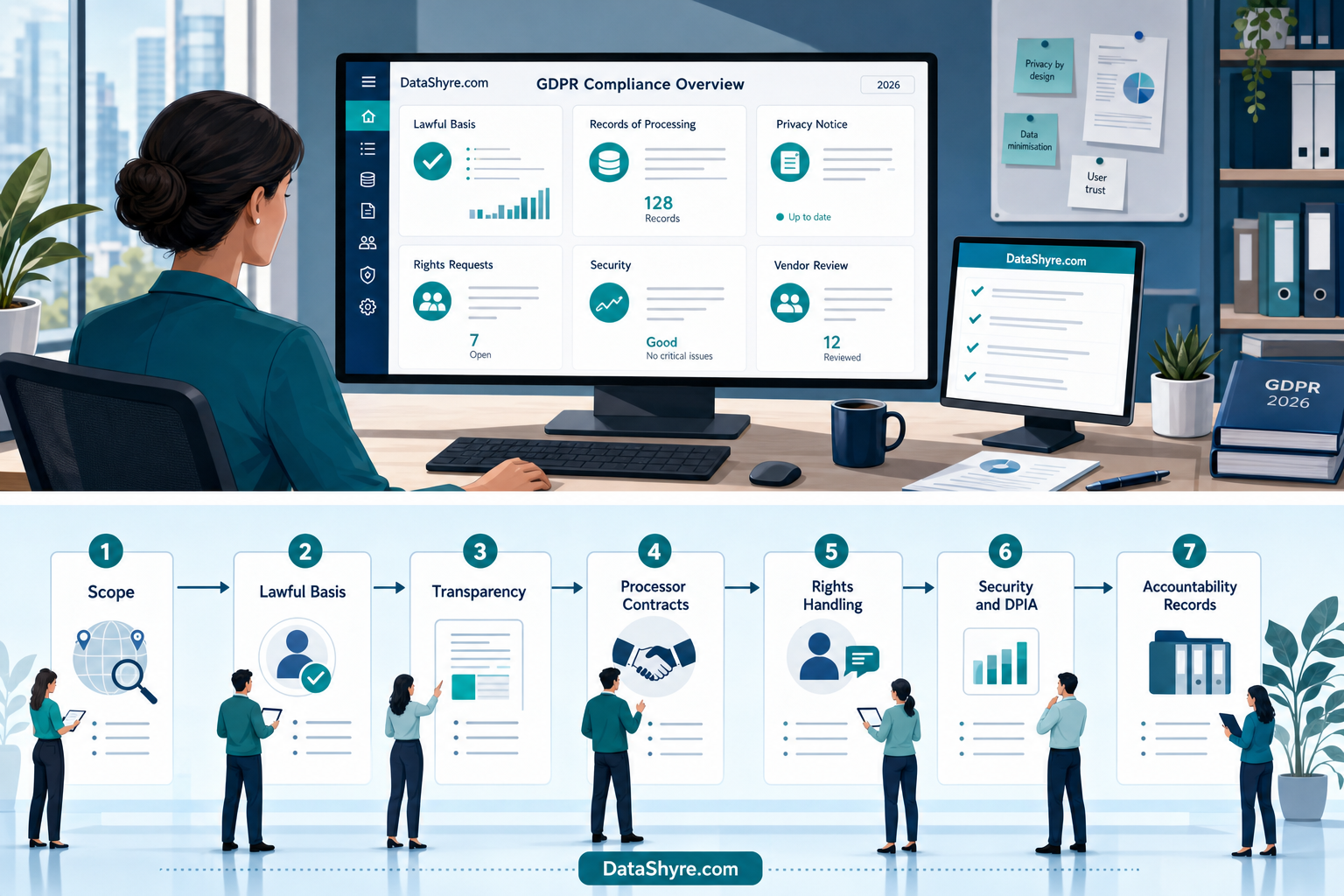
If I had to audit whether a product was gdpr compliant this week, I would use this order:
- confirm GDPR scope and role allocation;
- map each major processing purpose to a lawful basis;
- review whether privacy information is clear, complete, and delivered at the right point;
- check processors, contracts, and transfer exposure;
- test whether rights handling works across real systems;
- review security controls and whether any processing needs a DPIA; and
- update records so the current state can still be explained next month.
That order is more useful than asking whether the footer looks compliant.
FAQ
Does GDPR compliant mean I always need consent?
No. Consent is only one lawful basis. Some processing may instead rely on contract, legal obligation, legitimate interests, or another basis if the conditions are actually met. The mistake is using consent as a reflex instead of making a purpose-by-purpose decision.
Can a small business still need to do serious GDPR work?
Yes. The GDPR does not disappear because a company is small. Some obligations vary by context and risk, but scope is driven by what the organisation does with personal data, not by a simple headcount shortcut.
Is a privacy policy enough to be GDPR compliant?
No. A privacy policy is only one part of the transparency layer. Real compliance also depends on lawful basis decisions, vendor controls, rights handling, security, and accountability records.
Bottom line
In 2026, the most credible use of gdpr compliant is not a marketing claim.
It is the outcome of a system that can show its scope, justify its lawful bases, explain its data use clearly, control vendors, honour rights, secure the data, and keep evidence current as the product changes.
If your organisation cannot do those things yet, the next useful step is not better wording.
The fastest way to judge gdpr compliant is to test it the way a broken deployment would expose it: before consent, after consent, and again after a stack change.
Sources
- European Data Protection Board, CEF 2026 launch on transparency and information obligations under Articles 12, 13, and 14 GDPR: https://www.edpb.europa.eu/news/cef-2026-edpb-launches-coordinated-enforcement-action-on-transparency-and-information_sl
- European Commission, Application of the GDPR: https://commission.europa.eu/law/law-topic/data-protection/information-business-and-organisations/application-gdpr_en
- European Commission, Principles of the GDPR: https://commission.europa.eu/law/law-topic/data-protection/information-business-and-organisations/principles-gdpr_en
- European Commission, Obligations under the GDPR: https://commission.europa.eu/law/law-topic/data-protection/information-business-and-organisations/obligations_en
- European Commission, Information for individuals: https://commission.europa.eu/law/law-topic/data-protection/information-individuals_en
- European Data Protection Board, SME guide FAQ: https://www.edpb.europa.eu/sme/find-practical-info/faq_en
- European Data Protection Board, Process personal data lawfully: https://www.edpb.europa.eu/sme/be-compliant/process-personal-data-lawfully_en
- EUR-Lex, Regulation (EU) 2016/679 (GDPR): https://eur-lex.europa.eu/legal-content/EN/TXT/?uri=CELEX:32016R0679