GDPR Compliance Cookies in 2026: 7 Live Checks for Consent, Categories, and Proof
The real value in gdpr compliance cookies shows up when you debug it like a live system. A banner can render perfectly and still leak requests, misfire tags, or drift after the next plugin or theme update.
The useful test for gdpr compliance cookies is whether the live stack behaves correctly before consent, after consent, and after the next deployment. That is how hidden leaks and timing mistakes show up.
In real deployments, gdpr compliance cookies turn on whether the live site classifies technologies correctly, blocks non-exempt tracking until the right signal arrives, explains purposes in plain language, and keeps proof that the choice path actually works.
That is where the official guidance lines up. GDPR Article 12 still requires “clear and plain language.” Your Europe says cookies that require consent cannot be set when the webpage is first opened, users need “clear and comprehensive information” about cookies and their purpose, and withdrawal must be “as easy for your users to withdraw” as it is to accept. The ICO’s final April 29, 2026 storage-and-access guidance also stays blunt that you must provide “clear and comprehensive information” and respect user choices for non-exempt technologies, not only classic cookies. The EDPB’s cookie-banner taskforce report still treats the “absence of refuse/reject/not consent options” on any layer alongside a consent button as a recurring consent problem.
If you want the closest companion reads first, start with these guides to cookie banner examples, gdpr cookie policy template, and website privacy checker. This page stays narrower. It is the gdpr compliance cookies review I would use this week before approving a banner, a CMP rollout, or a policy refresh on a live EU-facing site.
If your team is trying to get gdpr compliance cookies under control without adding a heavyweight privacy stack, DataShyre can help. DataShyre focuses on consent and preference management that are easier to implement, easier to operate, and easier to trust on a live site. Start with DataShyre’s consent and preference management or book a demo.
If your team is trying to reconcile a OneTrust or Cookiebot setup with the real tag stack, policy wording, and proof trail, DataShyre can help with consent implementation review, runtime testing, and remediation so the live site matches the compliance story.
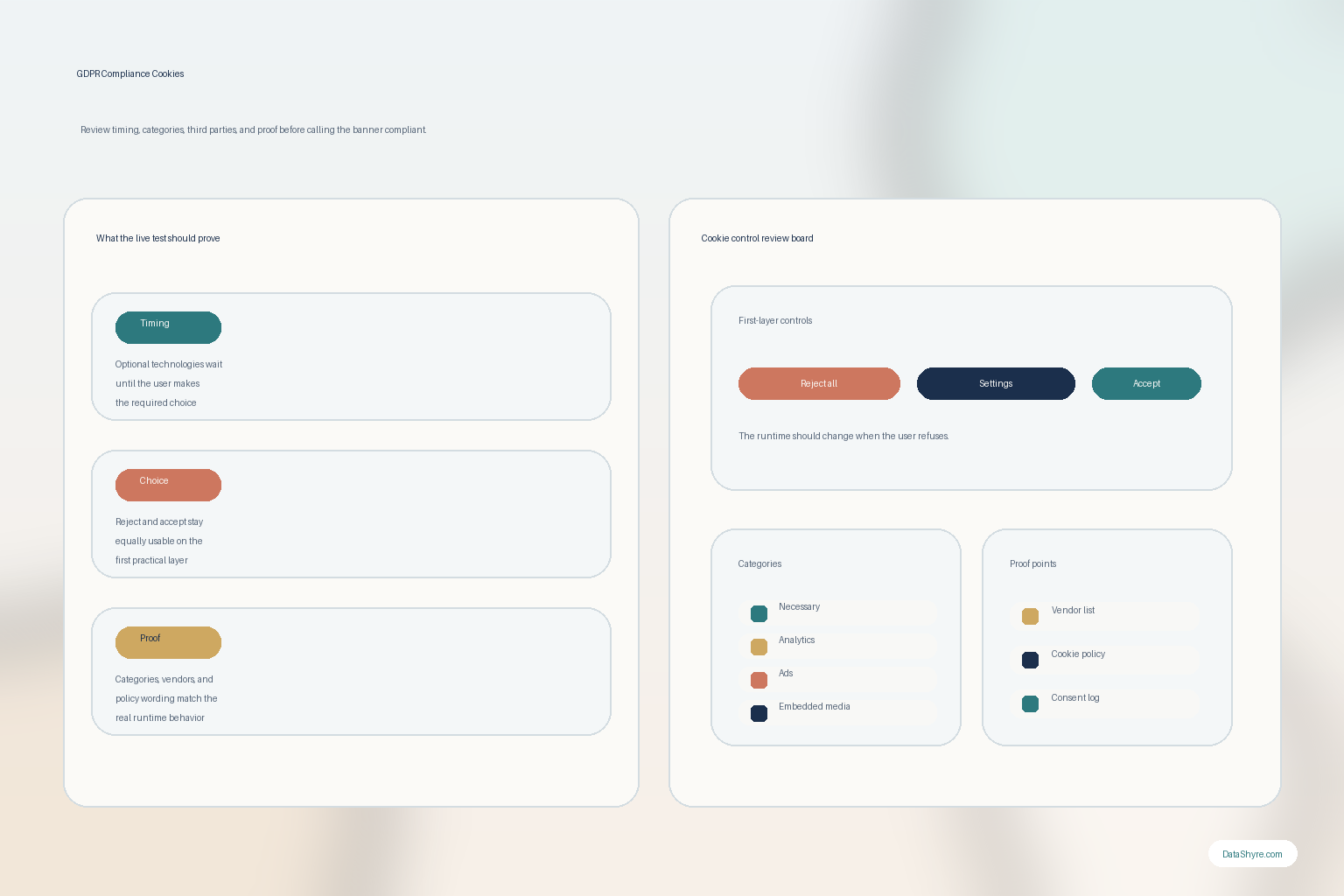
1. Define the scope as storage, access, tags, and trackers, not just cookie names
The first gdpr compliance cookies mistake is acting as if the whole problem lives inside a browser cookie table.
That is already too narrow.
The ICO’s 2026 guidance uses the broader label storage and access technologies because real sites often rely on:
- browser cookies;
- local or session storage;
- scripts and tags;
- pixels or beacons;
- embedded third-party tools; and
- identifiers read or written through related techniques.
If your review only inventories named cookies, the gdpr compliance cookies story will usually miss part of the runtime.
2. Separate truly exempt technologies from optional analytics, advertising, and personalization
The second gdpr compliance cookies mistake is calling too much of the stack necessary.
Your Europe still draws the familiar line. Consent is not required for technologies used only to carry out a communication or those strictly necessary to provide an online service the person explicitly requested, such as authentication or shopping-basket support. By contrast, tracking cookies for behavioural advertising, analytics, or market research sit on the consent side of the line.
That means a practical gdpr compliance cookies review should classify the live stack into buckets like:
- transmission or security support;
- login, basket, or form-completion continuity;
- analytics and measurement;
- advertising and retargeting;
- personalization;
- embedded media, chat, map, or social tooling.
If optional technologies keep getting renamed as functional or essential, the rest of the gdpr compliance cookies program will drift too.
3. Test whether non-exempt technologies stay blocked before the user chooses
This is still the fastest truth test.
Your Europe says cookies that require consent cannot be set when the webpage is first opened. The ICO says if no exception applies, you must obtain prior consent. So the first useful gdpr compliance cookies test is not a wording review. It is a runtime review:
- open a clean browser session;
- load the homepage and high-traffic templates;
- do not click the banner yet;
- inspect requests, storage, and cookies;
- repeat on mobile if mobile traffic matters.
If analytics, ad-tech, or third-party embeds fire before the person chooses, your gdpr compliance cookies posture is already weaker than the UI suggests.
4. Make the first layer offer a real reject path and specific choices
This is where a lot of weak gdpr compliance cookies implementations give themselves away.
Your Europe says users should be able to give specific consent depending on the purpose of different cookies they are accepting. The EDPB taskforce report says the “absence of refuse/reject/not consent options” on any layer with a consent button is not in line with valid-consent requirements in the view of most participating authorities.
So a serious gdpr compliance cookies review should ask:
- is refusal available without a deceptive detour;
- are categories separated clearly enough for purpose-specific choice;
- are labels plain enough for a normal user to understand;
- do desktop and mobile present the same practical choice.
If Accept all is prominent but rejection is hidden behind weak text or an extra maze, the gdpr compliance cookies story is not really about choice. It is about pressure.
5. Align categories, third parties, and policy wording with the live site
Many gdpr compliance cookies failures are not caused by the first layer alone.
They happen because the banner says one thing, the settings panel says another, and the policy page gives a third story.
The ICO says you must tell users about any third parties and provide a way for them to access specific information about each one. GDPR Article 12 still expects the explanation in “clear and plain language.” So a working gdpr compliance cookies review compares:
- category names in the banner;
- the descriptions in the settings panel;
- the cookie or privacy policy wording;
- the actual vendors and tools seen in runtime testing;
- the purposes each vendor supports.
If the panel says analytics but the live site still triggers advertising or cross-site tools in that bucket, the written compliance story is already out of sync with the technical one.
This is also where DataShyre can help if a CMP export, a vendor list, and the live network trace no longer agree with each other.
6. Re-check consent whenever purposes, vendors, or categories change
One of the easiest long-term gdpr compliance cookies mistakes is assuming a once-valid consent setup stays valid after the stack changes.
It does not.
The ICO’s current consent-management guidance says that if you introduce a new storage or access technology for a different purpose than what was originally stated when consent was granted, you must obtain fresh consent for the new technology or purpose.
That means your gdpr compliance cookies workflow should trigger a review whenever:
- a new vendor is added;
- a category is renamed;
- tag-manager logic changes;
- a new embed or tracking tool launches;
- the privacy or cookie policy is rewritten.
If changes can go live without re-checking purpose, timing, and consent logic, the gdpr compliance cookies setup will become inaccurate faster than most teams expect.
7. Make withdrawal easy, visible, and testable after the first click
The last gdpr compliance cookies mistake is treating the first choice like the end of the job.
Your Europe says it must be “as easy for your users to withdraw” consent as it is to accept cookies. The EDPB taskforce report also says website owners should implement easily accessible ways for users to withdraw consent at any time.
So the live review should test:
- whether the site exposes a clear return path to settings;
- whether a previous acceptance can actually be withdrawn;
- whether a previous refusal stays respected on later visits;
- whether the runtime changes after withdrawal instead of only changing the UI.
If a site promises preference changes but only updates the interface while tags, storage, or sharing continue unchanged, the gdpr compliance cookies control is mostly decorative.
The practical review I would use this week
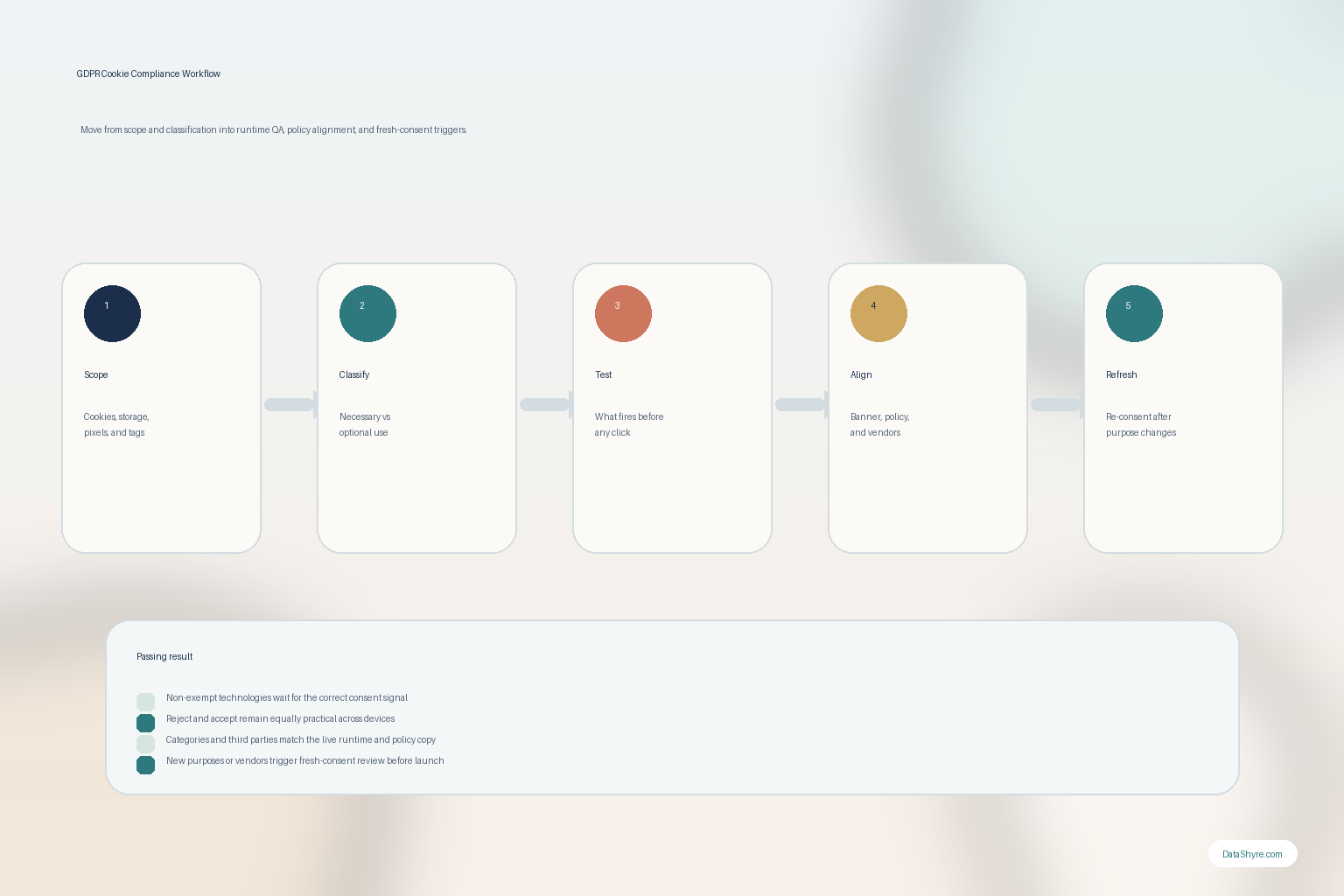
If I were checking gdpr compliance cookies today, I would use this order:
- map the real technologies in scope;
- separate exempt functions from optional tracking;
- test what fires before any choice;
- verify reject-all and purpose-specific controls;
- compare categories, third parties, and policy wording to runtime evidence;
- review fresh-consent triggers for changes;
- test withdrawal after the first click and after a revisit.
That sequence usually tells you more than polishing a banner design in isolation.
If your team wants help turning gdpr compliance cookies from a plugin setting into a defensible operating control, DataShyre can help with CMP implementation, runtime QA, consent records, and practical remediation.
FAQ
Are GDPR compliance cookies only about the banner?
No. A banner is only one surface. gdpr compliance cookies also depend on how the live site classifies technologies, blocks non-exempt tracking, names purposes, discloses third parties, records choices, and handles withdrawal later.
Do analytics cookies always need consent under GDPR?
Not every legal explanation uses the same shorthand, but many analytics implementations fall on the consent side when they are not strictly necessary for the user-requested service. Teams should test the actual implementation instead of assuming analytics automatically means exempt.
When do we need fresh consent for cookies?
If your setup introduces a new technology or a new purpose that was not covered by the original consent, the safer reading of current official guidance is that you need fresh consent for that new technology or purpose.
Bottom line
The best gdpr compliance cookies setup in 2026 is not the one with the prettiest banner.
It is the one that classifies technologies honestly, blocks the right things before consent, explains purposes and third parties clearly, makes refusal and withdrawal work in practice, and stays accurate after vendor changes.
The fastest way to judge gdpr compliance cookies is to test it the way a broken deployment would expose it: before consent, after consent, and again after a stack change.
Official sources used
- https://eur-lex.europa.eu/eli/reg/2016/679/oj/eng/
- https://europa.eu/youreurope/business/growing/digitalising/online-privacy/index_en.htm
- https://ico.org.uk/for-organisations/direct-marketing-and-privacy-and-electronic-communications/guidance-on-the-use-of-storage-and-access-technologies/
- https://ico.org.uk/for-organisations/direct-marketing-and-privacy-and-electronic-communications/guidance-on-the-use-of-storage-and-access-technologies/how-do-we-manage-consent-in-practice/
- https://www.edpb.europa.eu/system/files/documents/2023-01/edpb_20230118_report_cookie_banner_taskforce_en.pdf