Cookies Proxies in 2026: 7 Checks for Reverse Proxies, Consent, and Session Privacy
The real value in cookies proxies shows up when you debug it like a live system. A banner can render perfectly and still leak requests, misfire tags, or drift after the next plugin or theme update.
The useful test for cookies proxies is whether the live stack behaves correctly before consent, after consent, and after the next deployment. That is how hidden leaks and timing mistakes show up.
That is a real privacy and implementation question.
The official sources line up on why it matters. The ICO’s finalized storage-and-access-technologies guidance says PECR applies to any technology that “stores information, or accesses information stored” on the user’s device, not just classic cookie banners. The same ICO guidance also says first-party and third-party labels have “no inherent meaning in PECR or UK GDPR” by themselves. Google’s current consent documentation still says default consent states must be set “before any commands that send measurement data.” And both Apache and NGINX document features for rewriting cookie domain or path values at the proxy layer, which means your edge setup can materially change how cookies behave in the browser.
If you want nearby context first, start with these guides to cookie compliance tool, cookie law, and what are third party cookies. This page stays narrower. It is the cookies proxies review I would use this week before trusting a reverse-proxied site, consent setup, or session flow.
If your team is trying to get cookies proxies under control without adding a heavyweight privacy stack, DataShyre can help. DataShyre focuses on consent and preference management that are easier to implement, easier to operate, and easier to trust on a live site. Start with DataShyre’s consent and preference management or book a demo.
If your stack mixes a CDN or reverse proxy with consent tooling, login sessions, analytics tags, or regional privacy logic, DataShyre can help audit the live behavior so the browser trace, the policy page, and the infrastructure settings still tell the same story.

1. Identify which layer is actually setting, rewriting, or forwarding the cookie
The first cookies proxies mistake is assuming the application is the only layer that matters.
It often is not.
On a modern site, cookie behavior may be affected by:
- the origin application;
- a reverse proxy or gateway;
- a CDN or edge worker;
- a tag manager or script loader;
- embedded third-party tools; and
- a consent layer that decides when those tools may run.
That means the right opening question is not does the app set cookies.
It is which layer can set, rewrite, suppress, or expose cookie-related behavior before the page is fully usable.
For cookies proxies, that distinction changes both debugging and compliance review.
2. Do not let proxy rewriting disguise who is involved in the storage or access
This is where privacy teams can get misled.
The ICO’s current guidance says the PECR rules apply to storage and access technologies whether the setup appears first-party or third-party. It also says the first-party versus third-party labels do not decide the legal analysis on their own.
That matters because a reverse proxy can make an external service look closer to first-party behavior from the browser’s perspective while the real processing chain still involves another provider, another infrastructure layer, or another recipient.
For cookies proxies, ask:
- whether the proxy makes an external service appear under the main site hostname;
- whether the vendor still receives data server-side or through browser requests;
- whether the privacy notice explains the real recipient chain honestly; and
- whether consent or opt-out logic still covers the underlying tracking purpose rather than the cosmetic hostname.
If the proxy setup changes the surface appearance but not the underlying tracking purpose, your compliance review should not stop at the domain label.
3. Check cookie domain and path rewriting deliberately, not accidentally
This is the most literal cookies proxies check.
Apache documents ProxyPassReverseCookieDomain and says it “Adjusts the Domain string in Set-Cookie headers” from a reverse-proxied server. It also documents ProxyPassReverseCookiePath for rewriting the path string. NGINX likewise documents proxy_cookie_domain and proxy_cookie_path.
Those features are useful. They are also easy to misuse.
I would review:
- which backend domains are being rewritten to public domains;
- whether a backend cookie that should stay narrow is being widened accidentally;
- whether path rewriting causes cookies to be shared across more of the site than intended;
- whether subdomain behavior matches the real trust boundary; and
- whether staging, preview, and production rules differ in risky ways.
When cookies proxies are misconfigured here, the result is often weird session behavior, over-broad cookie scope, or misleading first-party appearances.
4. Harden session cookies after TLS termination and proxy handoff
Some of the riskiest cookies proxies problems are security problems before they are banner problems.
MDN’s current secure cookie guidance says to set Secure and HttpOnly where possible, use the most restrictive Path practical, and set the Domain attribute only when a cookie truly needs to be shared more broadly. It also recommends SameSite restrictions and notes that __Host- cookies must not set a Domain attribute and must use Path=/.
In real deployments, that means checking whether your reverse proxy or edge layer preserves the conditions needed for safer cookie behavior:
- HTTPS end to end where required;
Secureon sensitive cookies;HttpOnlyon session identifiers;- intentional
SameSitevalues; - narrow
DomainandPathscope; and - host-bound cookies where the architecture allows it.
If cookies proxies widen domain scope or break secure assumptions after TLS termination, the privacy story and the security story both get weaker.
5. Make proxy or edge region logic match the consent logic
This is the compliance check teams skip when they focus only on cookie flags.
Google’s current guidance still says default consent states belong on every page “before any commands that send measurement data.” The ICO’s April 29, 2026 update on storage and access technologies also reinforces that tracking analysis is broader than banner text alone.
For cookies proxies, the common failure is regional logic at the edge that does one thing while the consent runtime does another. For example:
- the proxy geolocates a visitor into the wrong region;
- the banner shows but the proxy has already allowed optional tooling to load;
- the proxy caches a response with the wrong consent branch;
- GTM or direct tags fire before the consent default is established; or
- California or UK branching is described in policy text but not reflected in the live page flow.
If the proxy is making routing or caching decisions, it belongs inside the consent review, not outside it.
6. Test no-choice, reject-all, and later return paths through the proxied routes
You cannot review cookies proxies safely from source code alone.
You have to test the runtime.
At minimum, I would test:
- first page load in a clean browser with no choice made;
- explicit reject all where consent is required;
- later return to settings and withdrawal;
- login and logout flows across proxied paths or subdomains;
- embedded assets or APIs served through a different route; and
- cached pages versus uncached pages.
This often reveals the real issue:
- a cookie appears on one route but not another;
- a proxy route rewrites scope unexpectedly;
- a cache leaks a consent state between contexts;
- a logout cookie never clears across the same public path structure; or
- a supposedly blocked vendor still receives browser requests through a proxied endpoint.
This is why cookies proxies work is usually live QA work, not just documentation review.
7. Re-check after proxy, CDN, or routing changes
The last cookies proxies mistake is treating the setup as stable.
It rarely is.
A small infrastructure change can alter cookie behavior without anybody touching the privacy page. New proxy rules, subdomain routing, edge workers, bot controls, header changes, and caching rules can all affect what gets stored, what gets forwarded, and what users can prove later.
So I would treat these as mandatory re-review triggers:
- new reverse proxy or CDN provider;
- changes to hostnames, subdomains, or path mapping;
- new consent tooling or GTM container logic;
- session-cookie naming or scope changes;
- new embedded third parties served through proxied routes; and
- any regional routing, personalization, or cache-key redesign.
This is usually where DataShyre implementation review helps most. The hard part is not writing another cookie paragraph. It is proving that the infrastructure change did not quietly change the runtime behavior.
A practical cookies proxies review for this week
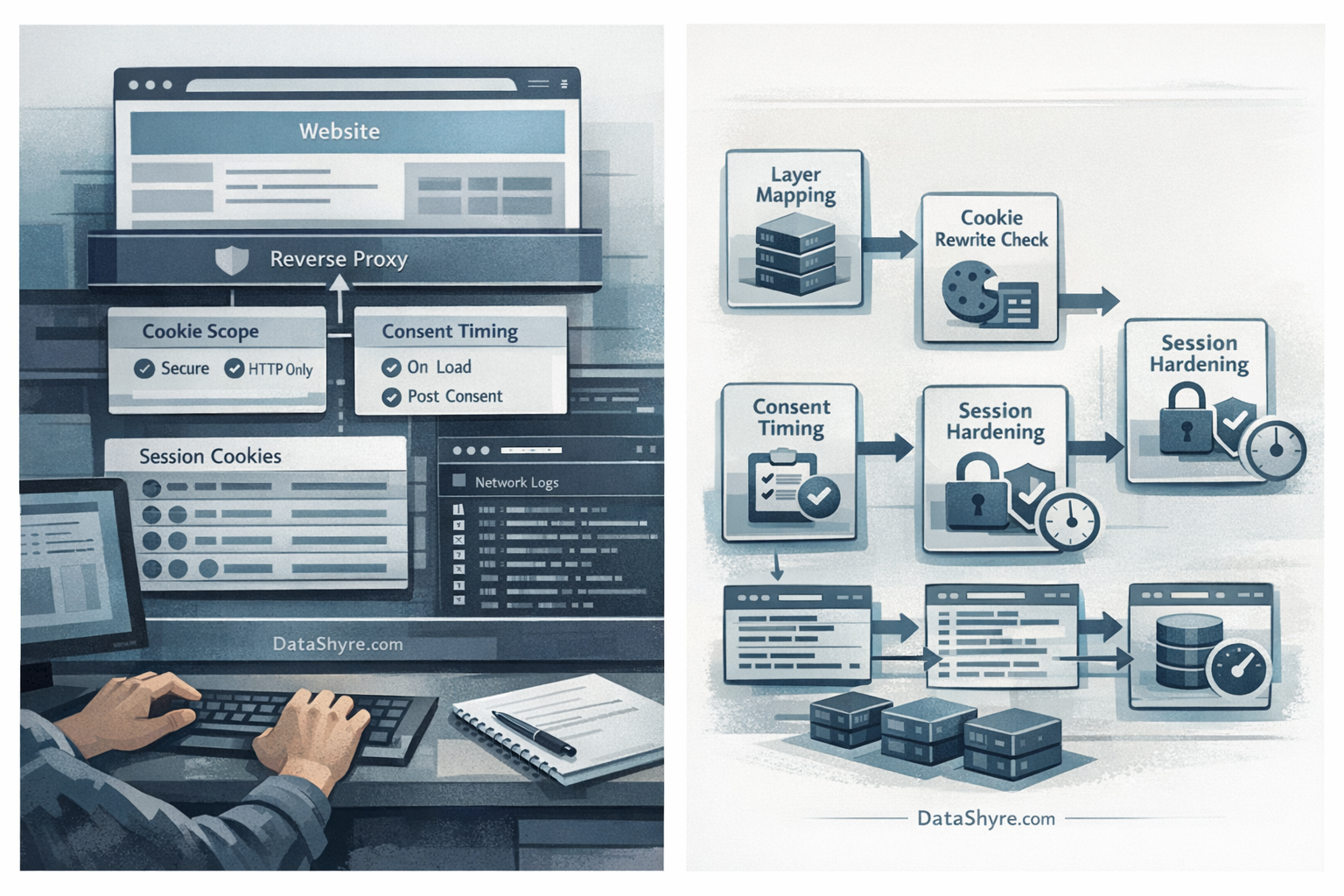
If you were reviewing cookies proxies today, use this order:
- map every layer that can set, rewrite, or forward cookie behavior;
- compare public hostname behavior with the real vendor and recipient chain;
- inspect domain and path rewriting rules at the proxy;
- harden session-cookie attributes and scope after TLS termination;
- test consent defaults before measurement or optional tracking loads;
- run no-choice, reject-all, and withdrawal tests across proxied routes; and
- log which infrastructure changes force a re-test later.
That sequence usually finds the problem faster than arguing over whether the cookie looks first-party.
FAQ
What does cookies proxies usually mean?
Usually it means cookie behavior when a site uses a reverse proxy, CDN, gateway, or similar layer that can rewrite domains, paths, routing, or consent timing.
Can a reverse proxy change cookie behavior without changing application code?
Yes. Apache and NGINX both document cookie-domain and cookie-path rewriting features, and proxy routing can also affect scope, caching, and session behavior even when the application code stays the same.
If a proxy makes tracking look first-party, does that remove the privacy issue?
No. The ICO’s current guidance says the first-party versus third-party labels do not decide the PECR or UK GDPR analysis by themselves. The real purpose, the storage or access behavior, and the actual recipient chain still matter.
Bottom line
The useful way to think about cookies proxies in 2026 is not as a niche browser curiosity.
It is a live infrastructure and privacy-control question.
If the proxy changes cookie scope, recipient visibility, consent timing, cache behavior, or session security, then it belongs in your privacy review just as much as the app code or banner copy does.
The fastest way to judge cookies proxies is to test it the way a broken deployment would expose it: before consent, after consent, and again after a stack change.
Official sources used
- ICO, final storage and access technologies guidance published on April 29, 2026: https://ico.org.uk/about-the-ico/media-centre/news-and-blogs/2026/04/final-storage-and-access-technologies-guidance-published/
- ICO, what are storage and access technologies: https://ico.org.uk/for-organisations/direct-marketing-and-privacy-and-electronic-communications/guidance-on-the-use-of-storage-and-access-technologies/what-are-storage-and-access-technologies/
- Google for Developers, set up consent mode on websites: https://developers.google.com/tag-platform/security/guides/consent
- Apache HTTP Server, mod_proxy: https://httpd.apache.org/docs/current/mod/mod_proxy.html
- NGINX, ngx_http_proxy_module: https://nginx.org/en/docs/http/ngx_http_proxy_module.html
- MDN, secure cookie configuration: https://developer.mozilla.org/en-US/docs/Web/Security/Practical_implementation_guides/Cookies