Cookiebot Pricing in 2026: What the Public Plans Cost and 7 Cost Checks Before You Buy
The real value in cookiebot pricing shows up when you debug it like a live system. A banner can render perfectly and still leak requests, misfire tags, or drift after the next plugin or theme update.
The useful test for cookiebot pricing is whether the live stack behaves correctly before consent, after consent, and after the next deployment. That is how hidden leaks and timing mistakes show up.
That framing matters because CMP buying is still tied to real compliance work. The European Commission still says a consent request should be “clear and concise” and easy to understand. The UK’s ICO said on April 29, 2026 that organizations want “clear, practical guidance” on cookies, tracking pixels, device fingerprinting, and similar technologies. So the price that matters is not the banner screenshot price. It is the price of getting a working consent layer live.
If you want the nearby context first, start with these guides to Cookiebot, Cookiebot consent management platform, and consent management platform pricing. This page stays narrower. It is the cookiebot pricing review I would use this week before approving a CMP budget.
If your team is trying to get cookiebot pricing under control without adding a heavyweight privacy stack, DataShyre can help. DataShyre focuses on consent and preference management that are easier to implement, easier to operate, and easier to trust on a live site. Start with DataShyre’s consent and preference management or book a demo.
If your team wants help pricing the real rollout instead of only the vendor card, DataShyre can help with CMP selection, implementation review, GTM and script testing, and runtime privacy QA. That is especially useful when Cookiebot looks affordable on paper but the launch scope spans multiple domains, heavier tracking, or California and EU requirements at once.
1. Read the meter before you compare the dollar figure
The first cookiebot pricing mistake is treating Cookiebot like a traffic-metered tool.
Its current public pricing FAQ says Cookiebot pricing is based on the “number of domains” and the number of subpages within each domain. The same page says the monthly subscription price is calculated from the “highest page count recorded” during website scan history.
That creates a different budget shape from visitor-based CMPs.
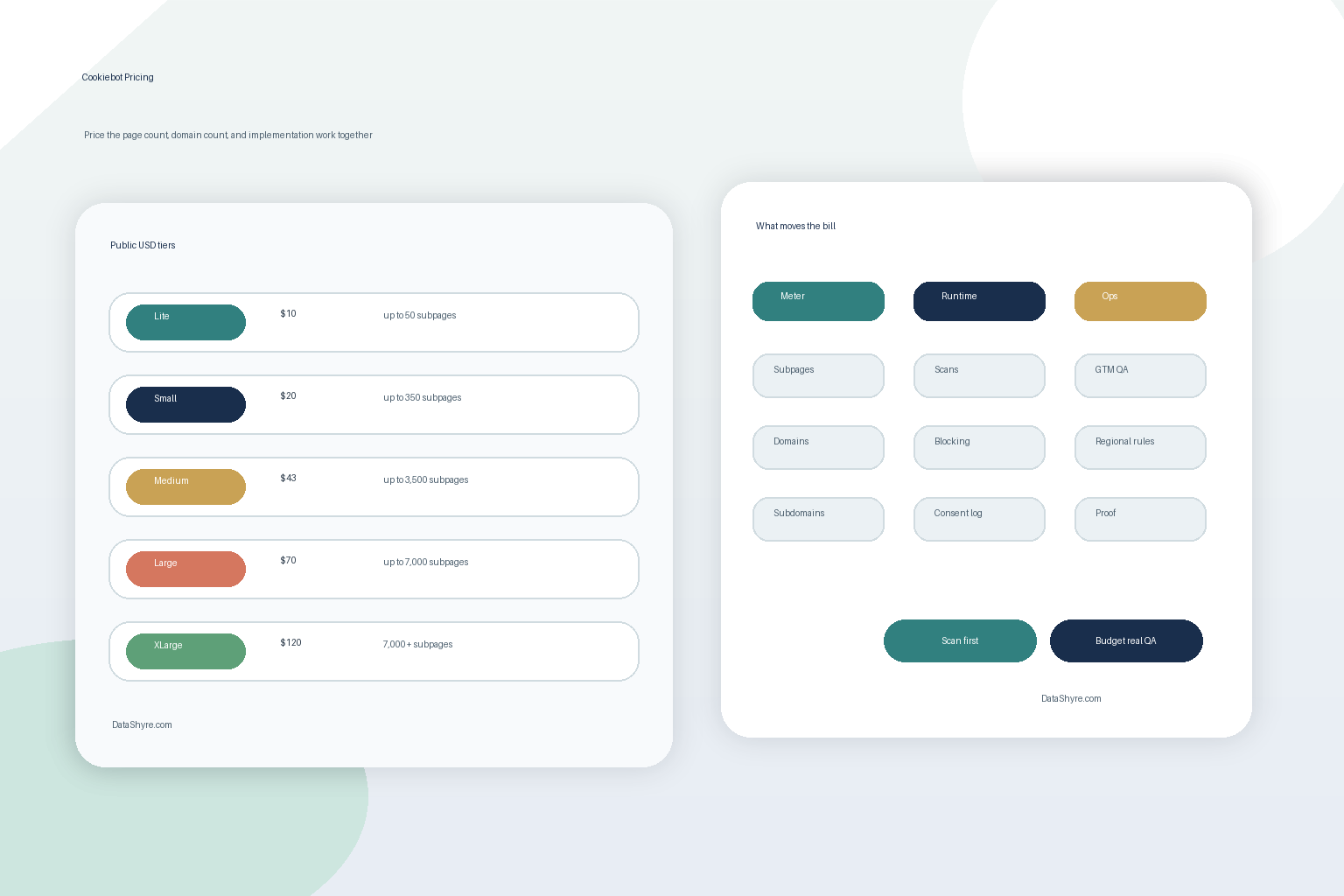
As of November 15, 2026, Cookiebot’s public USD pricing page shows these self-serve Premium list prices per domain:
- Lite: $10/month for up to 50 subpages;
- Small: $20/month for up to 350 subpages;
- Medium: $43/month for up to 3,500 subpages;
- Large: $70/month for up to 7,000 subpages;
- Extra Large: $120/month for more than 7,000 subpages.
There is also a Free plan for one small site, plus a Corporate tier that stays sales-led.
That means the first thing to measure is not traffic. It is:
- how many production domains and subdomains you really need;
- how many unique URLs the scanner is likely to find on each;
- whether product, docs, blog, help-center, and regional pages all sit inside the same crawl footprint.
If you skip that count, cookiebot pricing looks cheaper or simpler than it really is.
2. Use the current USD price-change date correctly
There is an easy date trap here.
Cookiebot Support published a USD price-increase notice on October 29, 2026. That article says USD list prices are rising by 25% and shows the new list prices above. But the same support article also says the new price applies to invoices issued from November 30, 2026 (UTC).
So if you are evaluating cookiebot pricing on November 15, 2026, the public price page already reflects the new USD list price, while some existing customers may still be between billing states until November 30, 2026.
That is not just a billing footnote. It changes how you compare quotes inside a live procurement cycle:
- a screenshot from earlier in 2026 may already be outdated;
- an internal budget sheet built on the old USD prices may now be wrong;
- a customer with a discount may see something different from the public list price.
So the practical rule is simple: budget from the current public price page, then confirm the live account price if you are already a customer.
3. Do not assume one subscription covers several sites
This is the next place teams misread cookiebot pricing.
Cookiebot Support is explicit that pricing is “per domain and per subdomain” and that you must pay one subscription for each domain. Support also says adding several domains under one account does not reduce the number of subscriptions needed.
That matters for buyers running:
- separate country sites;
- multiple product brands;
- a main site plus app landing domains;
- blog, support, and campaign subdomains that all need real consent controls.
The free plan is also narrower than people expect. Support says the Free subscription is limited to one domain with 50 subpages or fewer, and if you add additional domains they each require Premium coverage.
So when you price Cookiebot, do not ask only what is the plan for our website.
Ask:
- which domains are production;
- which subdomains are separate billing objects;
- which environments are staging only versus user-facing;
- which properties must behave consistently for consent, proof, and withdrawal.
That is often the difference between a low-cost small-site decision and a multi-property CMP program.
4. Separate banner access from Premium operations
A weak cookiebot pricing review treats the tool like a banner rental.
A better review checks what the paid layer is actually buying.
Cookiebot Support says Premium subscriptions include banner customizations, monthly scans, multiple domains, and support for multiple legislations. Cookiebot’s Terms of Service add more detail by listing monthly website scans and scan reports, a customizable banner and cookie declaration, multiple languages, geolocation, multiple domains, Cross Domain Consent Sharing, consent statistics, manual scans, and auto-blocking in Premium.
That matters because the cost question is not only can we show a banner.
It is also:
- can we rescan the site regularly;
- can we manage several domains cleanly;
- can we adapt by region;
- can we use the reporting and consent-log layer later;
- can we avoid hand-maintaining the whole setup.
If your team only needs one small site and minimal customization, Cookiebot can still look cost-effective. But once you need multiple properties, more languages, recurring scans, or stronger runtime control, the practical plan is rarely the headline entry price alone.
5. Budget for scan timing and plan movement, not only setup
This is where cookiebot pricing becomes operational.
Cookiebot’s automatic-blocking documentation says it can take up to 24 hours for the first full scan and analysis to complete. Support also says the scanner updates banner behavior and auto-blocking instructions after scans, and the pricing page says a subscription will “automatically upgrade” to the next tier if the scanner detects more subpages than the current plan allows.
So the real budget model needs two extra lines:
- launch timing risk;
- future page-growth risk.
That matters in practice because a team can sign up for a lower tier, launch a larger docs section or marketplace, and then quietly move into a higher billing tier after the scanner sees the bigger footprint.
The reverse side matters too. Support says if you are on a Premium Medium or Large plan and later reduce page count, you may need to contact support to adjust the subscription downward.
That means a careful cookiebot pricing review should ask:
- how many URLs will exist at launch, not only today;
- whether large hidden sections or parameter-driven routes will inflate the crawl;
- who will watch for tier changes after product releases;
- whether procurement expects the price to stay flat when the site footprint does not.
6. Price the implementation work outside the license
This is the biggest buying mistake I see.
Cookiebot’s current blocking documentation says auto blocking can hold back non-essential cookies until consent. But the same support materials also say the first scan matters, that the Cookiebot script needs to load before cookie-setting resources, and that resources may still need manual attention if blocking instructions are missing or markup is inconsistent.
The scan-report guidance gets even more practical. It says the report can help identify the initiator of a cookie, whether a resource is not blocked before consent, and whether a new scan or manual blocking work is needed.
So the real cookiebot pricing number is not only the subscription fee. It is also the work around it:
- GTM review and consent-aware tag setup;
- direct-script cleanup;
- embed blocking for video, chat, or marketing tools;
- browser QA for reject, accept, and later withdrawal paths;
- retesting after releases.
That is exactly where a lot of apparently cheap CMP deployments get expensive. The software is affordable. The runtime cleanup is not free.
If your site is simple, the gap may stay small. If your site uses many third-party scripts, multiple subdomains, or frequent marketing launches, the gap can be the real budget.
7. Know when self-serve stops being the real buying model
Cookiebot’s public pricing is refreshingly visible compared with some enterprise CMPs.
But not every buyer is really shopping in the self-serve lane.
Cookiebot’s public pricing page also shows a Corporate path with features such as A/B testing, bulk editing, Cross-Device Consent Sharing, and a dedicated Customer Success Manager. That is a different buying motion from a single-domain Premium plan.
If your team needs:
- many properties;
- coordinated rollout rules across regions;
- identity-aware or cross-device consent behavior;
- heavier support during onboarding;
- shared governance across product, marketing, legal, and engineering,
then cookiebot pricing should be evaluated as a program decision, not only a self-serve plugin decision.
That is also the moment when comparing only list price becomes misleading. You need to compare:
- meter shape;
- domain footprint;
- runtime complexity;
- support level;
- evidence and operating overhead.
A practical review order for this week
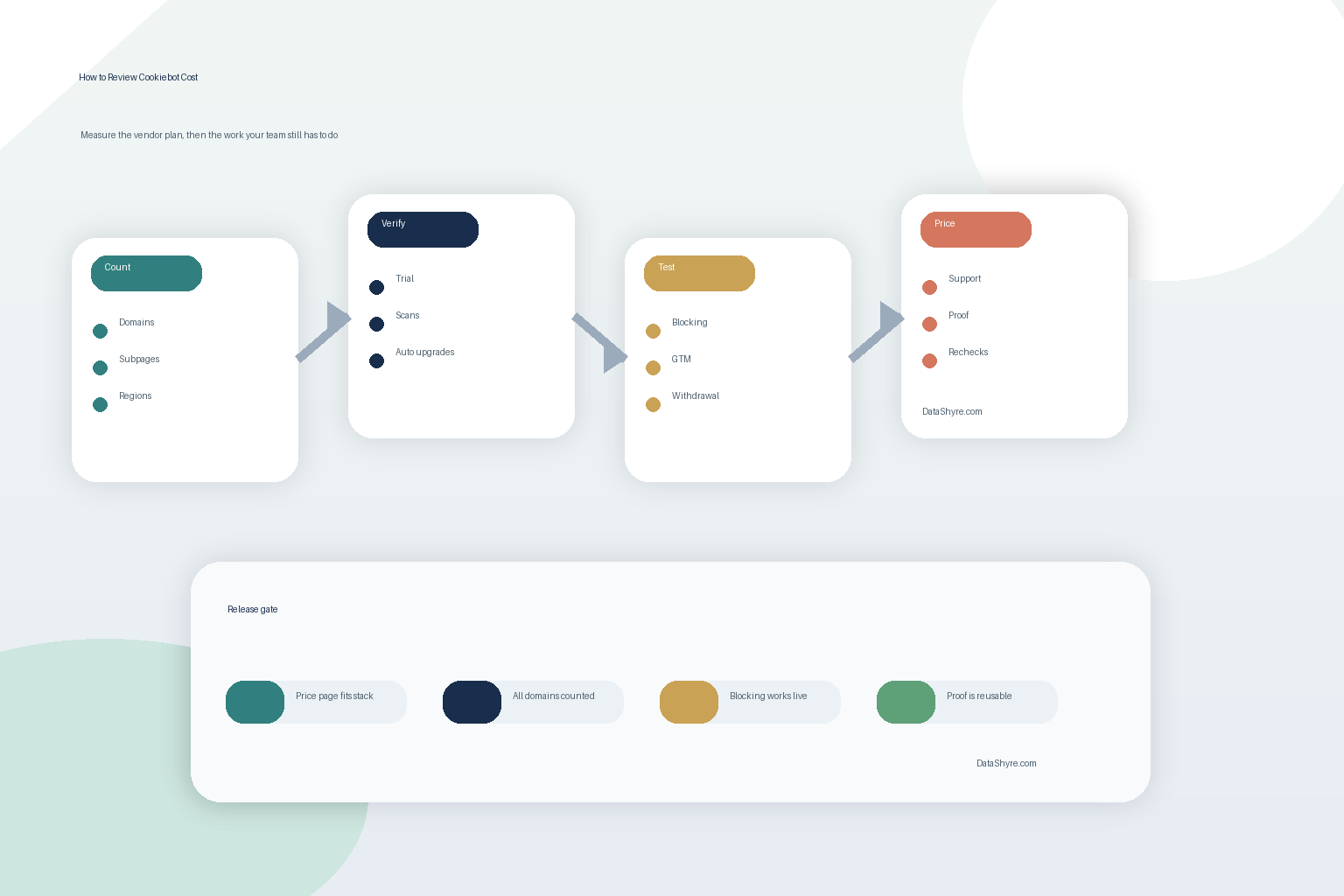
If you were reviewing cookiebot pricing right now, I would do it in this order:
- count real production domains and subdomains;
- estimate the subpage footprint the scanner will actually find;
- map the current public price tier against that footprint;
- add GTM, embeds, and QA work outside the license;
- test whether a multi-domain or corporate path is more honest than forcing a small self-serve plan.
That order usually produces a better budget than staring at the pricing card alone.
FAQ
What does Cookiebot charge by in 2026?
For public self-serve plans, Cookiebot currently charges based on domain count and subpage count, not pageviews. The public FAQ says pricing is tied to the number of domains and the number of subpages within each domain, with price calculations based on the highest page count recorded in scan history.
Is there still a free Cookiebot plan?
Yes, but it is narrow. Cookiebot Support says the Free plan is limited to one domain with 50 subpages or fewer, and adding other domains requires Premium coverage.
Can I put multiple websites under one Cookiebot subscription?
Not as one paid site bundle. Support says subscriptions are priced per domain and per subdomain, and adding multiple domains to one account does not reduce the number of subscriptions required.
What is the biggest hidden cost in Cookiebot pricing?
Usually implementation and re-testing. The license can be straightforward, but teams still need to budget for blocking fixes, GTM logic, scan review, and production QA so the consent layer actually works.
Bottom line
The best current answer to cookiebot pricing is not only a plan table.
It is this: on November 15, 2026, Cookiebot publicly shows transparent self-serve USD tiers, but the real cost still depends on page-count growth, per-domain billing, scan timing, and how much runtime cleanup your team must do outside the license.
If you price only the banner, you will under-budget the rollout.
The fastest way to judge cookiebot pricing is to test it the way a broken deployment would expose it: before consent, after consent, and again after a stack change.
Sources
- European Commission, Information for individuals: https://commission.europa.eu/law/law-topic/data-protection/information-individuals_en
- ICO, Final storage and access technologies guidance published: https://ico.org.uk/about-the-ico/media-centre/news-and-blogs/2026/04/final-storage-and-access-technologies-guidance-published/
- Cookiebot, Pricing and plans: https://www.cookiebot.com/us/pricing/
- Cookiebot Support, Cookiebot CMP price increase for USD customers: https://support.cookiebot.com/hc/en-us/articles/31389099992732-Cookiebot-CMP-price-increase-for-USD-customers
- Cookiebot Support, Can I add several websites under 1 subscription?: https://support.cookiebot.com/hc/en-us/articles/360004051054-Can-I-add-several-websites-under-1-subscription
- Cookiebot Support, Can I add multiple domains to a Free account?: https://support.cookiebot.com/hc/en-us/articles/360006243493-Can-I-add-multiple-domains-to-a-Free-account
- Cookiebot Support, What is my subscription plan?: https://support.cookiebot.com/hc/en-us/articles/360004162973-What-is-my-subscription-plan-Cookiebot-Admin
- Cookiebot Support, How can I upgrade to a Premium subscription in the Cookiebot Manager?: https://support.cookiebot.com/hc/en-us/articles/26360664568348-How-can-I-upgrade-to-a-Premium-subscription-in-the-Cookiebot-Manager
- Cookiebot Support, Understanding the scan report: https://support.cookiebot.com/hc/en-us/articles/5007079527580-Understanding-the-scan-report
- Cookiebot Support, Automatic cookie blocking: https://support.cookiebot.com/hc/en-us/articles/360009074960-Automatic-cookie-blocking
- Cookiebot, Terms of Service: https://www.cookiebot.com/en/terms-of-service/
—
Published: November 15, 2026. Updated using current official vendor and regulator materials available at publication time.