Cookie Preferences in 2026: 7 Live Checks Before You Trust the Settings Panel
The real value in cookie preferences shows up when you debug it like a live system. A banner can render perfectly and still leak requests, misfire tags, or drift after the next plugin or theme update.
The useful test for cookie preferences is whether the live stack behaves correctly before consent, after consent, and after the next deployment. That is how hidden leaks and timing mistakes show up.
That distinction matters more in late 2026 because the official guidance has become even more operational. The ICO’s final guidance on storage and access technologies, published on April 29, 2026, treats cookies, scripts, tags, and similar tools as one practical control layer. The ICO’s GDPR guidance also calls “preference-management tools like privacy dashboards” good practice. The EDPB’s consent summary still says withdrawal must be “as easy as giving it.” CNIL still says rejecting cookies should be “just as easy as accepting them.” And California’s current regulations say a cookie banner or cookie controls are “not by itself an acceptable method” for submitting a sale-or-sharing opt-out request.
If you want the closest companion reads first, start with these guides to cookie notice, cookie policy, and consent and preference management. This page stays focused on the cookie preferences layer itself and the live checks that tell you whether it is doing real work.
If your team is trying to get cookie preferences under control without adding a heavyweight privacy stack, DataShyre can help. DataShyre focuses on consent and preference management that are easier to implement, easier to operate, and easier to trust on a live site. Start with DataShyre’s consent and preference management or book a demo.
If your team needs help tying the preference panel to live runtime behavior, DataShyre can help with consent management, implementation review, and evidence-friendly privacy operations. The expensive mistake is not only a weak banner. It is a polished preferences screen that does not control the stack behind it.
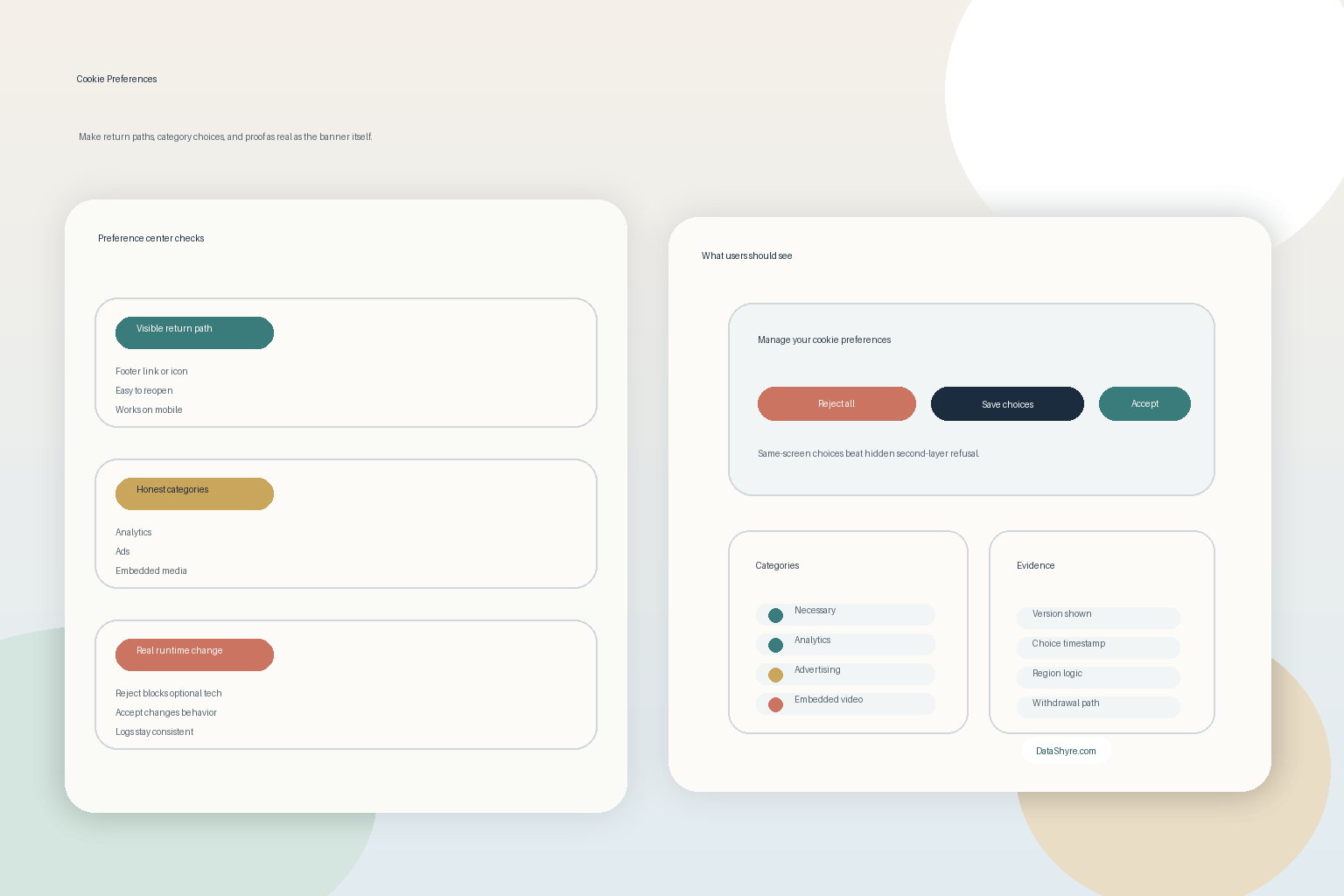
1. Treat cookie preferences as a runtime control, not a design element
The first cookie preferences mistake is assuming the settings panel is mainly a UX flourish added after the banner.
It is not.
A working preferences layer has to coordinate:
- what technologies are active before any choice;
- what categories the site presents;
- whether refusal is easy and visible;
- how users return later to change the decision; and
- what evidence survives after the choice is made.
If the interface looks calm and detailed but the runtime does not change, the cookie preferences experience is decorative.
2. Make the return path obvious before you worry about polish
This is the most common practical weakness.
The EDPB and the ICO both keep pushing the same principle: withdrawing consent should not be harder than giving it. In real deployments, that means cookie preferences need a visible return path, not just a first-visit overlay that disappears forever after one click.
So when reviewing cookie preferences, I check whether users can:
- reopen the panel from a footer link, icon, or other stable entry point;
- find it on mobile without hunting;
- update choices in one short flow;
- understand what changed after they saved.
If the only easy action is the first Accept click, the setup is already drifting away from valid consent practice.
3. Keep the categories honest enough to map to real technologies
This is where many settings panels become vague.
The panel might list analytics, marketing, or personalization, but those labels are only useful if they connect to real vendors, real scripts, and real purposes. The ICO’s guidance says consent requests should be purpose-specific. CNIL’s cookie materials also keep pushing for clear first-layer information on purposes and the means of refusal.
That means a serious cookie preferences review should ask:
- which vendors or tools sit inside each category;
- whether any category is broad enough to hide materially different uses;
- whether embedded video, chat, A/B testing, or tag-manager behavior has been classified honestly;
- whether the policy page uses the same categories the settings panel shows.
If the policy, the panel, and the runtime all describe the stack differently, the user is not really managing cookie preferences. They are guessing.
4. Test reject, save, and accept against the live runtime
This is the most important technical check.
For cookie preferences, the truth is in the browser and network logs:
- what fires before choice;
- what changes after
Reject all; - what changes after granular selection;
- what changes after
Accept; - what still loads on mobile, logged-in pages, campaign landing pages, or localized templates.
The ICO’s current storage-and-access-technologies guidance is useful because it keeps the test broad. The control problem is not limited to classic cookies. It can also reach scripts, tags, fingerprinting-related techniques, and similar tools.
That means a weak cookie preferences setup often looks like this:
The panel records a refusal, but optional analytics, ad tech, or embedded third-party requests still appear in the runtime anyway.
If that happens, the interface is promising something the system did not deliver.
5. Make refusal at least as usable as acceptance
This is where design and compliance meet.
CNIL’s reminder is still the cleanest one-line test: refusing should be “just as easy as accepting them.” The EDPB’s consent summary and GDPR materials point the same way with the wider principle that it should be “as easy as giving it.”
So for cookie preferences, I would verify:
Reject allis not buried in a weaker second layer when consent is the legal basis;- saving a limited or granular choice is straightforward;
- colors, size, spacing, and interaction order do not push users toward
Accept; - the panel does not quietly reset choices when users return.
If the preferences screen behaves like a conversion funnel, the word preferences is doing more work than the control itself.
6. Do not confuse cookie preferences with California sale-or-sharing opt-outs
This is the mistake that creates the most avoidable U.S. confusion.
California rights do not map perfectly onto EU- or UK-style consent panels. The California Attorney General still describes Global Privacy Control as a “stop selling or sharing my data switch.” The CPPA’s current regulations, effective January 1, 2026, also say a cookie tool is “not by itself an acceptable method” for submitting opt-out requests about sale or sharing.
That means your cookie preferences layer should not imply that one generic settings panel automatically handles every California rights path.
A California-facing review should ask whether the site also provides:
- the required opt-out path or frictionless GPC handling where applicable;
- clear
Your Privacy Choicesor equivalent rights links when needed; - a separation between cookie-level choices and broader sale-or-sharing choices.
If that separation is blurry, the site may sound more complete than it really is.
This is also where DataShyre implementation help is useful. The hard part is usually not creating one more panel. It is lining up the panel, the rights links, GPC behavior, and the downstream vendor logic so they tell the same story.
7. Keep proof that the preference layer matched the version of the site people actually saw
The long-term cookie preferences risk is not only first-launch quality. It is drift after releases.
New vendors get added.
Tag-manager rules change.
Embedded media changes by template.
The settings panel stays the same.
This is why I want cookie preferences evidence to connect at least:
- the interface version shown;
- the categories and purposes shown at the time;
- the user choice recorded;
- the region logic applied;
- the runtime behavior that followed; and
- the return path available for later change.
Without that chain, a preferences center can look mature in screenshots and still become hard to defend once the stack changes.
A practical cookie preferences review for this week
If you were reviewing cookie preferences today, use this order:
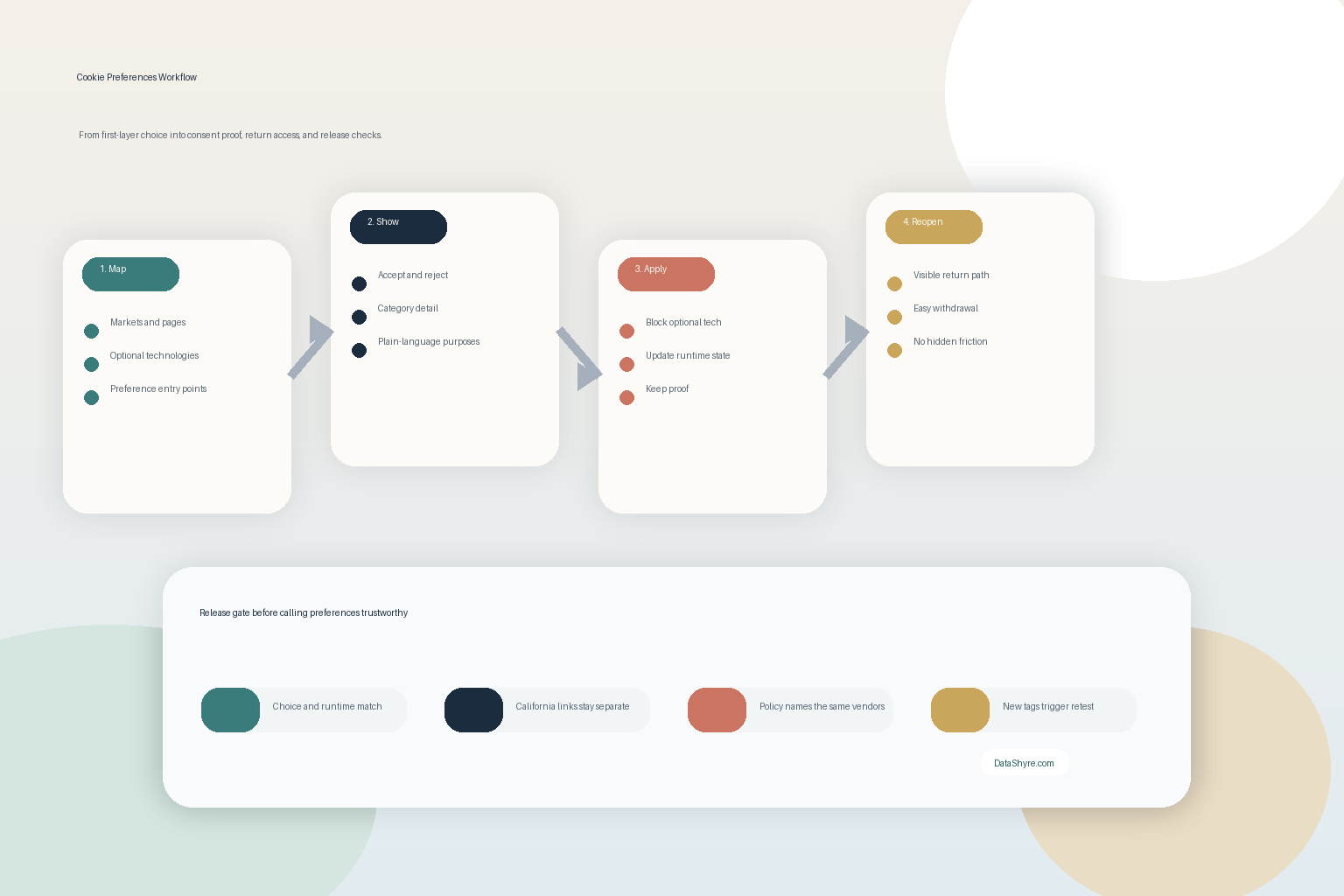
- map the pages, markets, and technologies the panel is meant to control;
- confirm the return path is easy to find on desktop and mobile;
- compare the category labels against the real vendors and purposes in play;
- test reject, granular save, and accept paths against live runtime behavior;
- separate EU or UK consent logic from California opt-out flows;
- save evidence that the panel version and runtime state matched.
That order catches more truth than visual review alone.
FAQ
Are cookie preferences the same thing as cookie consent?
Not exactly. Cookie preferences are the user-facing controls for managing choices. Cookie consent is the legal and technical outcome you still need to obtain, respect, and prove where consent is the rule.
Do cookie preferences need a return link after the first visit?
Usually yes if users need an ongoing way to withdraw or revise optional choices. A first-visit-only modal is not enough for many real consent scenarios.
Can one preferences panel cover California too?
Not by itself. California may also require sale-or-sharing opt-out handling, GPC recognition, and rights links that are distinct from a standard cookie-settings panel.
Bottom line
Strong cookie preferences in 2026 are not about adding one more icon to the footer.
They are about whether the user can make a real choice, revisit it later, and trust that the runtime, policy, and rights flow all stayed aligned.
The fastest way to judge cookie preferences is to test it the way a broken deployment would expose it: before consent, after consent, and again after a stack change.
Official sources used
- ICO: Guidance on the use of storage and access technologies
- ICO: How do we manage consent in practice?
- ICO: What methods can we use to provide privacy information?
- EDPB summary on consent under the GDPR
- CNIL: Dark patterns in cookie banners
- California DOJ: Global Privacy Control
- CPPA regulations effective January 1, 2026