Cookie Notice in 2026: 7 Live Checks Before You Call It Compliant
The real value in cookie notice shows up when you debug it like a live system. A banner can render perfectly and still leak requests, misfire tags, or drift after the next plugin or theme update.
The useful test for cookie notice is whether the live stack behaves correctly before consent, after consent, and after the next deployment. That is how hidden leaks and timing mistakes show up.
That sounds obvious, but it is where many teams still fail.
The official guidance is still pointed. The ICO now frames cookies, pixels, tags, fingerprinting, and similar tools under the broader label “storage and access technologies.” The same guidance says consent requests must be “specific to the purpose” and that users must be able to withdraw consent with the same ease they gave it. Your Europe still states the high-level rule clearly: “Not all cookies require your consent.” In California, the picture is different again. The Attorney General’s office describes Global Privacy Control as a “stop selling or sharing my data switch”, which is an opt-out signal rather than an EU-style cookie-consent shortcut.
If you want nearby context first, start with these guides to cookie banner, cookie law, and website privacy checker. This page stays focused on the cookie notice itself and the runtime checks that decide whether it is doing real work or just decorating the page.
If your team is trying to get cookie notice under control without adding a heavyweight privacy stack, DataShyre can help. DataShyre focuses on consent and preference management that are easier to implement, easier to operate, and easier to trust on a live site. Start with DataShyre’s consent and preference management or book a demo.
If your team needs the notice, consent logic, runtime behavior, and privacy controls to line up, DataShyre can help with consent management, implementation review, and cleanup. The expensive mistake is not only bad wording. It is a notice that sounds compliant while tags, pixels, storage, and sale-or-sharing controls tell a different story.
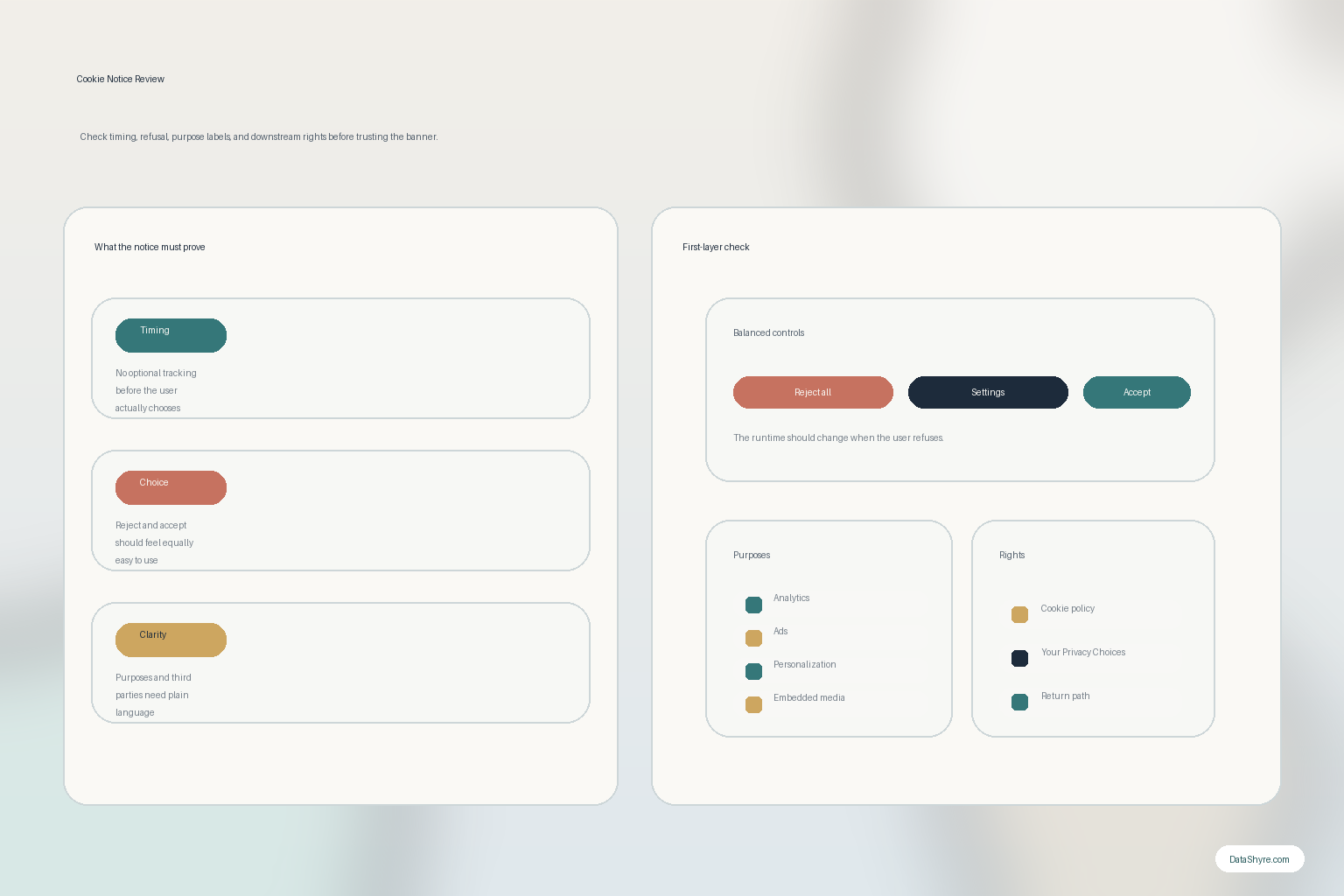
1. Treat the cookie notice as a live control, not a writing exercise
The first cookie notice mistake is assuming the copy is the product.
It is not.
A real cookie notice sits at the intersection of:
- what the site loads before consent;
- which technologies are actually necessary;
- how people refuse or customize tracking;
- what third parties receive data;
- how users return later and change the choice.
This is why a cookie notice review should start with the site behavior, not the text block.
If I were auditing a cookie notice this week, I would first ask:
- which properties and page templates use the notice;
- which tracking technologies are active on those templates;
- whether the site serves UK or EU users who need prior consent rules;
- whether California-facing rights also need separate opt-out handling;
- who owns updates when vendors, tags, or embeds change.
If nobody can answer those questions quickly, the notice is probably not under control.
2. Classify necessary and optional technologies before you polish the banner
This is the fastest useful test for a cookie notice.
Your Europe still explains the basic distinction cleanly: consent is generally required before using cookies, but some cookies used only to transmit a communication or provide an online service explicitly requested by the user do not need consent. That includes familiar functions like load balancing, baskets, and form-completion continuity.
The problem is that many teams use the label necessary too loosely.
A strong cookie notice review should separate:
- authentication and session continuity;
- checkout and basket state;
- fraud or security controls;
- analytics;
- advertising;
- personalization;
- embedded third-party content.
If analytics or ad tech drift into the necessary category because the naming is vague, the rest of the notice becomes misleading too.
3. Check what fires before the user chooses
Many cookie notice failures are timing failures rather than drafting failures.
The ICO’s current guidance is useful here because it no longer treats the problem as cookies alone. It talks about broader “storage and access technologies” and says prior consent is required when no exception applies.
So the live test is not only did the notice appear.
It is:
- what loads on first page view before any click;
- whether optional scripts, pixels, or tags fire anyway;
- whether
Reject allactually produces a different runtime fromAccept all; - whether mobile, logged-in, and campaign pages behave the same way.
If the interface offers a choice but the network already shows optional tracking, the cookie notice is decorative.
4. Make refusal as easy as acceptance
This is one of the easiest cookie notice checks to run and one of the hardest to explain away.
The ICO says consent mechanisms must let users withdraw consent with the same ease they gave it, and its guidance illustrates equally prominent options to accept, reject, or customize non-exempt technologies. CNIL stays equally direct in its cookie FAQ: refusal should be as easy as acceptance, and it strongly recommends putting the refusal path on the same screen rather than burying it behind extra steps.
So when I review a cookie notice, I check:
- whether
Reject allis visible on the first layer when consent is the legal basis; - whether refusing takes no more effort than accepting;
- whether color, size, spacing, or hierarchy pushes people heavily toward accept;
- whether the same balance survives on mobile.
If refusal is dim, delayed, or hidden behind a settings detour while acceptance takes one click, the interface is telling on itself.
5. Explain purposes and third parties in plain language
A cookie notice can fail even when the timing and button layout look better.
The ICO says consent requests must be specific to the purpose and that users need clear information about third parties. The same guidance says users should be able to access specific information about each one. CNIL similarly expects clear information on purposes and the identity of responsible parties, with the first layer clearly pointing people to that detail.
That means a weak cookie notice often sounds like this:
We use cookies to improve your experience.
That is polite, but it often says almost nothing.
A better cookie notice makes it much easier to answer:
- what each optional category actually does;
- whether third parties receive data;
- whether the purpose is analytics, advertising, personalization, or another concrete function;
- where the user can see the fuller list and revisit the choice later.
If your policy names categories but your live stack includes more vendors or different purposes, the notice is not specific enough for the job.
6. Do not confuse cookie consent with California opt-out rights
This is the cookie notice mistake I see most often on U.S.-facing sites.
California does not simply ask businesses to paste an EU-style cookie consent layer across the site and call it done. The CPPA FAQ says businesses must honor qualifying opt-out preference signals such as Global Privacy Control and, in most instances, also provide a clear and conspicuous link such as Do Not Sell or Share My Personal Information, Your Privacy Choices, or Your California Privacy Choices. The Attorney General’s office also describes GPC as a “stop selling or sharing my data switch.”
That means a California-facing cookie notice should not blur together very different user actions:
- consent to optional tracking under UK or EU-style rules;
- opt-out of sale or sharing under California law;
- access to a fuller privacy notice;
- control over sensitive-personal-information limits where applicable.
If the site uses a single banner to imply all of those rights are handled automatically, the wording is probably overstating what the user can actually do.
This is also where DataShyre implementation help can save teams time. The practical job is to map the banner behavior, GPC handling, footer rights links, and downstream tag logic so the user sees the right control in the right jurisdiction.
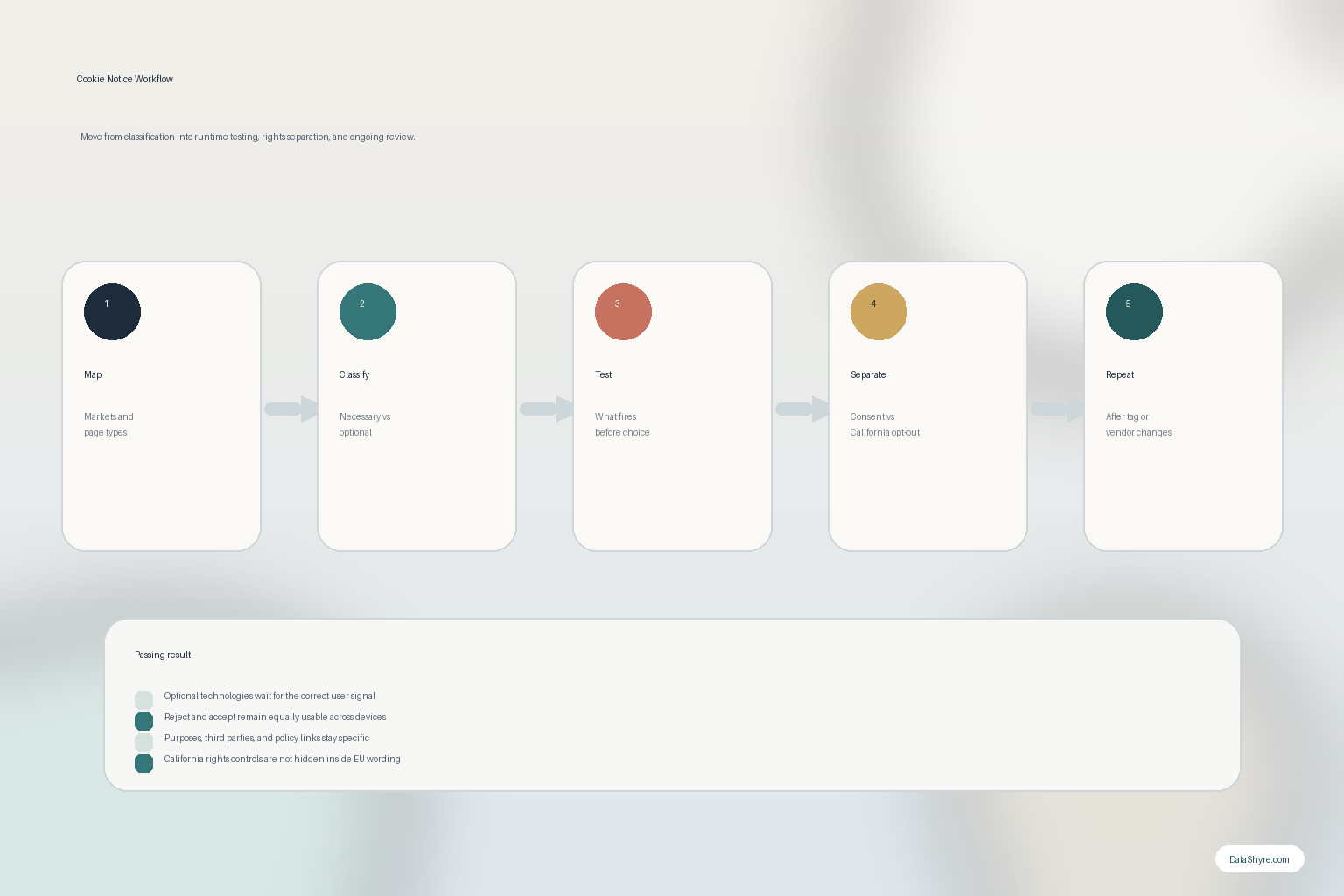
7. Re-test after every vendor, template, or tag change
The long-term cookie notice risk is drift.
Someone adds a new analytics script.
Marketing changes the tag-manager container.
A chatbot or video tool arrives on one template only.
The notice text and policy stay frozen.
That is how a once-reasonable setup becomes inaccurate.
The ICO’s guidance is explicit that fresh consent is needed if the technologies or purposes change from what was originally stated. It also offers six months as a general guideline for when to seek fresh consent after a refusal, while stressing that teams may need to refresh sooner when purposes or activities change.
So I would re-run a cookie notice review whenever:
- a new optional vendor is added;
- a purpose changes;
- a new embedded third-party service goes live;
- the consent-management logic is reconfigured;
- a new market rollout changes the applicable rule set.
If those release events do not trigger a privacy review, the notice will drift out of sync.
A practical 7-step cookie notice review for this week
If I were checking a live cookie notice today, I would use this order:
- list the markets, templates, and journeys that matter;
- classify technologies as necessary or optional;
- test what actually fires before any click;
- compare the effort required to accept versus refuse;
- rewrite vague purpose labels into plain English;
- separate cookie-consent flows from California opt-out controls;
- repeat the runtime test after vendor or tag changes.
That order usually reveals the real problems faster than tweaking the color of the accept button.
FAQ
Is a cookie notice the same as a cookie policy?
No. The cookie notice is the first-layer control or information point. The cookie policy is the fuller explanation that should match the live technologies, purposes, and third parties behind the notice.
Do I always need a Reject all button?
If your design relies on consent for optional technologies, the safer modern standard is to make refusal as easy as acceptance. That is the direction reflected in current ICO and CNIL guidance.
Can one cookie notice solve California too?
Not by itself. California rights may require separate opt-out mechanisms, GPC handling, and footer links such as Your Privacy Choices, depending on what the business does with personal information.
Bottom line
The best cookie notice in 2026 is not the prettiest banner.
It is the one that:
- matches the live runtime;
- separates necessary from optional technologies honestly;
- gives refusal and withdrawal the same practical weight as acceptance;
- explains purposes and third parties clearly;
- stays distinct from California opt-out controls when needed.
If those checks pass, the notice starts to mean something.
The fastest way to judge cookie notice is to test it the way a broken deployment would expose it: before consent, after consent, and again after a stack change.