Cookie Management in 2026: 7 Live Checks Before You Trust the Dashboard
The real value in cookie management shows up when you debug it like a live system. A banner can render perfectly and still leak requests, misfire tags, or drift after the next plugin or theme update.
The useful test for cookie management is whether the live stack behaves correctly before consent, after consent, and after the next deployment. That is how hidden leaks and timing mistakes show up.
That is the practical standard regulators keep reinforcing. The ICO’s final April 2026 guidance now groups cookies with broader storage and access technologies and says the goal is giving people “meaningful control over how their data is used.” GDPR Article 7 still says it must be “as easy to withdraw as to give consent.” CNIL still says rejecting cookies should be “just as easy as accepting them.” And California’s regulations still say a cookie tool is “not by itself an acceptable method” for submitting a sale-or-sharing opt-out request.
If you want the closest companion reads first, start with these guides to cookie preferences, cookie checker, and website privacy checker. This page stays focused on cookie management as an operating discipline, not only a banner purchase or policy-page exercise.
If your team is trying to get cookie management under control without adding a heavyweight privacy stack, DataShyre can help. DataShyre focuses on consent and preference management that are easier to implement, easier to operate, and easier to trust on a live site. Start with DataShyre’s consent and preference management or book a demo.
If your team needs help turning that discipline into a reliable control layer, DataShyre can help with consent management, data mapping, and implementation review so the dashboard, runtime, and disclosures stay aligned after releases.
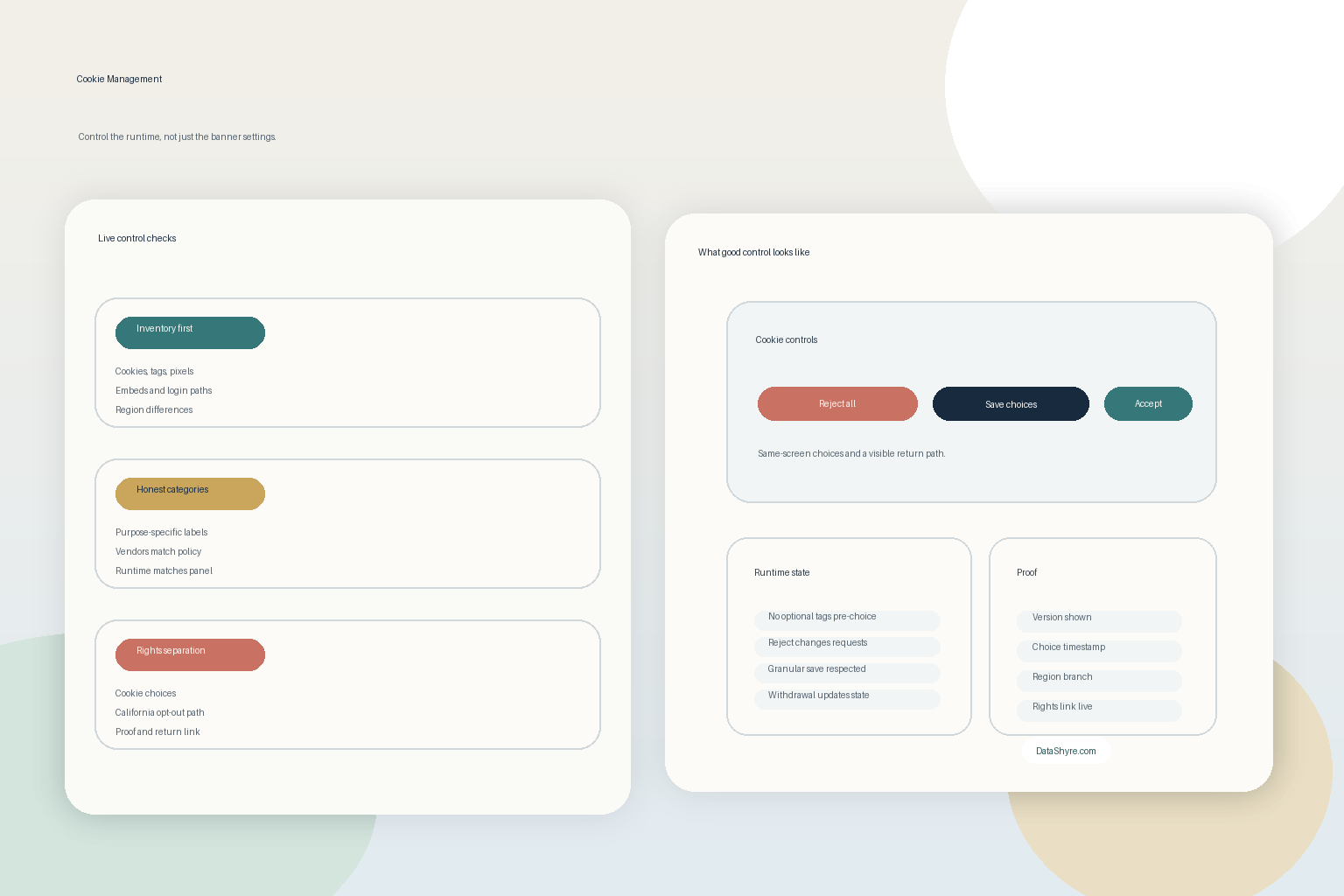
1. Treat cookie management as runtime governance, not banner administration
The first cookie management mistake is assuming the job ends when the site has:
- a visible banner;
- a preferences link;
- a cookie table in the policy page.
That is not enough.
Real cookie management sits across several moving parts:
- the technologies that load before any choice;
- the categories and purposes you show users;
- the conditions under which tools are allowed to run;
- the later return path for changing the choice;
- the evidence that proves what happened.
If one of those layers drifts, the dashboard starts acting like theater instead of control.
2. Inventory cookies and similar technologies before you organize them
This is where many projects go wrong.
They start by editing category names inside a CMP, then hope the labels match reality.
The ICO’s 2026 guidance is a useful reset because it is not limited to classic cookie files. It treats tracking pixels, device fingerprinting, scripts, and similar storage-or-access behavior as part of the same practical review.
So for cookie management, I would first map:
- first-party cookies and session identifiers;
- third-party cookies and cross-site behavior;
- pixels, scripts, and tag-manager paths;
- embedded media, chat, maps, or social components;
- mobile or logged-in flows that behave differently from the homepage.
If the inventory is incomplete, the category map will probably be incomplete too.
3. Keep category labels honest enough to match the real stack
Good cookie management needs category labels people can understand.
But it also needs categories that map cleanly to the technologies actually in play.
This is where vague labels become risky:
analyticsthat quietly bundles session replay and attribution tags;functionalthat hides third-party media or testing tools;marketingthat collapses very different ad-tech and profiling flows into one polite word.
The safer rule is simple: if the policy, settings panel, and runtime tell three different stories about the same vendor or tag path, the user is not really managing cookie management choices. They are guessing at a moving target.
This is why I compare:
- category names in the banner and preferences panel;
- vendor and purpose language in the cookie or privacy page;
- runtime behavior in the browser before and after each choice.
4. Test reject, save, and accept against live browser behavior
This is the most important technical check in cookie management.
The truth is not the admin screen.
The truth is what the browser and network logs show after each path:
- before any choice;
- after
Reject all; - after a granular save;
- after
Accept; - after a later withdrawal or preference change.
That review should not stop on the cleanest page template. It should include:
- landing pages with heavy campaign tags;
- pages with video or map embeds;
- logged-in pages if different scripts appear there;
- mobile views;
- region-specific variations.
If optional technologies still load after rejection, your cookie management setup is not working, no matter how polished the panel looks.
5. Make refusal and later withdrawal as easy as the first approval
This is where the legal principle becomes a UI and product discipline problem.
GDPR Article 7 still says withdrawal must be “as easy to withdraw as to give consent.” CNIL still says rejecting cookies should be “just as easy as accepting them.”
That means serious cookie management should verify:
Reject allis not hidden behind extra layers where consent is required;- granular save is simple enough to use on mobile;
- the return link is easy to find later;
- saved choices do not quietly reset after revisit, region switch, or login;
- withdrawing a choice actually changes runtime behavior, not only the visual state.
This is also where a lot of teams overfocus on first-visit copy.
The harder and more important question is what happens on day two, day ten, or after the next tag update.
6. Separate cookie controls from California sale-or-sharing rights
This is one of the most common cookie management misunderstandings on U.S.-facing sites.
California does not map perfectly to the EU or UK cookie-consent pattern. The California Attorney General still describes Global Privacy Control as a “stop selling or sharing my data switch.” The CCPA guidance also still requires a notice at collection for covered businesses. And the CPPA regulations say a cookie banner or cookie controls are “not by itself an acceptable method” for submitting requests to opt out of sale or sharing.
So a California-aware cookie management review should ask:
- whether GPC is recognized where required;
- whether the site also offers the right opt-out path or frictionless alternative link behavior where applicable;
- whether the cookie panel is being mistaken for the whole California rights program;
- whether the privacy notice, footer links, and runtime behavior all support the same rights story.
If the answer to those questions is fuzzy, the site may sound more compliant than it is.
7. Keep evidence that matches the actual site version users saw
The long-term cookie management risk is drift.
A setup can be clean today and misleading next month because:
- a new vendor was added through GTM;
- a plugin updated its behavior;
- a landing-page template added a different embed;
- region logic changed;
- categories were renamed without updating the policy page;
- the preferences link moved or disappeared on mobile.
This is why I want cookie management evidence to connect:
- the interface version shown;
- the categories and purposes shown at the time;
- the user choice recorded;
- the region logic applied;
- the runtime behavior observed after the choice;
- the return path available for later change.
Without that chain, the dashboard may look mature in screenshots while the live system keeps drifting underneath it.
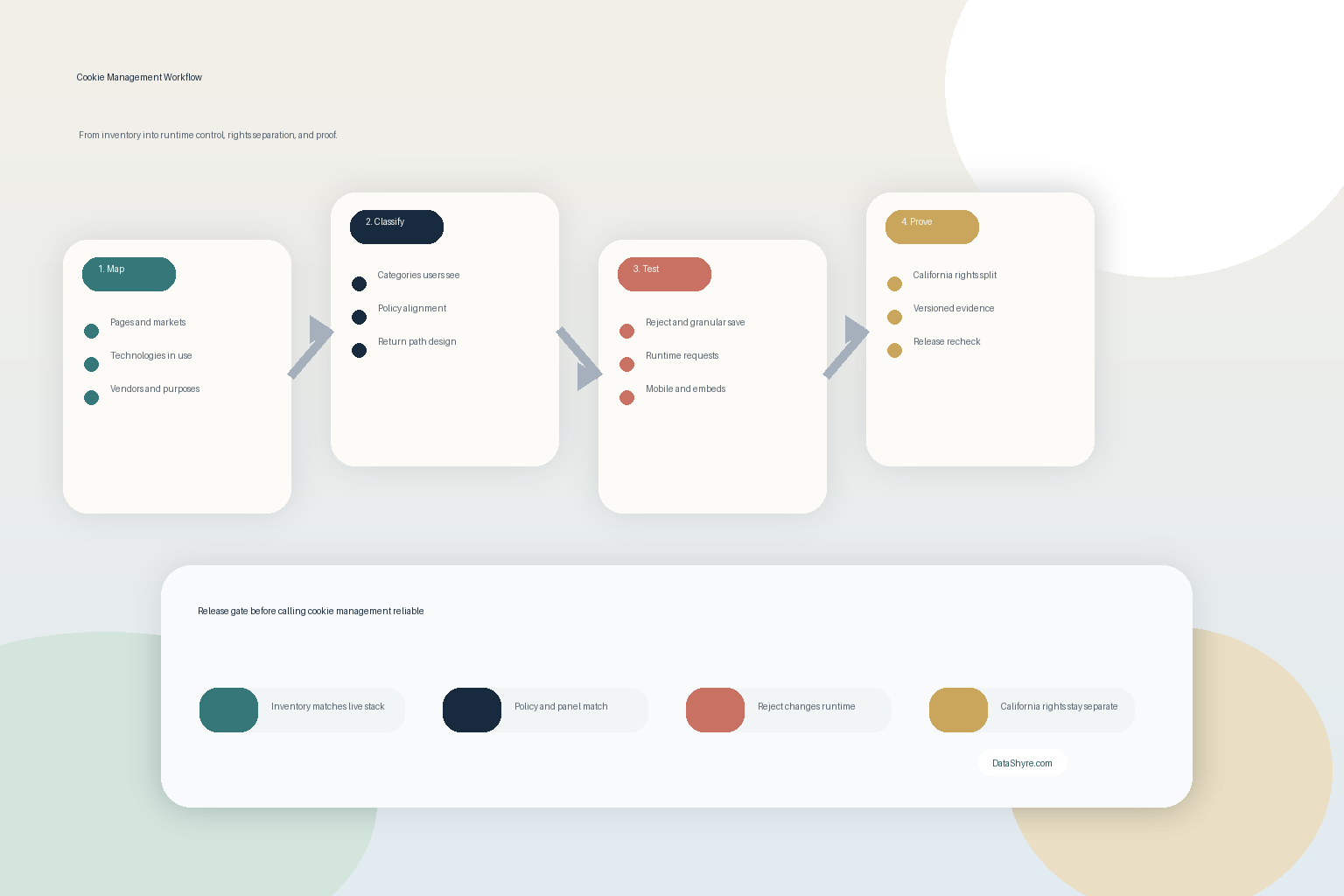
A practical cookie management review for this week
If you were reviewing cookie management today, use this order:
- inventory cookies and similar technologies across important templates;
- map the categories and purposes shown to users;
- compare the panel and policy language against the real stack;
- test reject, granular save, accept, and withdrawal in the browser;
- separate California rights handling from standard cookie controls;
- store evidence tied to the version of the experience users actually saw;
- set a re-test trigger for the next release that changes tags, vendors, embeds, or regional logic.
That order exposes more truth than visual banner review alone.
FAQ
Is cookie management just another name for cookie consent?
No. Cookie management is broader. It includes inventory, categorization, runtime control, withdrawal paths, and evidence, not only the moment when consent is collected.
Can a cookie management platform solve California by itself?
Not automatically. A platform can help, but California rights around sale or sharing, GPC, and notice at collection may require additional paths and clearer rights handling than a standard cookie panel alone.
What is the biggest cookie management failure mode?
Usually it is mismatch: the banner, panel, policy, and runtime all say slightly different things, so the user choice no longer maps to what the site actually does.
Bottom line
Strong cookie management in 2026 is not the presence of a dashboard.
It is whether the user can make a real choice, change it later, and rely on the runtime, rights links, and published disclosures to stay aligned.
The fastest way to judge cookie management is to test it the way a broken deployment would expose it: before consent, after consent, and again after a stack change.
Official sources used
- ICO, Final storage and access technologies guidance published: https://ico.org.uk/about-the-ico/media-centre/news-and-blogs/2026/04/final-storage-and-access-technologies-guidance-published/
- ICO, Guidance on the use of storage and access technologies: https://ico.org.uk/for-organisations/direct-marketing-and-privacy-and-electronic-communications/guidance-on-the-use-of-storage-and-access-technologies/
- EUR-Lex, Regulation (EU) 2016/679 (GDPR), Article 7: https://eur-lex.europa.eu/eli/reg/2016/679/oj/eng
- CNIL, Dark Patterns in Cookie Banners: CNIL issues formal notice to website publishers: https://www.cnil.fr/en/dark-patterns-cookie-banners-cnil-issues-formal-notice-website-publishers
- California Attorney General, California Consumer Privacy Act (CCPA): https://oag.ca.gov/privacy/ccpa
- California Attorney General, Global Privacy Control (GPC): https://oag.ca.gov/privacy/ccpa/gpc
- California Privacy Protection Agency, Final regulations text: https://cppa.ca.gov/regulations/pdf/20230329_final_regs_text.pdf