Cookie Consent WordPress: 8 Live Checks for Plugins, Tags, and GPC in 2026
The real value in cookie consent wordpress shows up when you debug it like a live system. A banner can render perfectly and still leak requests, misfire tags, or drift after the next plugin or theme update.
The useful test for cookie consent wordpress is whether the live stack behaves correctly before consent, after consent, and after the next deployment. That is how hidden leaks and timing mistakes show up.
That is a bigger operational problem than most banner setup guides admit. WordPress still says “Privacy should be the default setting.” Its detailed plugin guidelines still say plugins may not contact external servers without “explicit and authorized consent.” The ICO’s finalized storage-and-access-technologies guidance, published on April 29, 2026, also makes clear that the review now covers cookies, pixels, device fingerprinting, and similar technologies, not just classic cookie names.
If you want broader context first, start with these guides to cookie consent, cookie consent requirements, and wordpress cookie consent. This page is narrower. It is the live review sequence I would use this week for cookie consent wordpress on a production site.
If your team is trying to get cookie consent wordpress under control without adding a heavyweight privacy stack, DataShyre can help. DataShyre focuses on consent and preference management that are easier to implement, easier to operate, and easier to trust on a live site. Start with DataShyre’s consent and preference management or book a demo.
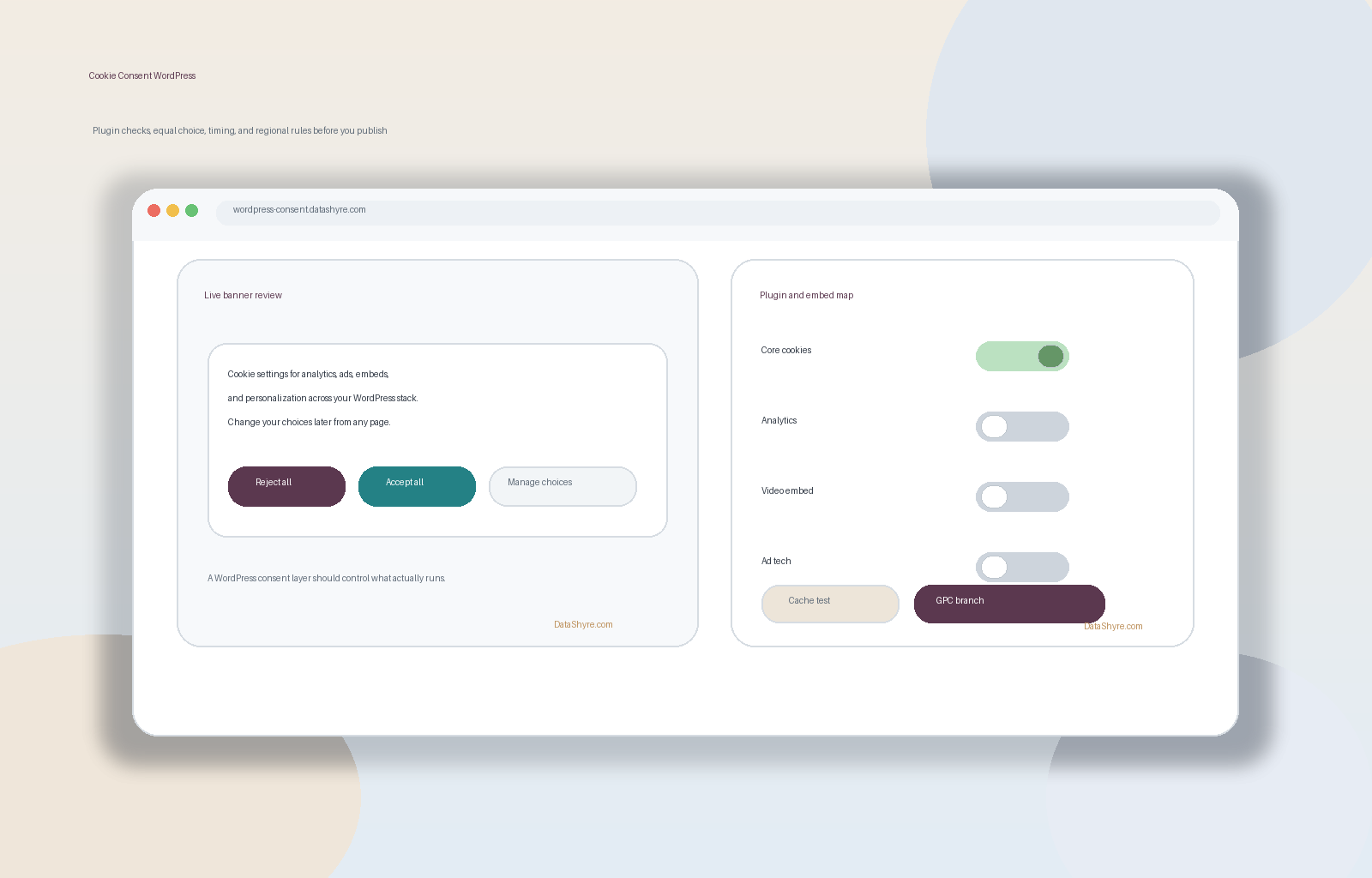
1. Inventory every place WordPress can store, access, or transmit data
The first cookie consent wordpress mistake is treating consent as a plugin-only setting.
On a real site, tracking behavior can begin from:
- the consent plugin itself;
- Google Tag Manager or direct tag snippets;
- analytics, ad-tech, heatmap, chat, and form plugins;
- video, map, social, or review embeds;
- theme code, page-builder blocks, and custom snippets; and
- optimization tooling that changes load order.
That inventory matters because the ICO’s 2026 guidance expressly covers cookies, tracking pixels, device fingerprinting, and similar storage-and-access technologies. If your audit still looks only at a cookie table while third-party requests, remote scripts, or embedded media are waking up before choice, the cookie consent wordpress review is incomplete.
2. Check whether denied defaults land before measurement or ads run
This is where many WordPress sites look compliant and still fail in practice.
Google’s current consent mode guidance still says to call the default consent command on every page before any commands that send measurement data such as config or event. Google’s Tag Assistant guidance also says you should verify the correct default consent state is set before tags fire.
For cookie consent wordpress, that means testing browser behavior, not just settings screens:
- load a page with no saved preference;
- confirm denied defaults exist before optional tags run;
- reject optional tracking and reload;
- accept and confirm the update happens on the page where the user acted; and
- repeat on pages with different templates, widgets, or embeds.
If a plugin or tag fires first and explains itself later, the consent layer is promising more than the runtime actually delivers.
3. Make the path to reject as clear as the path to accept
The front layer still matters because it decides whether users are getting a real choice.
The European Commission still says consent requests should use “clear and plain language” and that it should be as easy to withdraw as to give consent. CNIL’s position remains even more concrete for banner reviews: it should be “as easy to refuse cookies as to accept them.”
So a serious cookie consent wordpress check should ask:
- does
Reject allappear whereAccept allappears; - is the refusal path equally clear on mobile;
- do optional categories start off off where prior-consent rules apply; and
- does
Customizeclarify the choice instead of hiding the refusal path.
If saying no takes more effort than saying yes, the design is still doing compliance damage.
4. Test plugins and embeds that bypass the banner
This is the most WordPress-specific failure point.
WordPress’s detailed plugin guidelines still say plugins may not contact external servers without “explicit and authorized consent.” That is not only a plugin-directory rule. It is also a practical runtime lens for site owners, because many WordPress builds rely on plugins or blocks that call home early for analytics, recommendations, video, chat, form handling, or personalization.
So for cookie consent wordpress, do not only test the homepage. Test:
- a landing page with forms;
- a page with video or map embeds;
- a post template with ad or affiliate widgets;
- a cached page;
- a mobile layout if the theme changes script order there; and
- any page-builder template used for campaigns.
If one plugin or embed wakes up first and asks questions later, the site-wide consent story is not ready.
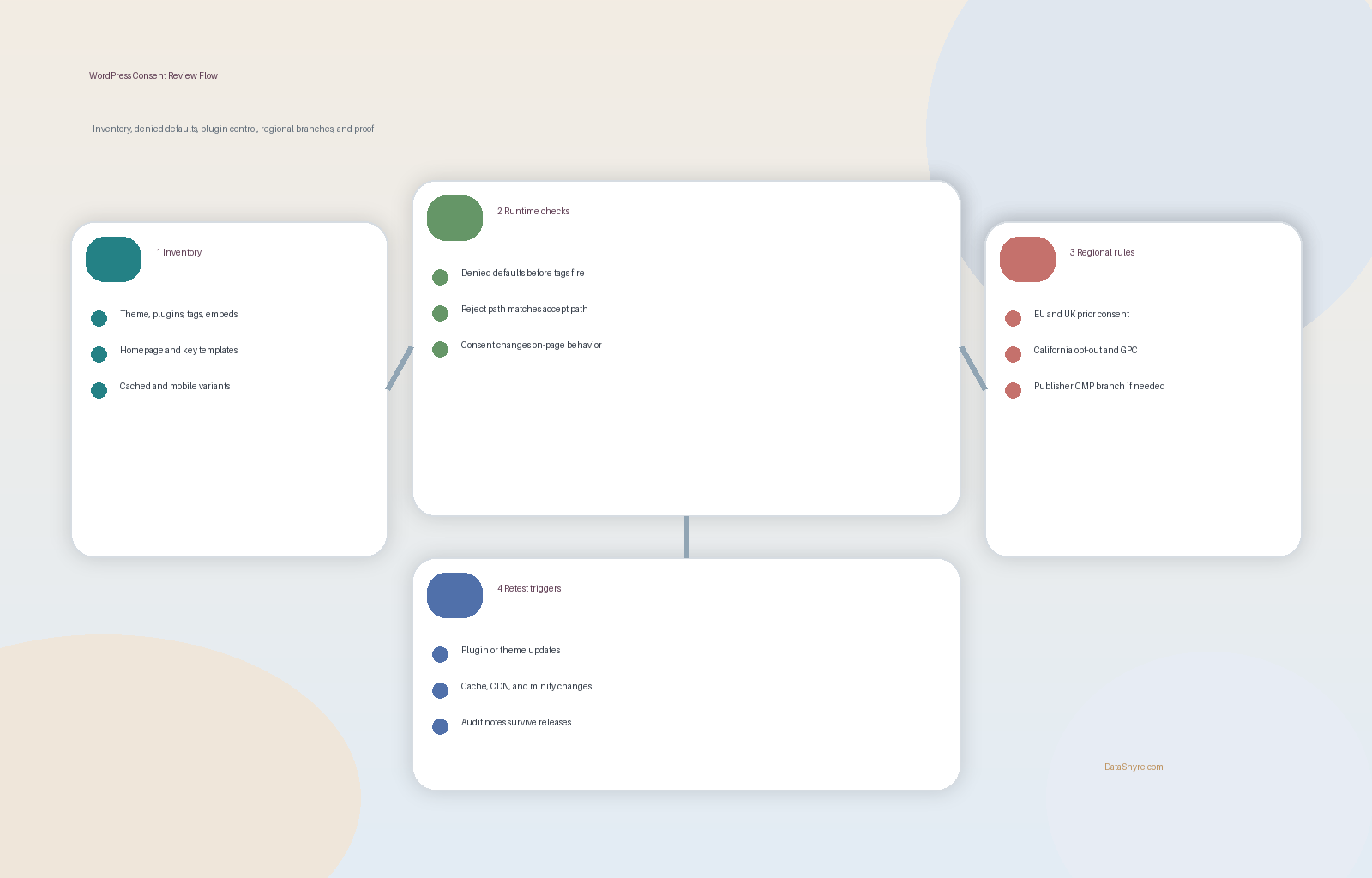
5. Separate the EU and UK prior-consent branch from the California opt-out branch
One cookie consent wordpress flow does not always fit every audience.
For EU and UK traffic, the live question is often whether non-essential storage or access waits for valid prior consent. The EDPB’s consent materials still say scrolling or swiping through a website is not a clear affirmative action for consent. That means implied-consent shortcuts remain weak patterns.
California is different. The California DOJ still describes Global Privacy Control as a “stop selling or sharing my data switch.” The DOJ’s enforcement examples also still show businesses getting in trouble when third-party trackers keep sharing data and GPC opt-out requests are not fully effectuated.
That means cookie consent wordpress should get a separate California branch if remarketing, audience sharing, or advertising signals are involved:
- enable GPC in the browser;
- load the site with no existing preference;
- verify the site’s sale-or-sharing logic changes where it should;
- check that notice text matches actual behavior; and
- confirm the result holds on all affected properties or account-linked experiences.
One polished banner does not automatically satisfy both prior-consent and downstream opt-out obligations.
6. Use the Disney settlement as a warning about partial opt-outs
On February 11, 2026, Attorney General Rob Bonta announced California’s $2.75 million Disney settlement and said Disney had failed to fully effectuate consumers’ requests to opt out of sale or sharing across all devices and streaming services associated with consumers’ accounts.
That matters for cookie consent wordpress because WordPress sites often combine:
- main-site analytics;
- ad-tech or retargeting scripts;
- embedded media platforms;
- customer-account areas; and
- separate campaign or microsite properties.
If an opt-out only changes one layer while another plugin or connected property keeps transmitting advertising-related data, the control may look complete from the banner but still fail operationally.
7. If you serve Google publisher ads, test the certified-CMP branch separately
Not every WordPress site needs this branch, but many content sites do.
Google’s current AdSense help still says publishers using AdSense, Ad Manager, or AdMob must use a Google-certified CMP integrated with the IAB Transparency and Consent Framework when serving personalized ads to users in the EEA and UK, with that requirement in place since January 16, 2024, and in Switzerland since July 31, 2024. Google also says its CMP checks do not decide full privacy-law compliance.
For cookie consent wordpress, that means your plugin short list may change if publisher monetization matters. A banner that looks fine from a pure UX standpoint may still be the wrong operational choice if it cannot support the certified-CMP path your ad stack needs.
8. Treat updates, caching, and theme changes as automatic retest triggers
The final cookie consent wordpress mistake is assuming a once-correct setup stays correct.
I would automatically retest after:
- plugin additions or updates;
- theme or page-builder releases;
- GTM, analytics, or ad-tech changes;
- cache, defer, minification, or CDN changes; and
- new embeds, chat tools, forms, or media widgets.
That discipline matters because WordPress consent failures usually arrive through routine operational drift, not dramatic redesigns.
A short review order for this week
If you were reviewing cookie consent wordpress today, I would use this sequence:
- inventory every storage, access, and third-party call path;
- verify denied defaults before optional tags fire;
- compare the reject path with the accept path;
- test plugin-heavy, embed-heavy, cached, and mobile pages;
- run a California GPC branch where sale or sharing may matter;
- confirm any Google publisher requirement separately; and
- retest after the next release.
That order catches more real failures than another round of banner-copy edits by itself.
FAQ
Is a cookie banner enough for WordPress?
No. A banner is only one layer. If tracking also comes from GTM, theme code, plugins, embeds, or page-builder templates, the site still needs runtime verification.
Does scrolling count as consent on WordPress?
No. The EDPB’s consent guidance still says scrolling or swiping through a website is not a clear affirmative action for consent.
Do all WordPress sites need the Google certified-CMP branch?
No. That branch matters specifically when the site uses publisher products such as AdSense, Ad Manager, or AdMob in the affected regions. It is a separate product requirement, not a universal legal rule for every WordPress site.
Bottom line
Good cookie consent wordpress work in 2026 is not mainly about banner styling.
It is a runtime-control problem. You need clear first-layer choices, denied defaults that land before optional tags run, plugins and embeds that actually respect those choices, regional logic that matches the legal branch involved, and evidence that the setup still works after the site changes.
The fastest way to judge cookie consent wordpress is to test it the way a broken deployment would expose it: before consent, after consent, and again after a stack change.
Sources
- WordPress Plugin Handbook, Privacy: https://developer.wordpress.org/plugins/privacy/
- WordPress Detailed Plugin Guidelines: https://developer.wordpress.org/plugins/wordpress-org/detailed-plugin-guidelines/
- ICO, final storage and access technologies guidance published: https://ico.org.uk/about-the-ico/media-centre/news-and-blogs/2026/04/final-storage-and-access-technologies-guidance-published/
- European Commission, legal grounds for processing data: https://commission.europa.eu/law/law-topic/data-protection/information-business-and-organisations/legal-grounds-processing-data_en
- EDPB, Guidelines 05/2020 on consent under Regulation 2016/679: https://www.edpb.europa.eu/documents/guideline/guidelines-052020-on-consent-under-regulation-2016679_en
- EDPB, Summary: Consent under GDPR, when to act and what to do: https://www.edpb.europa.eu/system/files/2026-04/edpb-summary-consent_en.pdf
- CNIL, dark patterns in cookie banners: https://www.cnil.fr/en/dark-patterns-cookie-banners-cnil-issues-formal-notice-website-publishers
- Google for Developers, set up consent mode on websites: https://developers.google.com/tag-platform/security/guides/consent
- Google for Developers, troubleshoot consent mode with Tag Assistant: https://developers.google.com/tag-platform/security/guides/consent-debugging
- Google AdSense Help, consent management requirements for publishers: https://support.google.com/adsense/answer/13554116
- California DOJ, Global Privacy Control: https://oag.ca.gov/privacy/ccpa/gpc
- California DOJ, CCPA enforcement case examples: https://oag.ca.gov/privacy/ccpa/enforcement
- California DOJ, Disney settlement announcement: https://www.oag.ca.gov/news/press-releases/california-wont-let-it-go-attorney-general-bonta-announces-275-million
—
Published: October 25, 2026. Updated using current official regulator, government, WordPress developer, and Google platform materials available at publication time.