Cookie Checker in 2026: What a Real One Should Catch on a Live Site
The real value in cookie checker shows up when you debug it like a live system. A banner can render perfectly and still leak requests, misfire tags, or drift after the next plugin or theme update.
The useful test for cookie checker is whether the live stack behaves correctly before consent, after consent, and after the next deployment. That is how hidden leaks and timing mistakes show up.
what should a cookie checker prove on a live site before you trust the result?
That is because a weak cookie checker can list cookie names and still miss the bigger problem:
optional tracking, tags, pixels, or storage activity may already be firing before the person actually makes a choice.
The ICO’s current guidance now uses the broader label “storage and access technologies” because modern reviews are not only about old-style cookie files. They also cover tracking pixels, scripts, tags, web storage, fingerprinting, and related access to information on a user’s device.
If you want adjacent background first, start with these guides to cookie law, cookie notice, and website privacy checker. This page stays focused on the cookie checker question and the live behaviors that matter most.
If your team is trying to get cookie checker under control without adding a heavyweight privacy stack, DataShyre can help. DataShyre focuses on consent and preference management that are easier to implement, easier to operate, and easier to trust on a live site. Start with DataShyre’s consent and preference management or book a demo.
If your team wants help testing what really loads before consent, comparing reject versus accept behavior, or aligning your cookie banner, privacy notice, and runtime behavior, DataShyre can help with consent management, implementation review, and cleanup.
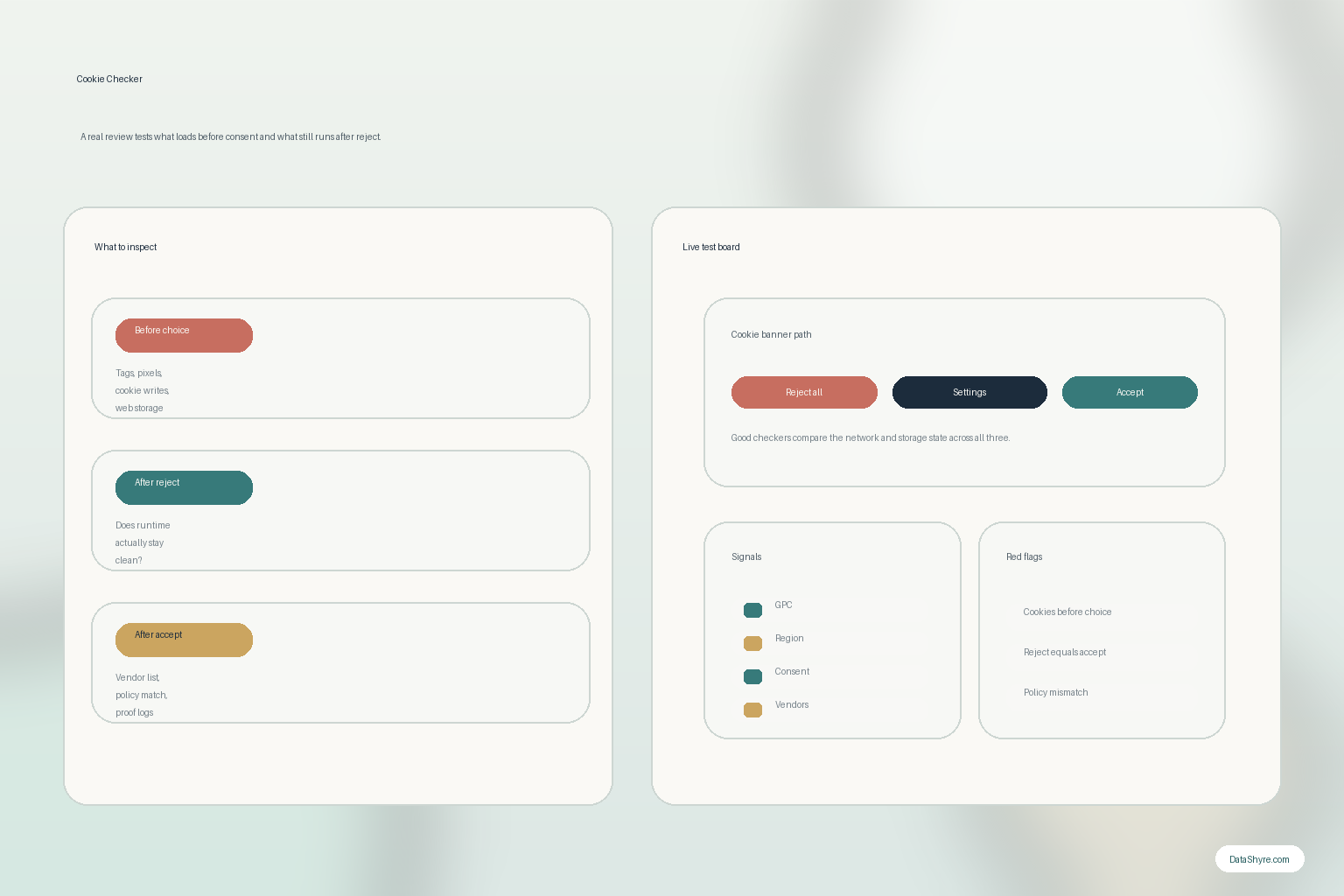
1. A cookie checker should test the page before the user clicks anything
The first job of a cookie checker is not reading banner copy.
It is observing the page before consent.
The ICO’s finalized storage-and-access-technologies guidance, updated on April 29, 2026, explains that the rules reach beyond cookies into a broader set of tools that store or access information on a device. The same ICO materials still describe cookies as widely used to make websites work, work more efficiently, and provide information to the operator.
So a serious cookie checker should look for more than cookie names:
- cookie writes;
- local or session storage activity;
- tags and scripts loading before a choice;
- calls to third-party domains;
- identifiers or preference state created too early.
If the page starts optional analytics or advertising activity before the visitor acts, the review should fail even if the banner looks polished.
2. It should compare reject, accept, and settings paths, not just the happy path
Many weak cookie checker tools test only the path after Accept.
That is the easiest path to pass and the least useful one.
A better cookie checker compares at least three states:
- first page load with no choice;
- explicit reject or necessary-only choice;
- accept-all or category-based opt-in.
This matters because many websites show a symmetric-looking banner while the runtime stays asymmetric. Reject can still leave optional tags in place, or the settings screen can be harder to use than the accept button.
For EU-facing sites, the European Commission still says information about personal-data processing should be presented in a concise, transparent, intelligible way and in “clear and plain language.” That is a copy rule, but it also becomes a runtime rule in practice. If the wording implies a real choice, the technical behavior needs to match it.
3. Necessary and optional technologies should be separated by purpose, not convenience
This is where a cookie checker becomes genuinely useful.
Your Europe still says websites generally need consent before installing cookies, while also reminding people that “Not all cookies require your consent.” It keeps the familiar exceptions for cookies used only to carry out a communication or to provide an online service explicitly requested by the user, such as load balancing or shopping-basket continuity.
That means a strong cookie checker should help a team answer:
- which technologies support the service the person asked for;
- which technologies mainly support analytics, advertising, or profiling;
- whether the claimed purpose matches the live vendor behavior;
- whether the retention window feels proportionate to the purpose.
If everything is labeled necessary, the checker has not really checked much.
4. A cookie checker should review policy accuracy, not only the browser state
A website can pass a narrow browser test and still fail the bigger disclosure test.
The privacy policy, cookie notice, or preferences screen may omit vendors, use vague purposes, or describe controls that do not change real behavior.
This is why I think a practical cookie checker should compare:
- the banner language;
- the categories in the settings panel;
- the vendor list or recipient disclosures;
- the privacy policy and cookie-policy text;
- the actual network and storage behavior on the page.
If those pieces disagree, the checker should raise a flag.
A beautiful dashboard is not evidence by itself.
5. California changes what the checker should verify
The California branch is where many generic cookie scans become incomplete.
The California Department of Justice still describes Global Privacy Control as a “stop selling or sharing my data switch.” The CPPA’s current FAQ also says that, in most instances, businesses must provide a clear and conspicuous footer or header link such as Do Not Sell or Share My Personal Information, Your Privacy Choices, or Your California Privacy Choices.
So for California-facing sites, a cookie checker should not stop at did the banner appear.
It should also check:
- whether sale or sharing logic exists;
- whether an opt-out path is clearly available when required;
- whether GPC is honored for the browser or device where it applies;
- whether cross-context advertising behavior changes after the opt-out path runs.
If the site presents a polished cookie layer but keeps cross-context advertising behavior unchanged after an opt-out signal, the review is incomplete.
6. Recent enforcement still rewards runtime testing over banner theater
This is not just theory.
On October 22, 2026, the CNIL fined FNAC DARTY PARTICIPATIONS ET SERVICES and FNAC DIRECT 7 million euros over a tracker used in a mobile app without prior consent. The CNIL said the tracker collected browsing-history information to show personalized recommendations and to train a recommendation algorithm.
That is a useful reminder for the cookie checker question because regulators still care about real purpose and real timing. They do not only look at what the banner claims.
If a checker cannot help you verify when a tracker fires, what purpose it supports, and whether refusal actually changes behavior, it is more of a report generator than a compliance tool.
7. Re-testing matters more than a one-time pass
The best cookie checker result is temporary by definition.
Why?
Because tags change.
Plugins change.
Vendors change.
New landing pages launch.
Embeds, chat widgets, analytics connectors, or A/B tools appear without much warning.
The ICO’s current consent guidance also says that if you introduce new storage and access technologies for a different purpose from the one originally stated when consent was granted, you must obtain fresh consent for the new technology or purpose.
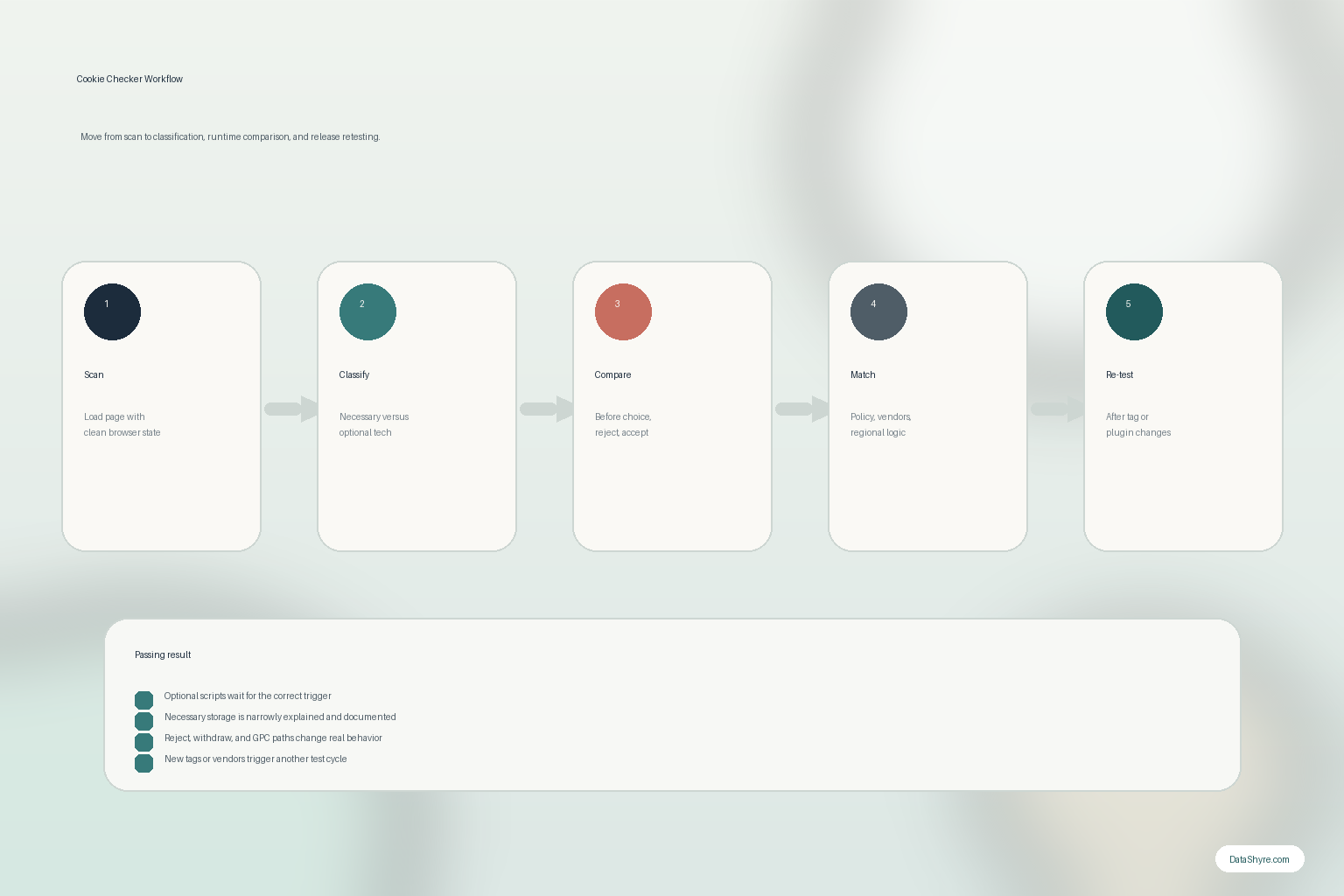
That means the strongest cookie checker workflow is cyclical:
- scan before launch;
- compare reject and accept behavior;
- confirm the policy and settings reflect the real stack;
- re-test after releases or vendor changes;
- keep evidence of what changed and when.
What I would test this week with a cookie checker
If I were auditing a live site today, I would use a cookie checker in this order:
- load the page in a clean browser state and watch what appears before choice;
- record storage activity, network calls, and third-party destinations;
- trigger reject, necessary-only, or equivalent settings paths;
- compare that behavior with accept-all behavior;
- check whether policy text and vendor disclosures describe the live stack accurately;
- run the California branch too if sale, sharing, or GPC could apply;
- repeat the test after new tags, plugins, or campaign tooling go live.
That sequence tells you far more than a cookie-name export on its own.
FAQ
What should a cookie checker detect before consent?
It should detect cookies, storage activity, scripts, tags, pixels, and third-party requests that appear before the user makes a valid choice.
Is a cookie checker only for EU or UK sites?
No. EU and UK sites often focus on prior consent for optional technologies, while California reviews may focus more on sale or sharing, Global Privacy Control, and opt-out behavior.
Does a clean cookie list prove compliance?
The fastest way to judge cookie checker is to test it the way a broken deployment would expose it: before consent, after consent, and again after a stack change.
Official sources used
- ICO guidance on storage and access technologies
- ICO section on what storage and access technologies include
- ICO section on managing consent in practice
- Your Europe guidance on data protection and online privacy
- European Commission information for individuals on data protection
- California DOJ page on Global Privacy Control
- California Privacy Protection Agency FAQ
- CNIL notice on the FNAC DARTY tracker enforcement action