CCPA Regulations in 2026: 8 Live Rules Businesses Should Audit Now
The real value in ccpa regulations shows up when you debug it like a live system. A banner can render perfectly and still leak requests, misfire tags, or drift after the next plugin or theme update.
The useful test for ccpa regulations is whether the live stack behaves correctly before consent, after consent, and after the next deployment. That is how hidden leaks and timing mistakes show up.
The current operating model is broader than that. The California Privacy Protection Agency says the current CCPA regulations are effective January 1, 2026, and the same rulemaking package added live branches for risk assessments, cybersecurity audits, and automated decisionmaking technology. Enforcement also kept moving through 2026. California announced a $12.75 million GM settlement on May 8, 2026, then a $1.8 million Lyft settlement on October 29, 2026, both tied to operational failures rather than draft-quality policy language alone.
If you want nearby context first, start with these guides to CCPA compliance, California web privacy law, and CCPA audit checklist. This article stays narrower. It is the ccpa regulations review I would use this week before telling leadership the California program is actually current.
If your team is trying to get ccpa regulations under control without adding a heavyweight privacy stack, DataShyre can help. DataShyre focuses on consent and preference management that are easier to implement, easier to operate, and easier to trust on a live site. Start with DataShyre’s consent and preference management or book a demo.
1. Reconfirm whether the business is in scope under the current threshold
Every serious ccpa regulations review starts with scope, because a stale threshold assumption can make the rest of the audit wrong.
The CPPA FAQ says the law applies to covered for-profit businesses doing business in California that meet at least one of three tests:
- gross annual revenue of $26.625 million or more for the preceding calendar year;
- buying, selling, or sharing the personal information of 100,000 or more California residents or households; or
- deriving 50% or more of annual revenue from selling or sharing California residents’ personal information.
That first number matters because the CPPA’s monetary-threshold page updated the revenue figure effective January 1, 2025.
So the first ccpa regulations check is not just Are we subject to California? It is:
- which legal entity is in scope;
- which threshold creates that scope;
- which sites, apps, brands, and account systems are included; and
- whether the answer changed since the last audit.
2. Check required notices against the live collection flow
The practical core of ccpa regulations is still disclosure accuracy.
The DOJ’s CCPA page says consumers must be notified, before or at the point of collection, of the types of personal information being collected and what may be done with it. The CPPA FAQ also says businesses subject to the CCPA must post a privacy policy and provide methods for consumers to exercise their rights.
That means your ccpa regulations review should compare the live experience against the notice layer:
- what categories are collected;
- whether sensitive personal information is involved;
- which purposes are actually operating in production;
- whether sale or sharing is really happening through ad-tech, SDKs, or partners; and
- where the rights methods are exposed on web and in app.
If the notice says one thing and the runtime does another, the mismatch is the problem.
3. Make opt-out and GPC work where the data actually moves
This is where a lot of ccpa regulations programs still break.
The DOJ says consumers can opt out of sale or sharing, including through a user-enabled global privacy control. The same California materials describe GPC as a “stop selling or sharing my data switch.”
That should turn the audit into a runtime test:
- does the business actually sell or share personal information;
- is the opt-out path easy to find;
- does GPC get honored as a valid request where required;
- does the opt-out reach downstream ad-tech, analytics, and partner flows; and
- does the effect persist across account-linked surfaces.
The hard part is not adding the link. The hard part is making sure the signal travels as far as the data does.
4. Remove dark patterns and rebalance the choice architecture
The modern ccpa regulations conversation is also an interface conversation.
CPPA Enforcement Advisory No. 2024-02 tells businesses to offer “symmetrical choices” and use clear, understandable language when presenting privacy choices. That matters because a control can exist on paper while still being hard to use in practice.
So test whether the live interface:
- makes refusal harder than acceptance;
- buries the opt-out path behind extra taps or pages;
- uses vague labels like
manage preferenceswithout making the effect obvious; - breaks on mobile screens or logged-in app states; or
- asks for information that is not needed to process the request.
If the flow is lopsided or confusing, the ccpa regulations issue is already in production.
5. Treat app-based rights flows as first-class compliance work
One of the clearest 2026 lessons for ccpa regulations is that app experiences need their own review, not a link back to the website and a shrug.
On October 29, 2026, California announced a settlement with Lyft over the lack of an in-app opt-out. The Attorney General said businesses cannot “throw up unnecessary roadblocks” when consumers try to exercise these rights. According to the release, Lyft users had to detour through the privacy policy, move from app to webpage, and re-enter information just to opt out.
That is a useful test for any mobile or connected-product environment:
- can users exercise the right inside the app or product experience;
- are logged-in users forced to repeat information the business already has;
- do web and app settings behave consistently;
- are mobile SDKs and in-app ads included in the same logic; and
- can support explain the flow without improvising.
This is a strong place for DataShyre to help because app privacy UX often fails at the handoff between product, analytics, and legal teams rather than inside any one document.
6. Follow requests across services, devices, and account-linked products
This remains one of the most important operational parts of ccpa regulations.
In the Disney settlement announced on February 11, 2026, Attorney General Bonta said a consumer’s opt-out right applies “wherever and however a business sells data.” The state said Disney’s opt-out methods left gaps across devices and streaming services connected to the same account.
So the better ccpa regulations review is not one browser test on one page. It is whether the request reaches:
- websites and mobile apps;
- logged-in and logged-out states;
- connected devices and streaming surfaces where relevant;
- third-party code embedded across products; and
- service providers and contractors supporting the response.
If the first screen changes but the downstream sale or sharing continues elsewhere, the request is not fully effectuated.
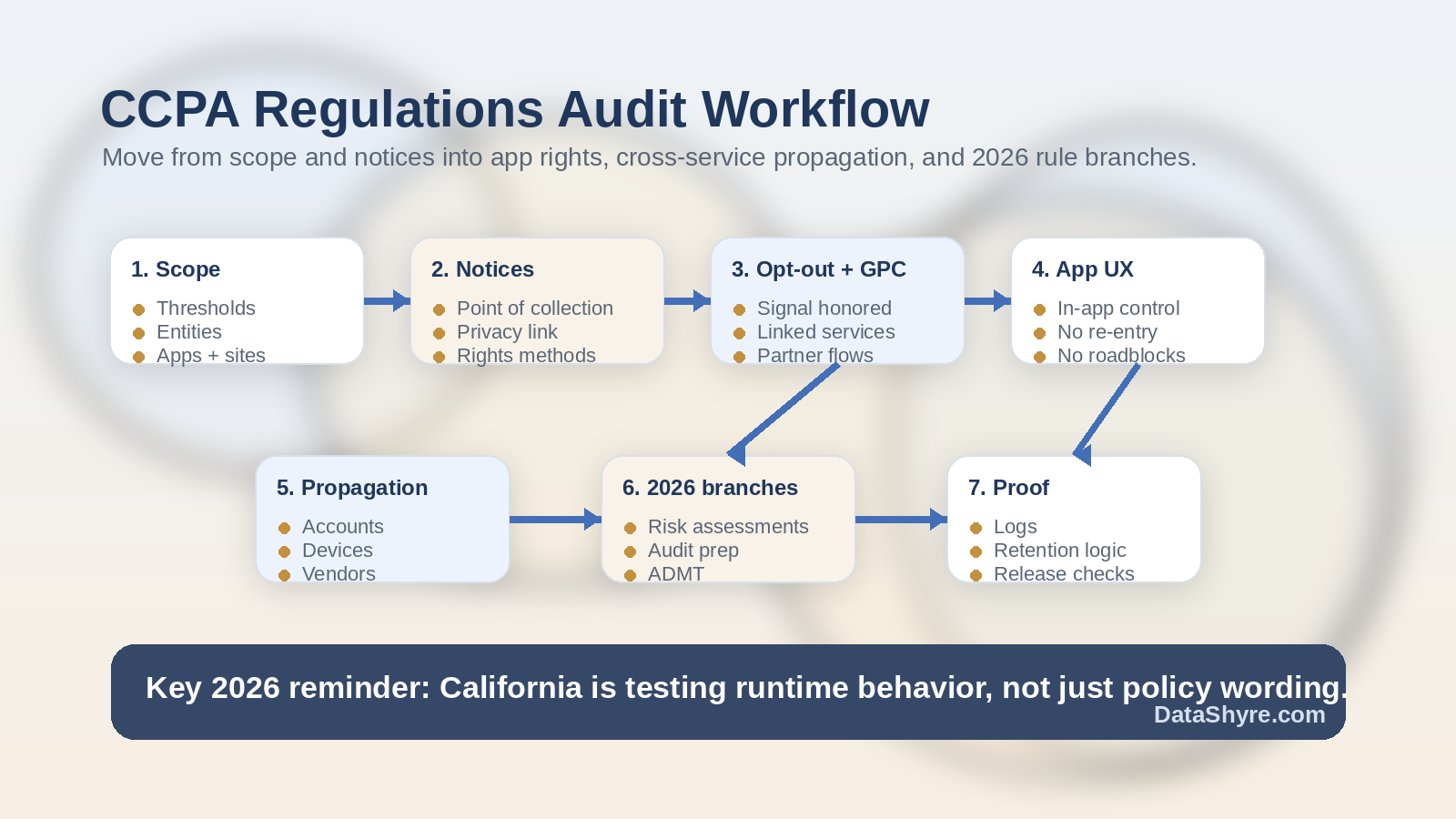
7. Add the 2026 risk assessment, cybersecurity audit, and ADMT branches
Older checklists often miss the newer branches of ccpa regulations.
The CPPA says the updated package covering CCPA updates, cybersecurity audits, risk assessments, ADMT, and insurance clarifications took effect on January 1, 2026. The same CPPA announcement says:
- businesses subject to risk-assessment requirements had to begin compliance on January 1, 2026 and must submit an attestation plus summary information by April 1, 2028;
- businesses required to complete cybersecurity audits must submit certifications by April 1, 2028, April 1, 2029, or April 1, 2030, depending on revenue; and
- businesses using ADMT for significant decisions must comply with ADMT requirements beginning January 1, 2027.
That changes the practical question. It is no longer only Do we have notices and opt-outs?
It is also:
- do our processing activities trigger risk-assessment duties;
- do we need cybersecurity-audit preparation now, before the filing year;
- do any significant-decision workflows depend on ADMT; and
- do we have enough documentation to defend those answers later.
8. Use enforcement trends to test purpose limitation and proof
The newest ccpa regulations work is about discipline after collection, not only at the moment of notice.
California’s May 8, 2026 GM settlement was described by the state as the largest CCPA penalty in California history to date and the first data-minimization case. The enforcement page says the sales of precise driving and location data violated purpose limitation and data minimization provisions.
That should change what teams save as evidence:
- what notice was shown at collection;
- what data was collected and why;
- what downstream sharing or sale was enabled;
- what opt-out or limitation signal was received;
- what systems and vendors were updated; and
- what proof survives after the next release.
If the business cannot reconstruct the logic after the fact, the ccpa regulations program is more fragile than it looks.
A practical review order for this week
If I were auditing ccpa regulations today, I would use this order:
- confirm scope using the current threshold and data-volume tests;
- compare notice at collection and the privacy policy against the live stack;
- test opt-out of sale or sharing, including GPC;
- review mobile-app, connected-device, and logged-in rights flows;
- follow requests across account-linked services and vendors;
- map any risk-assessment, cybersecurity-audit, and ADMT triggers; and
- save proof that still makes sense after the next deployment.
That order usually surfaces more truth than a policy rewrite alone.
FAQ
Are CCPA regulations only about websites?
No. Current ccpa regulations also matter in mobile apps, connected products, and account-linked service ecosystems if those surfaces collect, sell, or share personal information.
Does GPC still matter in 2026?
Yes. California still recognizes a valid user-enabled privacy signal as a way to opt out of sale or sharing, so teams should keep testing it in production.
What is the biggest 2026 CCPA regulations risk?
Operational drift. Notices, app behavior, SDKs, partner flows, and retention logic change faster than most teams update their compliance map.
Bottom line
The fastest way to understand ccpa regulations in late 2026 is to stop treating them like a static disclosure project and start treating them like a live control system.
If scope is current, notices match the runtime, GPC and opt-outs work in app as well as on web, requests propagate across linked services, and newer risk-assessment and ADMT branches are being tracked, the California program is usually in much better shape.
The fastest way to judge ccpa regulations is to test it the way a broken deployment would expose it: before consent, after consent, and again after a stack change.
Sources
- California Privacy Protection Agency, Laws & Regulations: https://cppa.ca.gov/regulations/
- California Privacy Protection Agency, Frequently Asked Questions: https://www.cppa.ca.gov/faq.html
- California Privacy Protection Agency, Updated Monetary Thresholds in CCPA: https://cppa.ca.gov/regulations/cpi_adjustment.html
- California Privacy Protection Agency, CCPA Updates, Cybersecurity Audits, Risk Assessments, Automated Decisionmaking Technology (ADMT), and Insurance Regulations: https://cppa.ca.gov/regulations/ccpa_updates.html
- California Privacy Protection Agency, Enforcement Advisory No. 2024-02: https://cppa.ca.gov/pdf/enfadvisory202402.pdf
- California Department of Justice, California Consumer Privacy Act (CCPA): https://oag.ca.gov/privacy/ccpa
- California Department of Justice, Privacy Enforcement Actions: https://oag.ca.gov/privacy/privacy-enforcement-actions
- California Department of Justice, Disney settlement announcement: https://oag.ca.gov/news/press-releases/california-wont-let-it-go-attorney-general-bonta-announces-275-million
- California Department of Justice, General Motors settlement announcement: https://oag.ca.gov/news/press-releases/when-it-comes-data-privacy-consumers-must-be-driver%E2%80%99s-seat-attorney-general
- California Department of Justice, Lyft settlement announcement: https://oag.ca.gov/news/press-releases/privacy-rights-can%E2%80%99t-be-left-rearview-attorney-general-bonta-secures-18-million