CA Data Privacy Law in 2026: 7 Live Checks for Collection, Choice, and Proof
The real value in ca data privacy law shows up when you debug it like a live system. A banner can render perfectly and still leak requests, misfire tags, or drift after the next plugin or theme update.
The useful test for ca data privacy law is whether the live stack behaves correctly before consent, after consent, and after the next deployment. That is how hidden leaks and timing mistakes show up.
That matters because the official California sources are still very specific. The CPPA FAQ says California residents have “six major privacy rights.” The current CCPA regulations, effective January 1, 2026, say the privacy policy should provide a “comprehensive description” of the business’s online and offline information practices. The same regulations say Notice at Collection must be available “at or before the point of collection.” California’s DOJ page, updated August 28, 2026, still frames the law around know, delete, opt-out, correct, limit, and non-discrimination rights. And recent enforcement is still concrete: on October 29, 2026, Attorney General Rob Bonta announced a $1.8 million settlement with Lyft over an app opt-out path he called an “illegal and unnecessary barrier.”
If you want the closest companion reads first, start with these guides to CA privacy law, California web privacy law, and California data privacy protection act. This page stays broader than one web page or one request form. It is the ca data privacy law review I would use this week before telling a team their California privacy layer is under control.
If your team is trying to get ca data privacy law under control without adding a heavyweight privacy stack, DataShyre can help. DataShyre focuses on consent and preference management that are easier to implement, easier to operate, and easier to trust on a live site. Start with DataShyre’s consent and preference management or book a demo.
If your team needs help connecting notices, choice signals, request handling, and vendor behavior into one working system, DataShyre can help with consent management, DSR automation, and risk management.
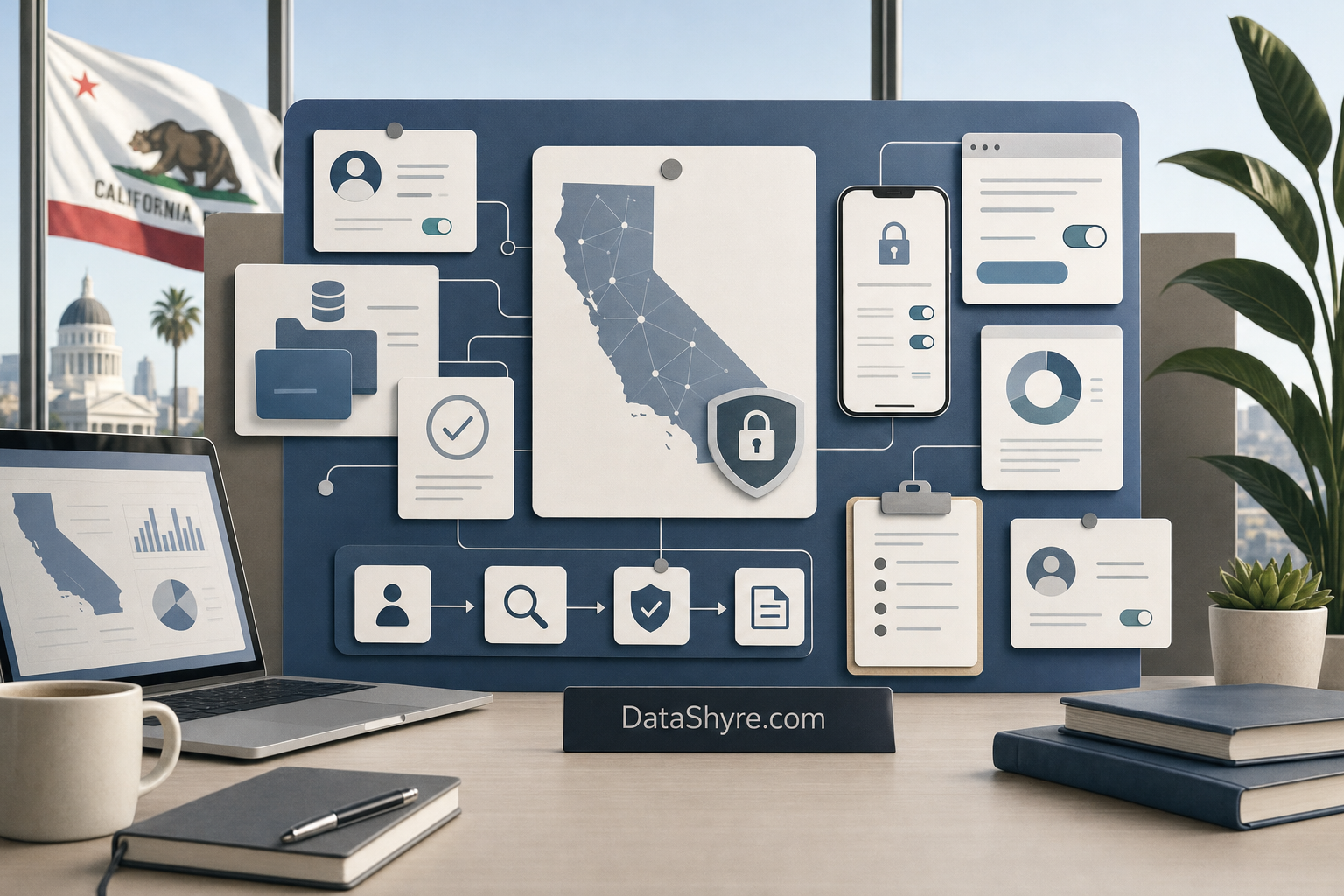
1. Treat CA data privacy law as a live system, not a policy file
The first ca data privacy law mistake is assuming the job lives in the privacy policy alone.
It does not.
In real deployments, the California layer cuts across:
- signup, checkout, contact, and demo forms;
- cookie, pixel, ad-tech, and partner-sharing flows;
- account settings and logged-in experiences;
- mobile app screens and in-app rights routes;
- support tools, CRM workflows, and downstream vendors; and
- the evidence trail that proves the business actually honored a user’s choice.
If those pieces drift apart, the footer page will not save the program.
2. Put Notice at Collection where people actually hand over data
This is one of the clearest places where ca data privacy law becomes operational.
The current regulations say the Notice at Collection is there to give consumers timely notice “at or before the point of collection” about what categories of personal information will be collected, why, and whether that information is sold or shared. They also say the notice should be readily available where consumers will encounter it, including near a webform field or submit button. And if the business does not provide the notice at or before collection, the regulations say it shall not collect that personal information.
That means a serious ca data privacy law review should check:
- whether each form or intake path exposes the notice before submission;
- whether the notice actually matches the categories and purposes tied to that collection point;
- whether the same logic works on mobile web and in-app collection paths;
- whether hidden enrichment, analytics, or sharing steps are still covered; and
- whether short-form notices and the full privacy policy tell the same story.
If the explanation appears only after the user already clicked submit, the notice was too late.
3. Make the privacy policy useful enough to exercise rights
A weak ca data privacy law implementation often has a privacy policy, but it does not really help anyone do anything.
The current regulations say the purpose of the privacy policy is to provide a “comprehensive description” of the business’s online and offline information practices and the information consumers need to exercise their rights. The regulations also require the policy to be posted through a conspicuous link and, for a mobile application, to include a link in the app’s settings menu. California’s DOJ guidance still points consumers to the privacy policy for instructions on how to exercise rights, and the DOJ’s privacy-policy page still says the policy should be updated at least once a year.
So for ca data privacy law work, the privacy policy should help a normal person answer:
- what information do you collect about me;
- why do you collect it;
- who receives it;
- how long do you keep it;
- what rights do I have here;
- how do I use those rights; and
- when was this last reviewed.
If the page sounds formal but leaves those questions muddy, it is not doing enough.
4. Test opt-out routes and GPC where the data really moves
Many ca data privacy law failures are not wording failures. They are choice failures.
The 2026 regulations still contemplate visible rights routes such as Do Not Sell or Share My Personal Information and the alternative opt-out link titled “Your Privacy Choices” or “Your California Privacy Choices.” The California DOJ’s current CCPA page still says consumers have the right to opt out of sale or sharing, including via the Global Privacy Control. And the regulations still require opt-out methods to be easy to execute, require minimal steps, and avoid unnecessary friction.
So the real ca data privacy law test is not did we add the label.
It is:
- whether sale or sharing is actually happening anywhere in the stack;
- whether the rights route appears where California users can realistically find it;
- whether GPC is detected and applied where required;
- whether downstream advertising or partner behavior changes after the opt-out; and
- whether the privacy policy explains the available paths clearly.
That is where legal copy turns into runtime truth.
5. Remove friction from request handling before enforcement removes it for you
California’s current rules say request methods must use language that is easy to understand and must not add unnecessary burden or friction. The regulations also say a business must not require a consumer submitting an opt-out request to create an account or provide extra information beyond what is necessary to direct the business not to sell or share the consumer’s data.
That line matters because recent enforcement keeps hitting the same operational failure.
In the Lyft settlement announced on October 29, 2026, the Attorney General said consumers had to detour through a privacy policy, re-enter personal information, and jump from the app to a webpage just to exercise an opt-out right. He called that design an “illegal and unnecessary barrier.”
A practical ca data privacy law review should ask:
- whether request methods are easy to find on web and mobile;
- whether the business asks only for the information it actually needs;
- whether requests route into an owned workflow rather than a general inbox;
- whether confirmation, verification, and completion are tracked; and
- whether a user can finish the process without a scavenger hunt.
If the rights path feels like customer support escape room design, it is already risky.
6. Branch into app, sensitive-data, and data-broker rules where needed
Another ca data privacy law mistake is assuming the public website is the whole story.
It rarely is.
The current regulations still say a mobile application must include a privacy-policy link in the settings menu. California consumers also still have rights to correct inaccurate personal information and to limit the use and disclosure of sensitive personal information when that right applies. And the CPPA FAQ says the agency was tasked with establishing, by January 1, 2026, a deletion mechanism that lets consumers send a single delete request through the agency to all registered data brokers.
So a serious ca data privacy law review should branch when:
- the product has a mobile app;
- precise geolocation, financial, health-related, or other sensitive information is involved;
- the account experience exposes different settings than the public website; or
- the business may qualify as a data broker.
This is where one generic website review usually misses the most expensive gaps.
7. Keep proof, because California enforcement is still active
The last ca data privacy law check is evidence.
The official California enforcement record should end any nobody will look at this optimism. The DOJ’s Lyft announcement says the settlement was the state’s ninth enforcement action under the CCPA. The DOJ’s privacy enforcement page also keeps surfacing actions where opt-outs, app experiences, or data-sharing controls did not work the way users were led to expect.
So when you review ca data privacy law in practice, keep proof of:
- the notice that was live at collection;
- the privacy-policy version users actually saw;
- the opt-out or GPC behavior applied in the live flow;
- the request intake, verification, and completion trail; and
- the downstream vendor or system changes that followed.
If you cannot reconstruct what happened later, the privacy layer is weaker than it looks.
A practical CA data privacy law review for this week
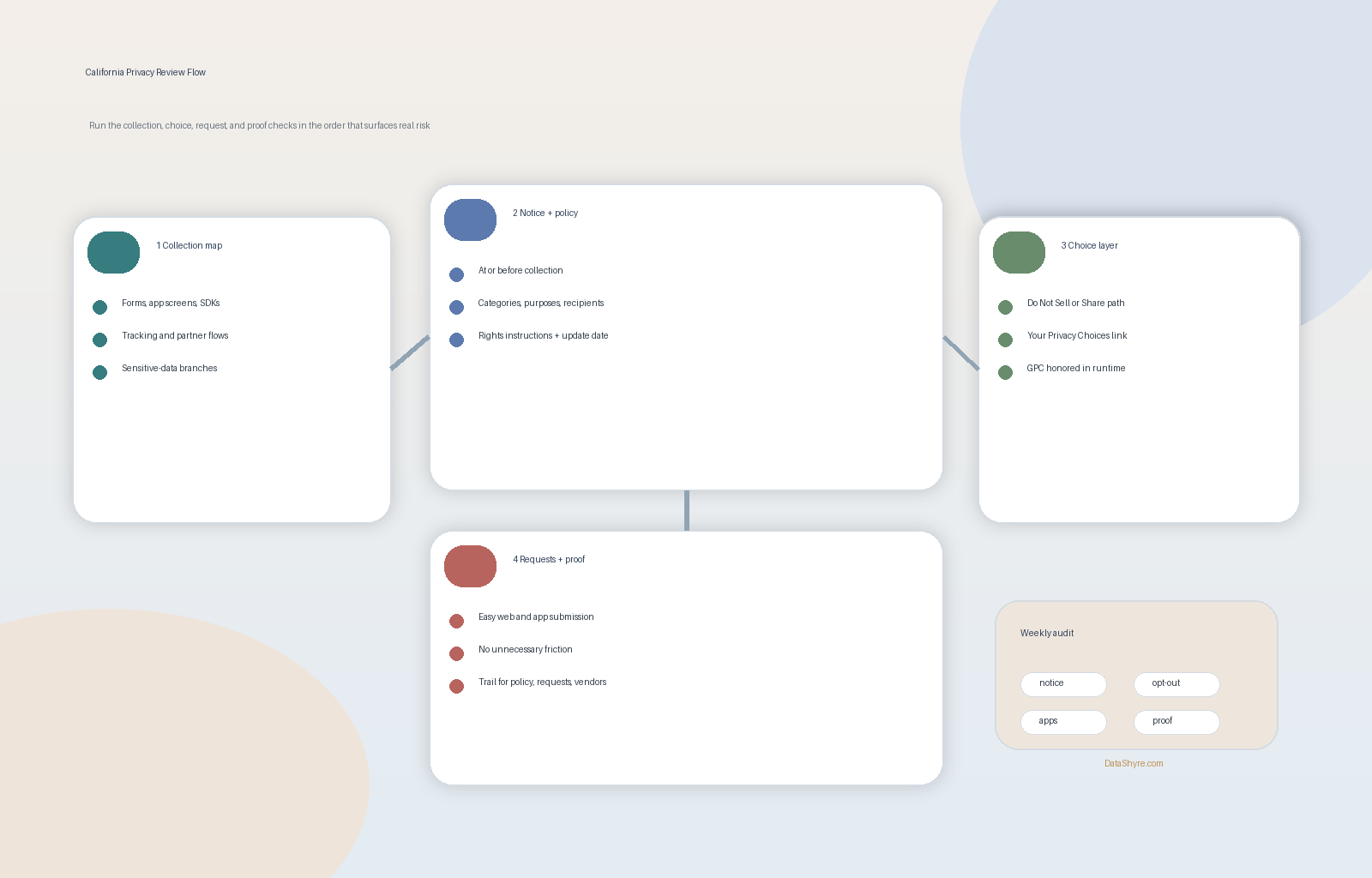
If you were reviewing ca data privacy law this week, use this order:
- map the real collection points across web, app, and vendor flows;
- verify Notice at Collection appears at or before each collection point;
- review the privacy policy for categories, purposes, recipients, retention, rights, and update logic;
- test
Do Not Sell or Share,Your Privacy Choices, and GPC behavior against live flows; - run real opt-out, know, delete, correct, and limit request paths from the user’s perspective;
- branch into app, sensitive-data, and data-broker reviews where relevant; and
- collect proof that will still make sense after the next release.
That order usually exposes more truth than another legal copy pass.
FAQ
Is CA data privacy law basically just the CCPA?
For most business teams, the day-to-day work centers on the CCPA as amended by the CPRA, the 2026 regulations, related DOJ guidance, and the surrounding California notice and rights rules.
Is a privacy policy enough on its own?
No. A privacy policy matters, but ca data privacy law also lives in Notice at Collection, opt-out behavior, GPC handling, request operations, app settings, and evidence.
When does the data broker branch matter?
The fastest way to judge ca data privacy law is to test it the way a broken deployment would expose it: before consent, after consent, and again after a stack change.
Official sources used
- California Privacy Protection Agency FAQ
- California Consumer Privacy Act Regulations, effective January 1, 2026
- California Department of Justice CCPA page, updated August 28, 2026
- California Department of Justice, How to Read a Privacy Policy
- California Department of Justice privacy enforcement actions
- California Attorney General press release on the October 29, 2026 Lyft settlement