Online Consent Management Tool in 2026: 8 Live Checks Before You Trust One
The real value in online consent management tool shows up when you debug it like a live system. A banner can render perfectly and still leak requests, misfire tags, or drift after the next plugin or theme update.
The linked DataShyre references add background, but the useful work here is in troubleshooting, release checks, and runtime verification on the live stack.
If you want nearby context first, start with these guides to consent software, cookie consent requirements, and consent management platform best practices. This page is narrower. It is the eight-check review I would use this week before trusting any online consent management tool on a live site.
Why the standard for an online consent management tool is broader now
The legal baseline is still practical.
The European Commission still says valid consent must be tied to a specific purpose, given through an affirmative act, written in “clear and plain language,” and easy to reverse. It also says the organization must be able to demonstrate that consent was obtained and that it should be “as easy to withdraw as to give consent.”
The UK’s ICO raised the operational bar again on April 29, 2026 when it finalized its storage-and-access-technologies guidance. That guidance is important because it is not limited to classic cookies. It covers cookies, tracking pixels, fingerprinting, web storage, and “scripts and tags” as well. California’s current CPPA FAQ also keeps the web branch practical: where sale or sharing rights apply, businesses must honor opt-out preference signals such as Global Privacy Control and, in most cases, provide a clear website link such as “Do Not Sell or Share My Personal Information” or “Your Privacy Choices.”
That combination changes the buying and implementation test. A capable online consent management tool is not just a banner designer. It is a control layer for notice, choice, enforcement, and proof.
1. Make sure the tool models more than cookies
This is the fastest way to separate a serious online consent management tool from a superficial one.
The ICO’s final guidance explicitly says PECR applies to technologies including cookies, tracking pixels, web storage, fingerprinting, and scripts or tags. So if a vendor demo still behaves as if privacy control means only renaming cookie categories, the tool is already too small for a modern stack.
At minimum, the tool should help you identify and govern:
- cookies and local storage;
- tracking pixels and affiliate or ad conversion tags;
- analytics and experimentation scripts;
- device fingerprinting or similar identifiers;
- embedded video, maps, chat, and social widgets; and
- the systems that pass those signals downstream.
If your inventory is wider than the tool’s control model, the gaps will eventually show up in production.
2. Check whether refusal is as usable as acceptance
The first live test for any online consent management tool is still the first screen a person sees.
That is not just a design preference. It is directly tied to validity.
On December 12, 2024, CNIL said rejecting cookies should be “just as easy as accepting them” and formally challenged website publishers that used misleading banner patterns. The European Commission’s consent guidance points the same direction by requiring specific consent, an affirmative act, and requests written in clear and plain language.
So before you compare dashboards, test the first layer on desktop and mobile:
- Is
Reject allvisible whereAccept allis visible? - Is the privacy-protective option equally legible and clickable on mobile?
- Are purposes written in ordinary language instead of vendor jargon?
- Can a visitor reach settings without scrolling through legal copy to find them?
If the answer is no, the online consent management tool is already asking the user to absorb the compliance gap.
3. Verify that optional technologies stay off before choice
This is where many teams think they have an online consent management tool when they really have a logging tool.
The live test is simple:
- load a fresh session;
- do not click anything;
- inspect the network and storage activity;
- reject optional uses;
- accept optional uses; and
- withdraw later and compare the result.
For EU or UK prior-consent paths, optional analytics, advertising, and similar technologies should not already be active before the user chooses them. If they are, the tool is recording consent after the meaningful event has already happened.
This check should cover more than the homepage. Test the pages most likely to leak or load extras: pricing pages, lead forms, landing pages, embedded media pages, logged-in areas, and any page routed through a tag manager.
4. Do not let server-side marketing hide from the review
Some teams still talk as if “server-side” automatically means “privacy-safe.” That is not how the current guidance reads.
The ICO’s 2026 guidance says regulation 6 applies in both “client-side” and “server-side” contexts where information is stored or accessed on a device. It also says site operators using a server-side tag manager must inform users about third parties the information is shared with.
That makes this a mandatory online consent management tool check:
- does the tool govern browser tags and server-side routing together;
- can it suppress or branch events before they are forwarded to ad or analytics partners;
- can it explain which third parties still receive data in each consent state; and
- does a later withdrawal actually change that downstream behavior.
If the tool only controls the visible banner while server-side flows keep operating the same way, the important part of consent is happening off-screen and out of reach.
5. Test the regional branches instead of assuming one banner solves them all
An online consent management tool often has to handle different legal mechanics at once.
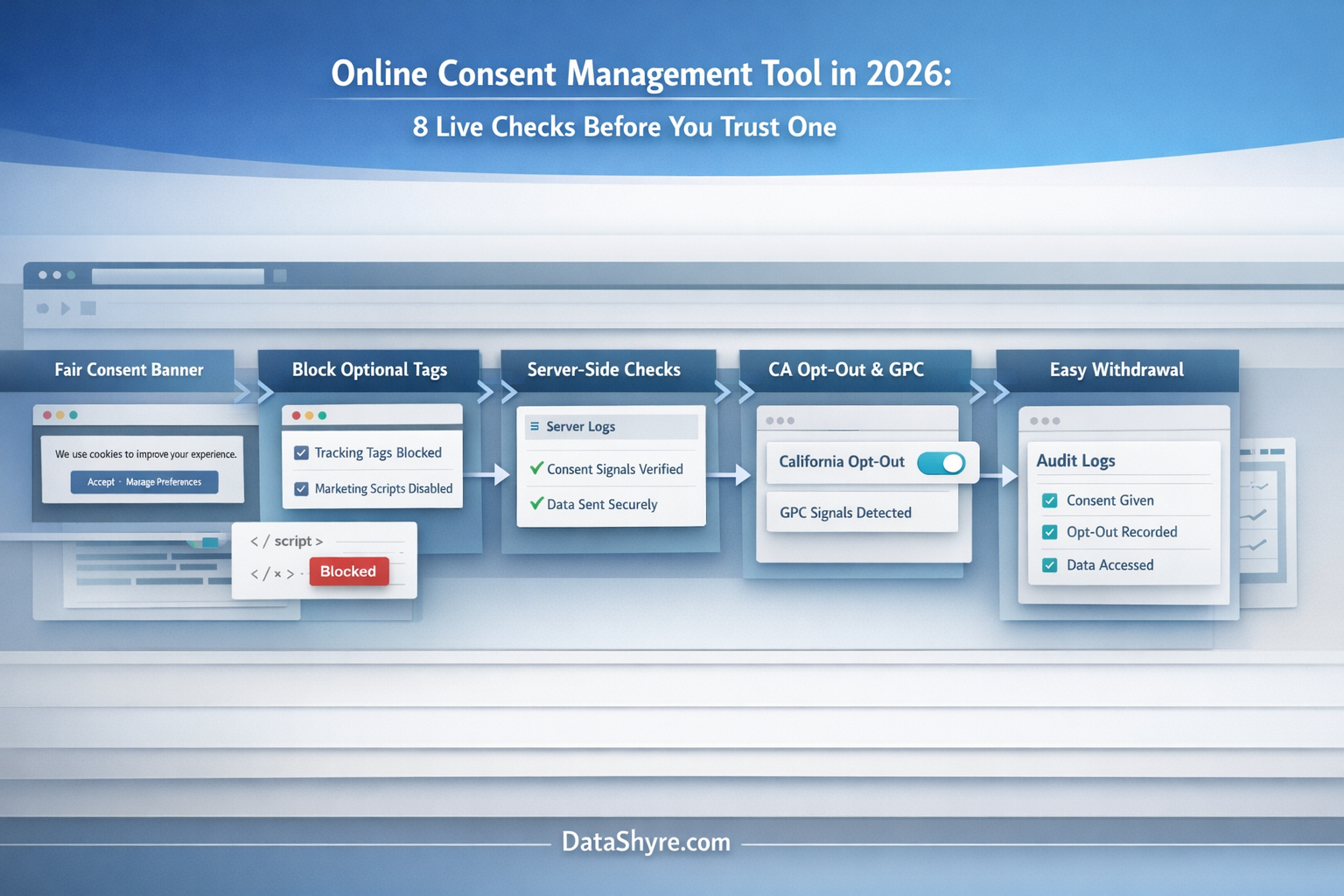
For EU and UK visitors, the issue is usually prior consent for optional storage or access. For California visitors, the issue may shift toward sale or sharing opt-out handling, browser-based preference signals, and the availability of a clear website choice link. The current CPPA FAQ is useful here because it explicitly says covered businesses must honor qualifying opt-out preference signals and, in most cases, also provide a clear and conspicuous link such as “Do Not Sell or Share My Personal Information,” “Your Privacy Choices,” or “Your California Privacy Choices.”
So a serious online consent management tool should be tested across at least these branches:
- EU or UK first visit with no saved preference;
- California visit where sale or sharing choices matter;
- a browser with Global Privacy Control enabled;
- a return visit after refusal; and
- a return visit after later withdrawal.
If the product story collapses all of that into one default banner, it is probably hiding complexity rather than handling it.
6. Treat withdrawal as a live feature, not a policy sentence
One of the clearest official tests is also one of the most ignored.
The European Commission says withdrawal should be “as easy to withdraw as to give consent.” That means the reopen path matters, but so does the runtime result after the change.
For any online consent management tool, I would test:
- how many clicks it takes to reopen settings;
- whether the withdrawal path is visible on mobile and desktop;
- whether withdrawal changes storage, tags, and downstream signals;
- whether the next visit respects the withdrawn state; and
- whether the site quietly recreates old identifiers on return.
If a tool makes acceptance immediate but makes withdrawal hard to find, slow to apply, or incomplete in effect, it is weak at the point the regulator is most likely to care about.
7. Inspect the evidence model, not only the settings UI
A trustworthy online consent management tool should help your team explain what happened later, after the banner version changes and the tag stack evolves.
The European Commission’s guidance is useful here because it says the organization must be able to demonstrate that consent was obtained. In real deployments, that means the record should be strong enough to answer:
- what banner or notice version the person saw;
- which purposes or categories were offered;
- what they chose and when;
- which region or ruleset applied;
- what the system did after that choice; and
- how the person could later change it.
If the tool stores only accepted or rejected without context, the proof may be thinner than the interface suggests.
8. Re-test after ordinary site changes
The final test for an online consent management tool is whether it survives normal website operations.
Privacy stacks rarely fail because the original configuration was impossible. They fail because a marketer adds a pixel, a product team enables a new embedded tool, a tag manager publish changes timing, or a developer routes events through a new server-side endpoint without updating the consent logic.
This is why I would treat these as automatic re-test triggers:
- new analytics, adtech, chat, or video vendors;
- tag-manager container publishes;
- changes to server-side event routing;
- new domains, microsites, or localized properties;
- revised first-layer copy or button behavior; and
- any project that changes account, login, or preference flows.
The best online consent management tool is the one that still tells the truth after the site changes, not only on launch day.
FAQ
Is an online consent management tool the same as a CMP?
Often yes, or at least very close. The more useful question is whether the tool actually manages notice, choice, enforcement, regional branching, and proof rather than just drawing a banner.
Do server-side tags remove consent duties?
No. The ICO’s current guidance says the rules can still apply in server-side contexts where information is stored or accessed on a device.
Can a good tool make a site compliant by itself?
No. A tool can help, but the live result still depends on your tag setup, vendor choices, copy, regional logic, and downstream data handling.
Bottom line
The best online consent management tool in 2026 is not the one with the nicest preview mode.
It is the one that understands more than cookies, gives refusal equal practical weight, blocks optional technologies before they should run, handles server-side and regional complexity honestly, makes withdrawal genuinely usable, and leaves behind records another team can still verify later.
The fastest way to judge online consent management tool is to test it the way a broken deployment would expose it: before consent, after consent, and again after a stack change.
Sources
- European Commission, legal grounds for processing data: https://commission.europa.eu/law/law-topic/data-protection/information-business-and-organisations/legal-grounds-processing-data_en
- UK ICO, final storage and access technologies guidance published: https://ico.org.uk/about-the-ico/media-centre/news-and-blogs/2026/04/final-storage-and-access-technologies-guidance-published/
- UK ICO, what are storage and access technologies?: https://ico.org.uk/for-organisations/direct-marketing-and-privacy-and-electronic-communications/guidance-on-the-use-of-storage-and-access-technologies/what-are-storage-and-access-technologies/
- California Privacy Protection Agency, FAQs: https://cppa.ca.gov/faq
- CNIL, dark patterns in cookie banners: https://www.cnil.fr/en/dark-patterns-cookie-banners-cnil-issues-formal-notice-website-publishers
—
Published: October 25, 2026. Updated using current official regulator and government materials available at publication time.