Cookie Agreement in 2026: Why the Wording Is Not Enough and 7 Live Checks
The real value in cookie agreement shows up when you debug it like a live system. A banner can render perfectly and still leak requests, misfire tags, or drift after the next plugin or theme update.
The useful test for cookie agreement is whether the live stack behaves correctly before consent, after consent, and after the next deployment. That is how hidden leaks and timing mistakes show up.
A cookie agreement only works when the live site still gets a real choice, blocks the right technologies before that choice, and keeps the notice, settings, and policy pages telling the same story.
This is why the current official guidance matters more than the label itself. The ICO says cookie information should be “clear and comprehensive” and that consent needs a “clear positive action.” The same ICO guidance says you “cannot set non-essential cookies” before consent. The CNIL says “rejecting cookies should be just as easy as accepting them.” The Court of Justice of the European Union made clear that a “pre-checked checkbox” is not valid consent. California’s Department of Justice adds that the privacy policy should give a “fuller description” of privacy practices and that Global Privacy Control can be “one acceptable method” for online opt-out requests.
That gives you the right frame for a cookie agreement review in late 2026.
The more useful question is not does the banner say agree.
It is does the site earn that agreement through valid choice, honest disclosure, and runtime behavior that still matches what the user was told.
If you want the closest companion reads first, start with these guides to cookie banner, cookie notice, and website privacy checker. This page stays narrower. It is the cookie agreement review I would use this week before approving a banner, rewriting privacy copy, or trusting a vendor demo.
If your team is trying to get cookie agreement under control without adding a heavyweight privacy stack, DataShyre can help. DataShyre focuses on consent and preference management that are easier to implement, easier to operate, and easier to trust on a live site. Start with DataShyre’s consent and preference management or book a demo.
If your team needs help checking whether the banner text, blocking logic, privacy page, and opt-out flow still line up, DataShyre can help with consent management, data mapping, and implementation QA. The expensive failure is not awkward wording. It is a site that says agree while doing something else underneath.

1. Decide what your cookie agreement is actually asking for
The first cookie agreement mistake is treating the phrase like a contract shortcut.
For most sites, the issue is not a legal agreement in the broad sense. It is whether the user was given enough information and a real choice before non-essential storage or access technologies started working.
The ICO’s current PECR guidance still frames the operational baseline clearly:
- tell people the cookies are there;
- explain what they do and why;
- get consent where required; and
- treat similar storage-and-access technologies the same way.
That means a serious cookie agreement review starts by defining the real scope:
- browser cookies;
- local or session storage;
- analytics and advertising tags;
- pixels, chat widgets, maps, video, and embedded tools; and
- regional differences in consent or opt-out behavior.
If the site uses more than classic cookies, the cookie agreement should not imply the whole story is a single pop-up and a single button.
2. Test the first page load before you trust any button text
This is the fastest way to separate a real cookie agreement from decorative language.
The ICO remains blunt: you “cannot set non-essential cookies” before consent. So the first review step is behavioral:
- open the site in a clean browser session;
- do not click anything yet;
- inspect requests, cookies, and storage;
- repeat on the homepage plus key conversion pages; and
- repeat on mobile if mobile traffic matters.
Why start here?
Because a polished cookie agreement can still sit on top of a runtime that fires analytics, ad-tech, or embedded vendor calls too early.
If that happens, the text is already behind reality.
3. Make Reject as real as Agree
This is still where many cookie agreement implementations quietly fail.
The CNIL says “rejecting cookies should be just as easy as accepting them.” The EDPB cookie-banner taskforce also treated the absence of a first-layer reject option as a recurring enforcement issue.
So a strong cookie agreement should be checked for first-layer parity:
- can a user refuse optional tracking from the first notice where the regime expects it;
- is the refusal path obvious on desktop and mobile;
- are the color, font, and placement choices avoiding pressure tactics; and
- does the refusal actually stick after navigation and revisit.
If Agree is a bright primary button and refusal is hidden as faint microcopy, the cookie agreement is steering the user, not collecting a fair choice.
4. Do not count silence, scrolling, or pre-ticked settings as agreement
The word cookie agreement can push teams into lazy patterns.
They assume continued browsing is good enough.
They bury the refusal path.
They leave categories pre-enabled.
That is the wrong mental model.
The ICO says consent must be a “clear positive action.” The Court of Justice said a “pre-checked checkbox” does not create valid consent for cookies. So a serious cookie agreement review should ask:
- does any choice default to
onfor non-essential technologies; - does continued browsing get treated as consent anywhere in the flow;
- does the settings panel push people toward acceptance by design;
- do third-party scripts load before the explicit choice is made.
If the site depends on passive behavior to make the cookie agreement work, it is not a strong agreement at all.
5. Make the agreement match the settings panel and privacy policy
One of the most common cookie agreement failures is vocabulary drift.
The banner says one thing.
The settings panel says another.
The privacy policy says something broader or older.
That is how trust breaks.
California’s DOJ says the privacy policy should give a “fuller description” of privacy practices and rights. The practical implication is that the first-layer cookie agreement should connect cleanly to the deeper policy instead of inventing a separate language.
Check for alignment across:
- category names such as necessary, analytics, advertising, or personalization;
- descriptions of what each category actually does;
- third-party involvement and sharing;
- the linked cookie or privacy policy page; and
- instructions for changing choices later.
If the cookie agreement uses labels the policy never explains, or the policy promises controls the banner does not offer, the site is telling two different stories.
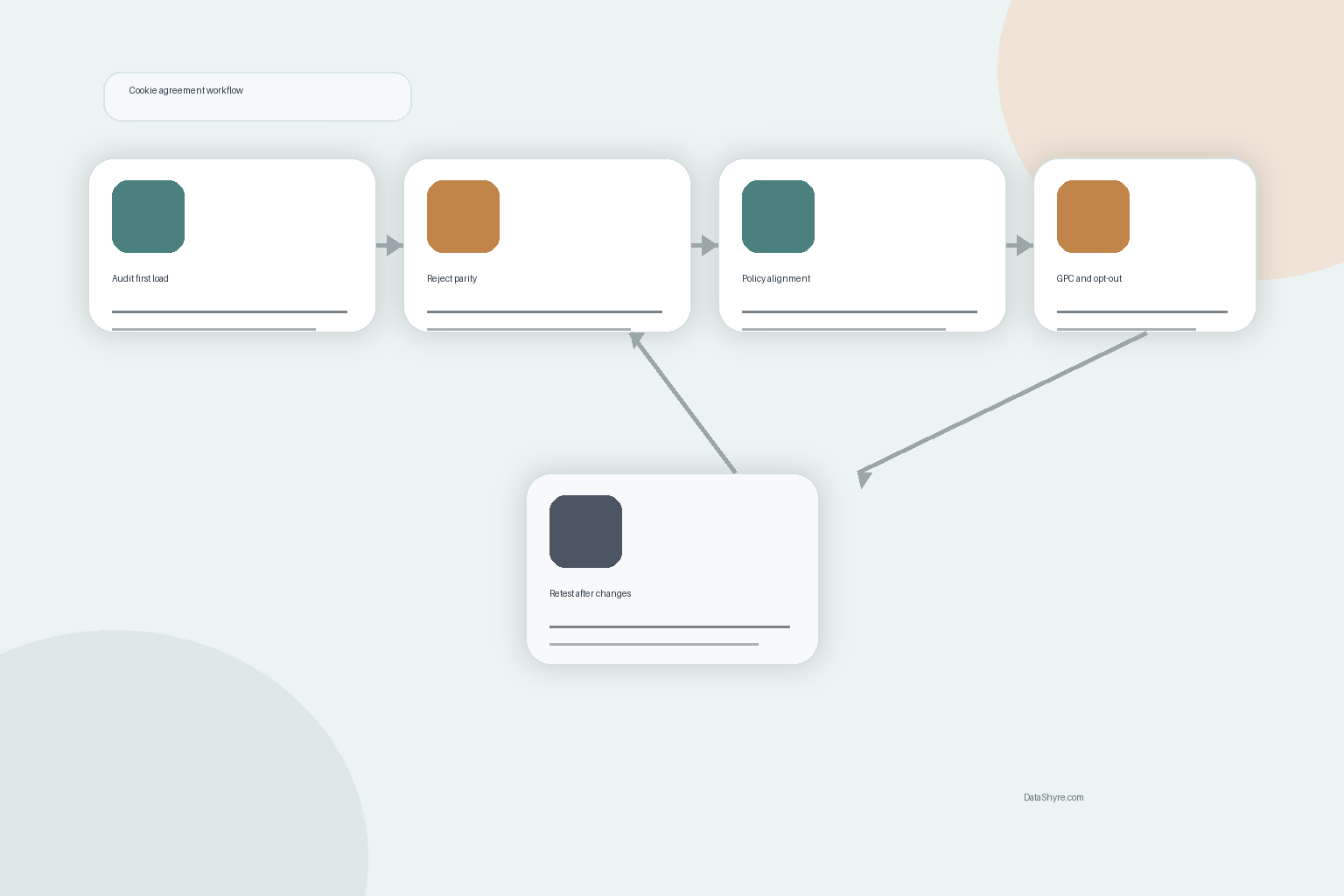
6. Keep the California opt-out story aligned too
Not every cookie agreement is serving only a European consent model.
Many sites show one banner globally while their California privacy duties sit elsewhere in the stack.
That can create a false sense of safety.
California’s DOJ says the privacy policy should give a “fuller description” of privacy practices, and it says Global Privacy Control can be “one acceptable method” for online opt-out requests. So if your cookie agreement is visible to California users too, review whether it still lines up with:
- the site’s privacy policy;
- any
Do Not Sell or Sharepath; - Global Privacy Control handling where relevant; and
- the real downstream sharing behavior behind analytics, advertising, or embedded vendors.
If the banner looks careful but the opt-out path is vague or broken, the overall privacy experience is still weak.
7. Treat the cookie agreement like a release-controlled asset
The long-term cookie agreement risk is drift.
New tags appear.
Embeds change.
Plugins update.
Marketing launches experiments.
But the notice often stays frozen.
That is how a once-accurate cookie agreement becomes misleading without anyone intending it.
A better workflow ties the page to change management:
- retest after new tags, embeds, or vendors are added;
- retest after consent-platform changes;
- review again after privacy-policy edits;
- check mobile and regional behavior after site redesigns; and
- keep ownership clear so updates are not nobody’s job.
If your team wants a simple operating rule, use this one:
every meaningful tracking change should trigger a quick cookie agreement review.
The practical review I would use this week
If you were reviewing a cookie agreement today, use this order:
- define the actual technologies in scope;
- test the first load before any click;
- check first-layer refusal parity;
- verify that consent depends on an explicit action, not passive behavior;
- compare the banner to the settings panel and privacy policy;
- verify the California opt-out story where relevant; and
- tie the page to release re-testing instead of a one-time launch task.
That sequence tells you more than a mockup or a vendor claim ever will.
If your team needs help turning a banner from agree theater into a defensible live control, DataShyre can help with consent testing, policy alignment, implementation cleanup, and cross-stack privacy QA.
FAQ
Is a cookie agreement the same thing as a cookie policy?
No. A cookie agreement is usually the first-layer choice flow or banner interaction. A cookie policy or privacy policy goes deeper on categories, vendors, purposes, and rights.
Can a cookie agreement be valid if the text sounds good but tags fire early?
No. If non-essential technologies load before the required choice is captured, the wording is not enough.
Is clicking Agree the only thing that matters?
The fastest way to judge cookie agreement is to test it the way a broken deployment would expose it: before consent, after consent, and again after a stack change.
Official sources used
- ICO, Cookies and similar technologies: https://ico.org.uk/for-organisations/direct-marketing-and-privacy-and-electronic-communications/guide-to-pecr/cookies-and-similar-technologies/
- CNIL, Dark Patterns in Cookie Banners: CNIL issues formal notice to website publishers: https://www.cnil.fr/en/dark-patterns-cookie-banners-cnil-issues-formal-notice-website-publishers
- Court of Justice of the European Union, Press Release No 125/19 on Planet49 (Case C-673/17): https://curia.europa.eu/jcms/upload/docs/application/pdf/2019-10/cp190125en.pdf
- California Department of Justice, Global Privacy Control (GPC): https://oag.ca.gov/privacy/ccpa/gpc
- California Department of Justice, How to Read a Privacy Policy: https://oag.ca.gov/privacy/facts/online-privacy/privacy-policy