GDPR Requirements in 2026: 7 Practical Checks for Scope, Rights, and Proof
The real value in gdpr requirements shows up when you debug it like a live system. A banner can render perfectly and still leak requests, misfire tags, or drift after the next plugin or theme update.
The useful test for gdpr requirements is whether the live stack behaves correctly before consent, after consent, and after the next deployment. That is how hidden leaks and timing mistakes show up.
The real work still turns on scope, lawful basis, transparency, data-subject rights, records, security, and accountability. That is also where the enforcement attention still points. On March 19, 2026, the European Data Protection Board launched its 2026 Coordinated Enforcement Framework action on compliance with the GDPR’s transparency and information duties in Articles 12, 13, and 14. On September 17, 2026, the EDPB published Guidelines 04/2026 on how administrative fines interact with other corrective powers under the GDPR, and the related public consultation closed on November 13, 2026.
If you want narrower companion guides first, start with our posts on general data protection regulation, gdpr compliant privacy notice, and website privacy checker. This page stays broader. It is the working review I would use this week to explain gdpr requirements to an operations, product, or marketing team that needs the real checklist instead of the slogan.
If your team is trying to get gdpr requirements under control without adding a heavyweight privacy stack, DataShyre can help. DataShyre focuses on consent and preference management that are easier to implement, easier to operate, and easier to trust on a live site. Start with DataShyre’s consent and preference management or book a demo.
If your team needs help turning that checklist into an operating review, DataShyre can help with privacy QA, notice-to-runtime checks, consent implementation, and evidence-ready testing before a launch or audit.

1. Confirm whether the GDPR applies before you debate the details
The first gdpr requirements mistake is assuming the law only matters if your company is physically based in the EU.
The European Commission’s current application guidance says the GDPR applies when:
- a company or organisation processes personal data as part of the activities of an establishment in the EU, regardless of where the data is processed; or
- a company outside the EU offers goods or services to people in the EU; or
- a company outside the EU monitors the behaviour of people in the EU.
That is the first operational branch to settle.
It also matters for smaller teams. The Commission says SME status does not remove GDPR obligations by itself. Some duties vary by risk and context, but the basic compliance question is driven by what the organisation does with personal data, not by headcount alone.
2. Map each processing purpose to the right lawful basis
Another common gdpr requirements error is treating consent as the default answer to every processing question.
It is not.
The GDPR requires processing to rest on a lawful basis. The European Commission’s guidance still points to the familiar bases:
- consent;
- contract;
- legal obligation;
- vital interests;
- public task; and
- legitimate interests.
This is where many compliance stories start to fall apart.
If your team cannot explain which basis supports each major processing purpose, then your notices, request handling, and retention choices are probably drifting too. The EDPB’s SME guidance also makes the consent branch stricter than many teams remember: consent must be freely given, informed, specific, and unambiguous, it must involve a clear affirmative action, and withdrawal must be as easy as giving it.
So a useful gdpr requirements review should ask:
- what each processing purpose is;
- which lawful basis supports it;
- whether the basis was chosen because it truly fits, not because it sounded safest;
- whether the privacy notice explains that basis clearly enough; and
- whether the operational workflow still matches the basis claimed.
3. Make transparency a live control, not a writing exercise
This is one of the clearest current enforcement themes.
The GDPR requires information to be provided in a concise, transparent, intelligible, and easily accessible form. The EDPB’s 2026 coordinated action is focused specifically on those transparency and information obligations.
That should change how you interpret gdpr requirements in practice.
Do not only ask whether a privacy notice exists.
Ask whether people are actually told, in the right place and at the right time:
- who the controller is;
- what categories of data are being processed;
- the purposes and lawful bases;
- the recipients or categories of recipients;
- whether data is transferred outside the EU;
- how long the data is kept or how that period is decided; and
- how people can exercise their rights.
The European Commission’s principles guidance still ties transparency closely to collection timing too. If data is not collected directly from the individual, the organisation generally has to inform that person no later than one month after obtaining the data, or when first communicating with them, unless a specific exception applies.
That makes gdpr requirements a timing problem as much as a drafting problem.
4. Treat rights handling as a product workflow, not an inbox chore
Many teams can name the GDPR rights but still fail the live test when a request comes in.
For most organisations, the practical gdpr requirements review should cover at least the workflows for:
- access;
- rectification;
- erasure;
- restriction;
- portability, where applicable; and
- objection, especially in direct-marketing contexts.
The main operational question is simple: can your team route, verify, fulfil, and document a request without improvising every step?
That matters because a rights process is rarely only a legal process. It is usually a systems process across forms, customer support, identity checks, product databases, backup logic, and vendor dependencies.
If the organisation says people can exercise their rights but the live route is buried, unclear, or manually fragile, the gdpr requirements posture is weaker than the policy page suggests.
5. Keep records, vendor controls, and accountability evidence
This is where abstract compliance turns into proof.
The European Commission still frames accountability as the duty to comply with the data-processing principles and to be able to demonstrate compliance when required. The EDPB’s SME guidance makes the same point more concretely: compliance includes data protection by design, keeping records of processing activities, and carrying out a DPIA in the situations where one is required.
For many teams, this is the part of gdpr requirements that gets underbuilt.
A working accountability branch usually includes:
- a current record of processing activities where required;
- processor contracts and vendor oversight that match the real stack;
- retention rules that are more concrete than
we keep data as long as necessary; - evidence that collection points and notices match the live system; and
- a change process that catches new tools, new vendors, and new uses before they go live.
The Commission also notes that organisations with fewer than 250 employees may be exempt from the record-keeping duty in some cases, but not where processing is regular, risky, or involves sensitive data or criminal records. So the practical question is not Are we small? It is Does our actual processing fit the derogation?
6. Build for security incidents and breach decisions before the breach happens
Security is not a side branch of gdpr requirements.
It is part of the core requirement set.
The European Commission’s principles guidance still links integrity and confidentiality to appropriate technical and organisational measures. The EDPB’s data-breach guidance also reminds controllers that a personal data breach includes more than a hacked server. It can include accidental disclosure, accidental deletion, loss of availability, phishing-related access, or ransomware events affecting personal data.
For controllers, the EDPB summarises the breach obligations into three practical duties:
- document the breach;
- notify the relevant supervisory authority within 72 hours unless the breach is unlikely to result in a risk to individuals; and
- communicate the breach to affected individuals without undue delay where it is likely to result in a high risk.
That means a serious gdpr requirements review should test whether the organisation already knows:
- who decides whether an incident is a personal data breach;
- who assesses risk;
- who files the notification;
- how evidence is preserved; and
- how affected individuals would be contacted if required.
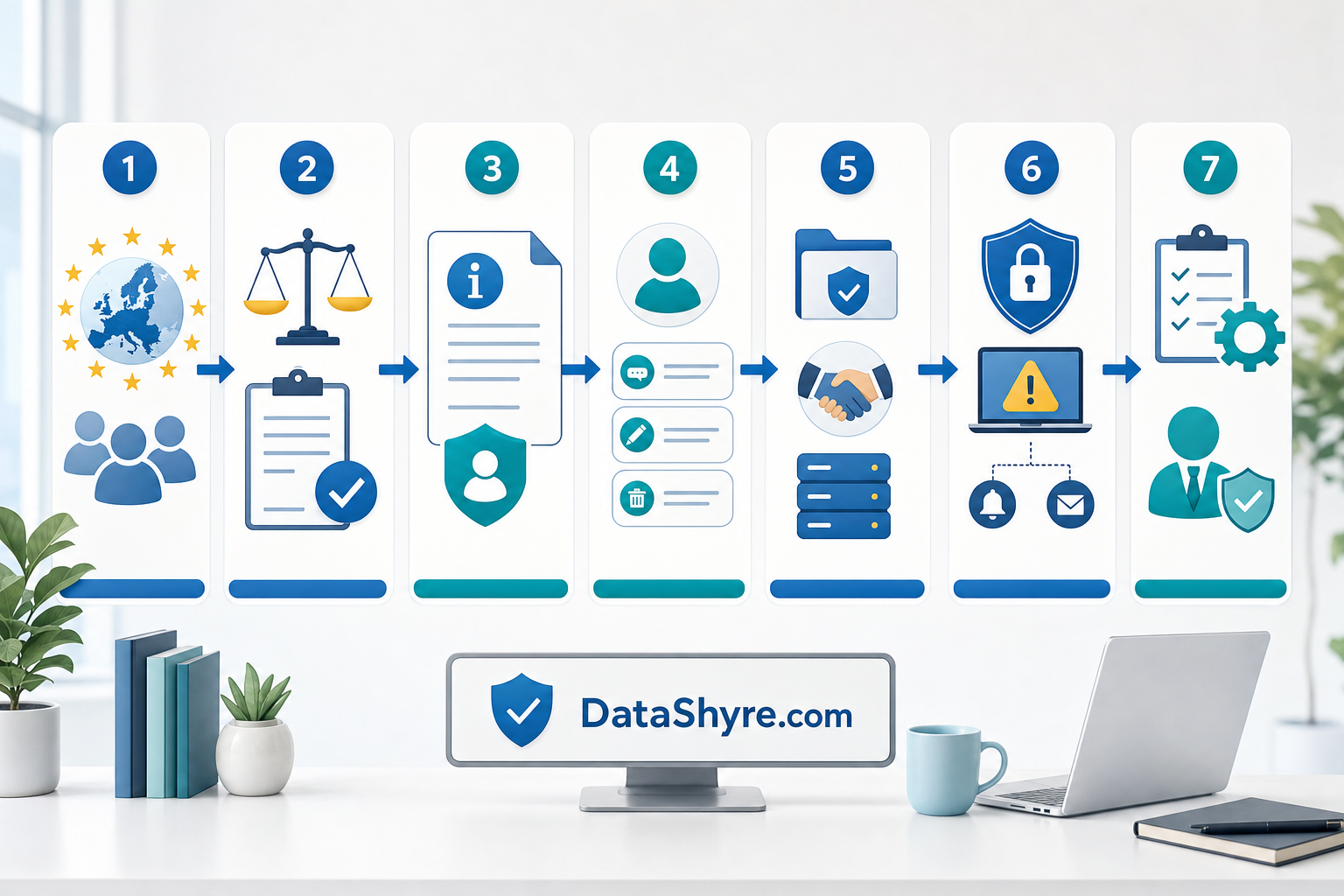
7. Use the high-risk branch for DPIAs and DPO decisions
Not every organisation needs the same governance stack for every processing activity.
But some gdpr requirements get stricter once the risk profile rises.
The EDPB says a DPIA is required where processing is likely to result in a high risk to the rights and freedoms of individuals. Its SME guidance points to examples such as:
- large-scale processing of sensitive data or criminal-offence data;
- systematic and extensive evaluation based on automated processing, including profiling, with significant effects; and
- systematic monitoring of publicly accessible areas on a large scale.
The DPO branch is similar.
The Commission says some SME obligations do not apply unless processing is a core part of the business and creates specific risks, and the EDPB notes that organisations can appoint a DPO voluntarily. But it adds an important warning: if you use the title DPO voluntarily, you still have to comply with the GDPR rules governing that role.
So the real gdpr requirements question is not Do we have someone with privacy in their title?
It is:
- are we in a scenario that requires a DPIA;
- are we in a scenario that requires a DPO;
- if not required, do we still have a named owner for compliance;
- can that owner actually influence product, vendor, and incident decisions; and
- is there any conflict between that role and operational decision-making?
A practical review order for this week
If I had to turn gdpr requirements into an operational checklist this week, I would use this order:
- confirm scope first;
- map each major processing purpose to a lawful basis;
- compare collection points and privacy notices against live behavior;
- test the request path for access, erasure, and objection;
- review records, vendors, and retention logic;
- check incident response for the 72-hour branch; and
- decide whether any processing activity triggers a DPIA or DPO requirement.
That order tends to surface the most important gaps faster than starting with policy wording alone.
FAQ
Do all SMEs need a DPO under the GDPR?
No. The European Commission says some obligations do not apply to all SMEs, and the EDPB’s SME guidance says a DPO is required only in certain circumstances, such as when core processing activities involve specific high-risk patterns. But even if a formal DPO is not required, someone still needs to own compliance in practice.
Are GDPR requirements only about consent?
No. Consent is only one lawful basis. GDPR requirements also cover scope, transparency, rights, accountability, records, security, breach handling, and high-risk governance.
What is the fastest way to fail GDPR requirements on a live site?
The fastest way to judge gdpr requirements is to test it the way a broken deployment would expose it: before consent, after consent, and again after a stack change.
Sources
- EUR-Lex, Regulation (EU) 2016/679 (GDPR text): https://eur-lex.europa.eu/legal-content/EN/TXT/?uri=CELEX:32016R0679
- European Commission, Application of the GDPR: https://commission.europa.eu/law/law-topic/data-protection/information-business-and-organisations/application-gdpr_en
- European Commission, Principles of the GDPR: https://commission.europa.eu/law/law-topic/data-protection/information-business-and-organisations/principles-gdpr_en
- European Commission, Legal grounds for processing data: https://commission.europa.eu/law/law-topic/data-protection/information-business-and-organisations/legal-grounds-processing-data_en
- European Commission, Obligations under the GDPR: https://commission.europa.eu/law/law-topic/data-protection/information-business-and-organisations/obligations_en
- European Commission, Enforcement and sanctions: https://commission.europa.eu/law/law-topic/data-protection/information-business-and-organisations/enforcement-and-sanctions_en
- EDPB, CEF 2026: coordinated enforcement action on transparency and information obligations under the GDPR: https://www.edpb.europa.eu/news/cef-2026-edpb-launches-coordinated-enforcement-action-on-transparency-and-information_en
- EDPB, Data protection guide for small business – Data protection basics: https://www.edpb.europa.eu/sme/learn-the-basics/data-protection-basics_en
- EDPB, Data protection guide for small business – Be compliant: https://www.edpb.europa.eu/sme/be-compliant/be-compliant_en
- EDPB, Data protection guide for small business – Process personal data lawfully: https://www.edpb.europa.eu/sme/be-compliant/process-personal-data-lawfully_en
- EDPB, Data protection guide for small business – Data breaches: https://www.edpb.europa.eu/sme/assess-the-risks/data-breaches_en
- EDPB, Data protection guide for small business – Data Protection Officer: https://www.edpb.europa.eu/sme/be-compliant/data-protection-officer_en
- EDPB, Guidelines 04/2026 on the application of the power to impose administrative fines in relation to other corrective powers under the GDPR: https://www.edpb.europa.eu/documents/guideline/guidelines-042026-on-the-application-of-the-power-to-impose-administrative-fines-in-relation-to-other-corrective-powers-under-the-gdpr_en
Published: November 24, 2026. Updated using current official EU and EDPB materials available at publication time.