California Data Protection in 2026: 7 Live Checks for Notice, Security, and Proof
The real value in california data protection shows up when you debug it like a live system. A banner can render perfectly and still leak requests, misfire tags, or drift after the next plugin or theme update.
The useful test for california data protection is whether the live stack behaves correctly before consent, after consent, and after the next deployment. That is how hidden leaks and timing mistakes show up.
It is the operating layer that decides what your business collects, what it tells people, which choices actually work, how sensitive data is handled, what vendors can do, and what evidence you can still show after a complaint, audit, or enforcement letter lands.
That is also where current official California sources still point. The CPPA FAQ says California residents have “six major privacy rights.” The current CCPA regulations, effective January 1, 2026, say the privacy policy should provide a “comprehensive description” of a business’s online and offline information practices. The CPPA’s regulations page also says the 2026 rule set includes “cybersecurity audits”, risk assessments, and automated decisionmaking rules. And California enforcement is still concrete: on October 29, 2026, Attorney General Rob Bonta announced a $1.8 million Lyft settlement over an app opt-out path he called an “illegal and unnecessary barrier.”
If you want the closest California companion reads first, start with these guides to CA data privacy law, CA privacy law, and California web privacy law. This page stays broader than one notice page or one browser setting. It is the california data protection review I would use this week before telling a team its California program is actually under control.
If your team is trying to get california data protection under control without adding a heavyweight privacy stack, DataShyre can help. DataShyre focuses on consent and preference management that are easier to implement, easier to operate, and easier to trust on a live site. Start with DataShyre’s consent and preference management or book a demo.
If your team needs help connecting notices, consent or opt-out controls, vendor governance, and evidence into one working system, DataShyre can help with consent management, DSR automation, and risk management.
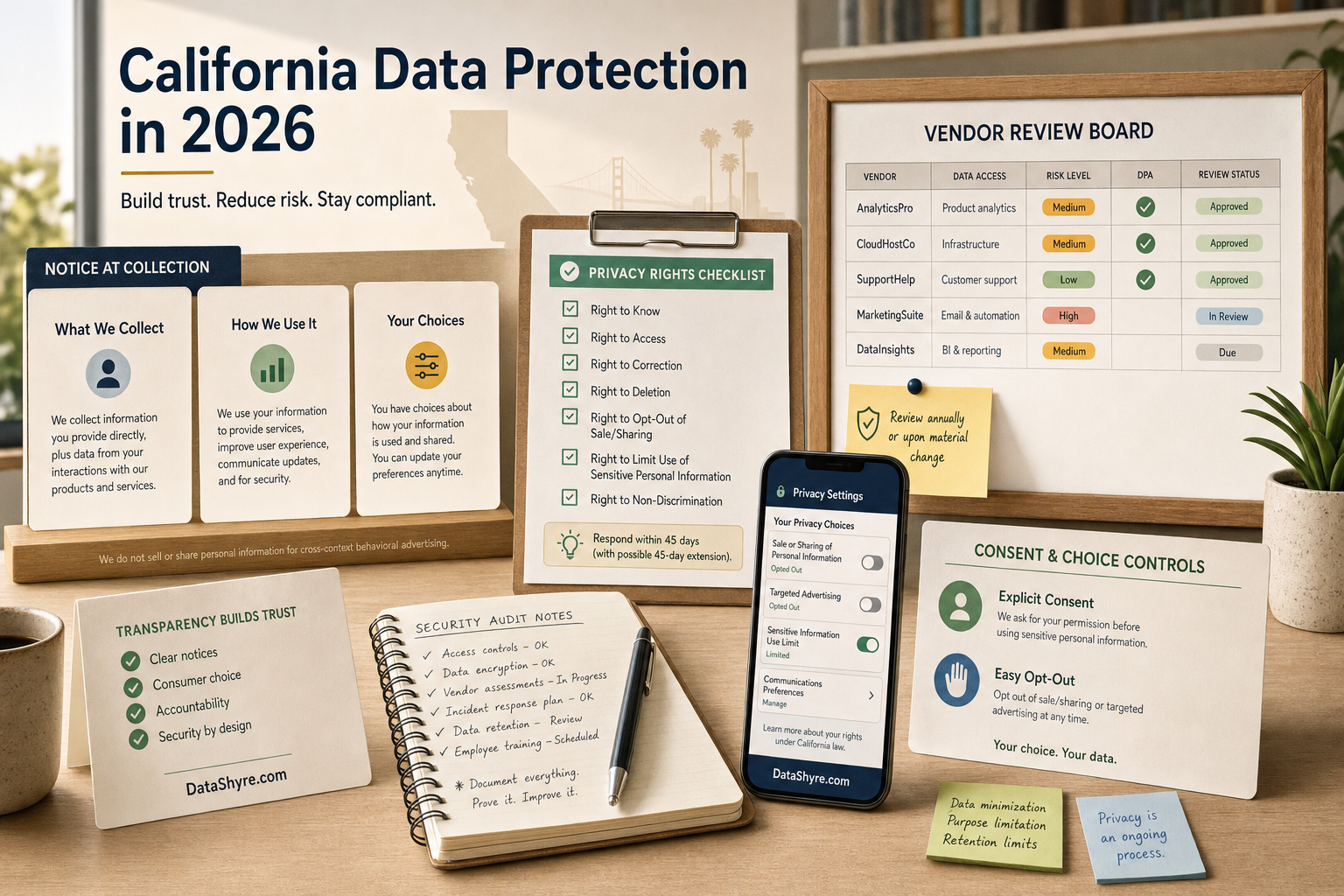
1. Treat California data protection as a live system, not a policy artifact
The first california data protection mistake is acting as if legal text is the control layer.
It is not.
In real deployments, the California branch cuts across:
- lead, support, account, checkout, and mobile-app collection points;
- cookie, SDK, advertising, sharing, and analytics flows;
- privacy requests and identity-verification steps;
- CRM, support, and downstream processor workflows;
- retention, deletion, and suppression logic; and
- evidence that proves the business actually honored the user’s choice.
If those parts disagree, the privacy page becomes a promise the systems cannot keep.
2. Put notice at collection where people actually hand over data
This is still one of the clearest operational tests.
The current regulations say Notice at Collection must appear at or before the point of collection and must tell consumers what categories of personal information will be collected, why, and whether the information is sold or shared. They also say the notice should be readily available where the consumer will encounter it, including near a webform field or submit button. If the notice does not show up before collection, the regulations say the business shall not collect that information.
That means a serious california data protection review should check:
- whether each form, signup, checkout, booking, and app intake path exposes the notice before submission;
- whether the notice matches the real categories and purposes tied to that collection point;
- whether mobile layouts and in-app screens still show the notice clearly;
- whether background enrichment, pixels, or downstream sharing are still covered; and
- whether the short notice and full privacy policy tell the same story.
If the explanation appears only after the consumer already acted, the control was too late.
3. Make rights handling operational, not ceremonial
A lot of california data protection work sounds acceptable on paper and collapses in the request path.
California’s public guidance still frames the law around rights to know, delete, correct, opt out of sale or sharing, limit certain uses of sensitive personal information, and avoid discrimination for exercising those rights. But the real test is not whether those rights appear in a footer paragraph.
It is whether the business can answer:
- where requests arrive;
- how opt-out and other rights paths differ;
- when verification is needed and when it is not;
- which systems and vendors have to change after a request is accepted; and
- what proof remains after the workflow finishes.
The Lyft matter is useful because it shows how quickly California focuses on friction. If the path forces users through extra screens, unnecessary data re-entry, or device-specific dead ends, the experience is already risky.
4. Branch explicitly for sensitive data, apps, and automated systems
This is where california data protection gets broader than a website review.
The current California framework does not stop at browser forms. Mobile apps still need usable privacy links and rights routes. Sensitive personal information can trigger separate limit-use questions. And the CPPA’s January 1, 2026 rule package also brought in operational branches around risk assessments, automated decisionmaking, and cybersecurity audits.
So a stronger california data protection review asks whether the business:
- has a mobile app with settings and rights flows that match the website story;
- handles precise geolocation, financial, health-related, or other sensitive information differently where required;
- uses profiling, scoring, or automated decision tools that deserve a separate review;
- knows whether any system falls into the cybersecurity-audit or risk-assessment branch; and
- updates notices and workflows when those higher-risk systems change.
This is often where one generic privacy checklist becomes too shallow.
5. Review vendors and sharing like part of the product, not procurement leftovers
Weak california data protection programs often fail in the vendor layer.
The business may write a decent notice, but the live stack still includes ad-tech partners, support tools, payment providers, analytics vendors, mobile SDKs, or enrichment services that change the real data path.
This is why I would check whether the business can explain:
- which vendors receive which categories of data;
- whether any of those flows count as sale, sharing, contractor, or service-provider relationships;
- whether the privacy policy and notice language still match the live vendor chain;
- whether opt-out or limit signals actually propagate downstream; and
- whether vendor changes trigger a fresh California review.
This is also where DataShyre implementation help is often more useful than another copy pass. The expensive failures usually happen between the published story and the live integrations.
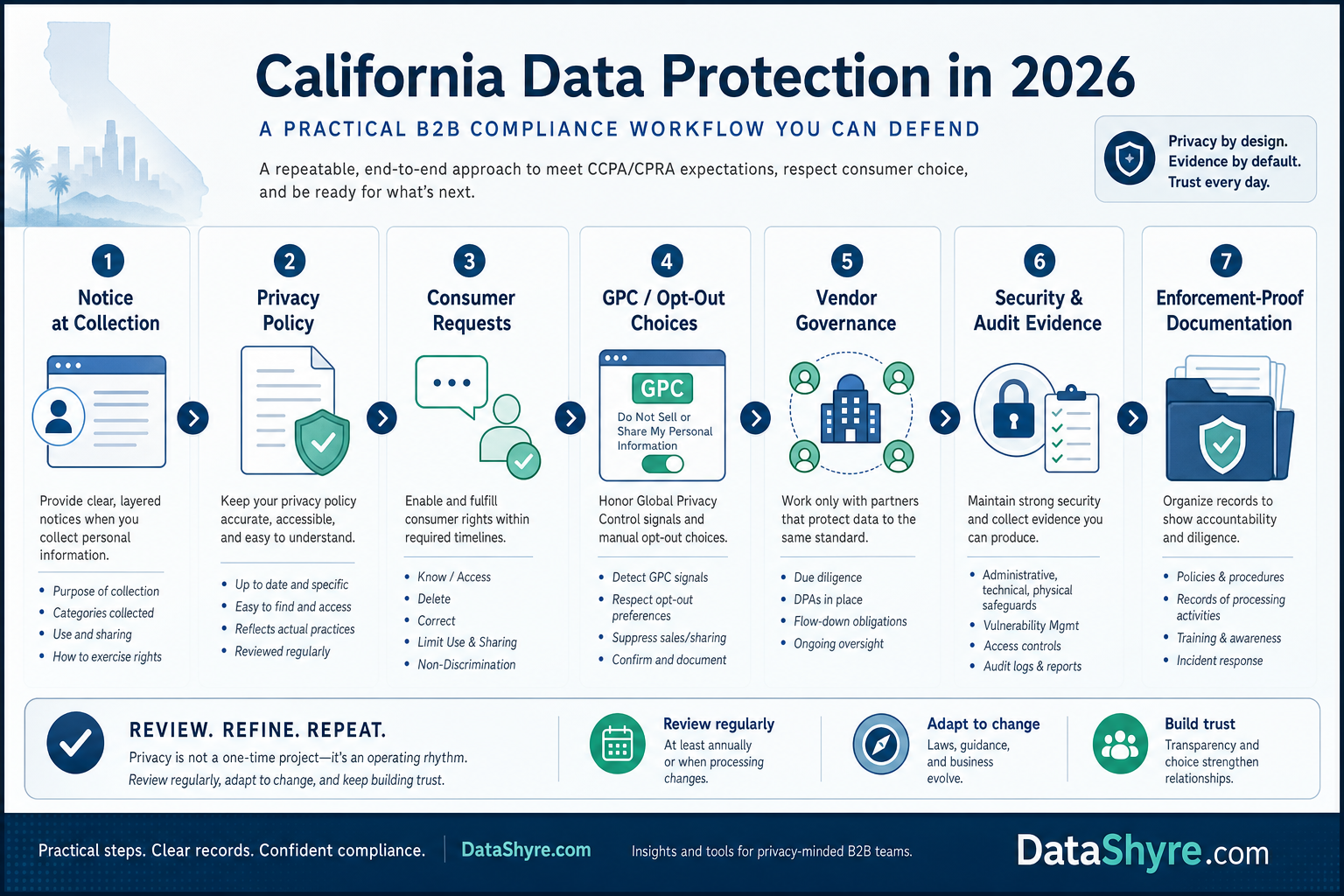
6. Treat cybersecurity and retention as privacy controls too
Another california data protection mistake is splitting privacy from security too cleanly.
California’s current regulatory picture does not really support that split anymore. The CPPA’s 2026 regulations explicitly added cybersecurity-audit and risk-assessment branches for covered situations. The Department of Justice privacy enforcement page also keeps reminding teams that California privacy enforcement is not only about banner wording or one opt-out link.
In real deployments, a useful california data protection review checks:
- access controls for systems holding California consumer data;
- retention logic, deletion timing, and suppression records;
- whether backups, exports, and downstream copies follow the same rules;
- whether audit evidence exists for higher-risk systems; and
- whether incident response, privacy, and product teams can reconstruct what happened after a failure.
If the business cannot explain how long data stays, where copies live, or who can still reach them, the program is weaker than the notice language suggests.
7. Keep proof because California enforcement is still active
The last california data protection check is evidence.
California has already shown that the state will test whether privacy choices work in the real product, not only in the policy layer. The Department of Justice’s privacy enforcement page continues to surface actions where request routes, opt-out controls, or broader privacy protections did not work the way users were led to expect.
So the practical proof set should include:
- the notice that was live at the moment of collection;
- the privacy-policy version users actually saw;
- the rights route, GPC, or opt-out behavior that actually fired;
- the request intake, routing, and completion trail;
- the vendor or system changes made downstream; and
- the dates when the workflow was last re-tested.
If you cannot reconstruct the user path later, you do not really know whether the California control held.
A practical California data protection review for this week
If I were pressure-testing california data protection this week, I would use this order:
- map live collection, app, vendor, and sharing flows first;
- verify Notice at Collection appears at or before each collection point;
- test rights handling and opt-out friction from the user’s perspective;
- branch into sensitive-data, app, ADMT, risk-assessment, and cybersecurity-audit questions where relevant;
- compare the live vendor chain against the notices and policy;
- review retention, deletion, and security evidence; and
- keep proof that still makes sense after the next release.
That order usually reveals more truth than another policy-only review.
FAQ
Is California data protection basically just the CCPA?
For most operating teams, the day-to-day work sits inside the CCPA ecosystem, the 2026 regulations, California rights guidance, and related enforcement. But the practical job is broader than naming the statute. It is making the live collection, choice, vendor, and proof layers work together.
Does a privacy policy by itself cover California data protection?
No. The privacy policy matters, but california data protection also lives in notice at collection, request handling, app settings, vendor governance, security controls, and evidence.
When do cybersecurity audits or risk assessments matter?
The fastest way to judge california data protection is to test it the way a broken deployment would expose it: before consent, after consent, and again after a stack change.
Official sources used
- California Privacy Protection Agency FAQ
- California Privacy Protection Agency regulations page
- California Consumer Privacy Act Regulations, effective January 1, 2026
- California Department of Justice CCPA page, updated August 28, 2026
- California Department of Justice privacy enforcement actions
- California Attorney General press release on the October 29, 2026 Lyft settlement