Cookies Policy Generator in 2026: 7 Checks Before You Trust the Output
The real value in cookies policy generator shows up when you debug it like a live system. A banner can render perfectly and still leak requests, misfire tags, or drift after the next plugin or theme update.
The useful test for cookies policy generator is whether the live stack behaves correctly before consent, after consent, and after the next deployment. That is how hidden leaks and timing mistakes show up.
The underlying need is not.
Most teams want a faster way to publish a cookie page that explains what their site uses, why it uses it, and how people can control it.
The problem is that a generator can only draft from the information you give it.
It cannot confirm whether the live site actually matches the draft.
That matters because the current official sources still push the same operating basics. Your Europe says that if you use cookies that require consent, you must give users “clear and comprehensive information” about the cookies and their purpose. GDPR Article 7 still says it must be “as easy to withdraw as to give consent.” CNIL still says rejecting cookies should be “just as easy as accepting them.” And the ICO’s April 2026 guidance makes clear the review is broader than classic cookies alone, covering “tracking pixels” and similar storage-and-access technologies.
If you want the closest companion reads first, start with these guides to cookie policy example, cookie declaration, and website privacy checker. This page stays focused on the search phrase cookies policy generator and the practical review I would use this week before publishing generated cookie text on a live site.
If your team is trying to get cookies policy generator under control without adding a heavyweight privacy stack, DataShyre can help. DataShyre focuses on consent and preference management that are easier to implement, easier to operate, and easier to trust on a live site. Start with DataShyre’s consent and preference management or book a demo.
If your team already has a generated page but is not confident the runtime, banner, and vendor stack still match it, DataShyre can help with consent management, data mapping, and implementation review work that compares the published policy against what the browser actually does.
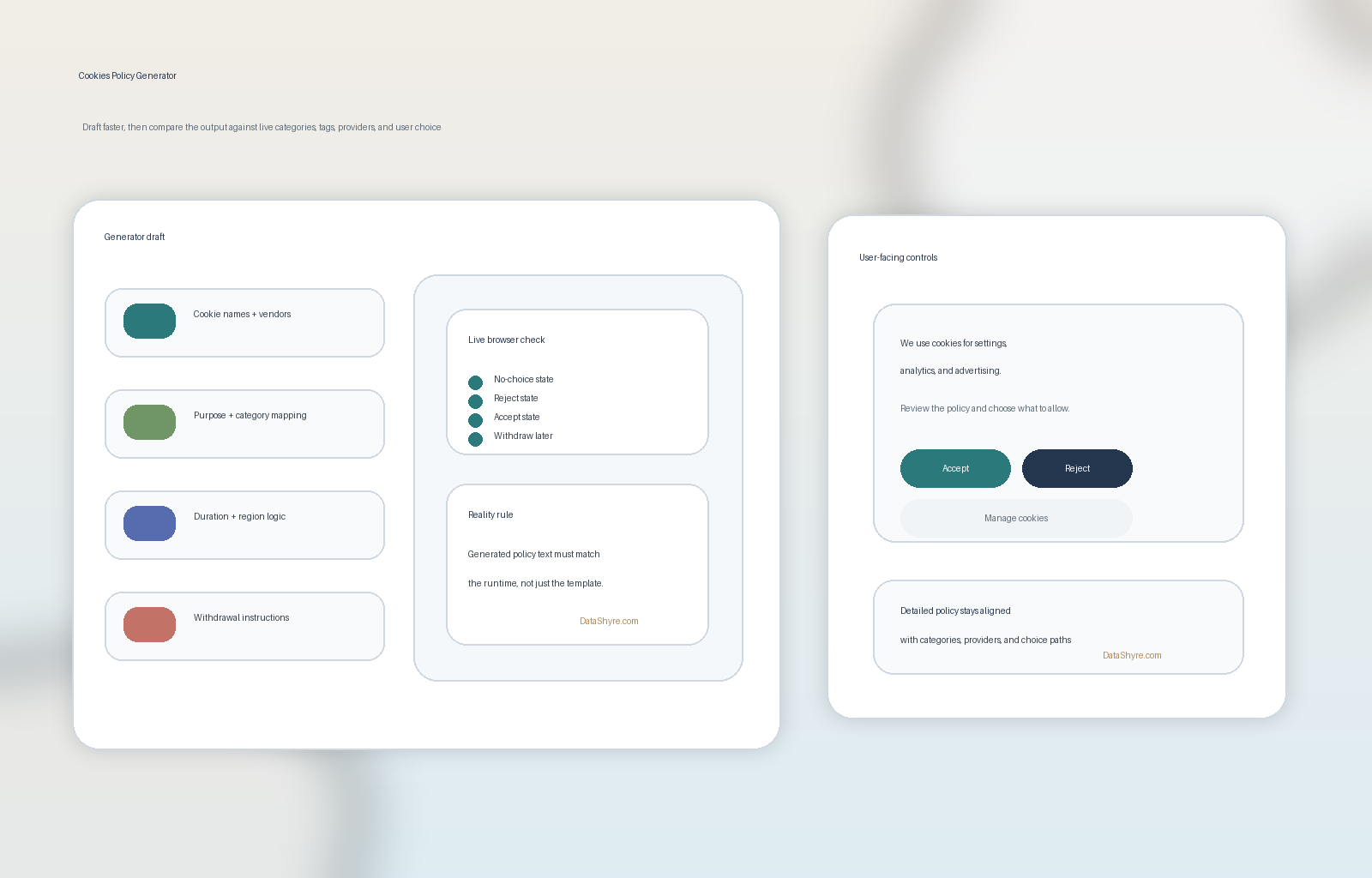
1. Treat the generator as a drafting tool, not the source of truth
The first cookies policy generator mistake is trusting the wizard more than the live site.
That is backwards.
A generator can help you structure the page.
It cannot independently verify:
- which cookies or similar technologies are active right now;
- which provider sets them;
- which page templates or embeds trigger them;
- which ones are strictly necessary versus optional; or
- whether the consent layer actually changes what loads.
So the generator should supply the draft shell.
Your inventory is still the truth.
2. Force the output to name categories, providers, purpose, and duration
A weak cookies policy generator output usually says something like:
we use cookies to improve your experience
That is not enough.
If users are supposed to understand what is happening, the page needs more than category names.
It should help explain:
- what category the technology belongs to;
- what practical purpose it serves;
- whether it is first-party or third-party;
- whether it is session-based or persistent; and
- where the person can later change the related choice.
If the generated page cannot support that level of specificity, it is closer to marketing copy than disclosure.
3. Separate necessary functions from optional tracking before you publish
This is one of the fastest ways to tell whether a cookies policy generator is useful or decorative.
Your Europe still distinguishes between cookies that require consent and limited cases that do not. That means the generated page should not flatten everything into one harmless bucket.
I would want the output to clearly separate at least:
- security, session, checkout, or login cookies;
- preference cookies;
- analytics or measurement cookies;
- advertising or cross-context tracking cookies; and
- third-party embeds or tools that bring in related identifiers.
If the page does not make those branches understandable, it will be harder for users and harder for your own team.
4. Review more than the cookie table
This is where many cookies policy generator reviews become stale on day one.
The ICO’s current guidance says the same rules can apply more broadly than classic cookies, and its April 2026 guidance specifically covers storage-and-access technologies such as tracking pixels, device fingerprinting, and similar tools.
That means a serious cookies policy generator review should also account for:
- pixels;
- scripts loaded through a tag manager;
- chat, video, map, or scheduling embeds;
- CAPTCHA or bot-detection tools;
- other third-party components that store or access information on the device.
If the generated page only fits a simple browser-cookie list, it may already miss the riskiest part of the stack.
5. Compare the generated page against the live banner, reject flow, and withdrawal flow
A cookies policy generator cannot be correct by itself.
It has to match the control layer.
GDPR Article 7 still says withdrawal must be “as easy to withdraw as to give consent.” CNIL still says rejecting cookies should be “just as easy as accepting them.” That means the cookie page should not promise controls the interface does not actually deliver.
So when I review generated output, I compare it against:
- the first-layer banner copy;
- the
accept allandreject allcontrols; - the category labels inside the settings panel;
- the later
manage cookiesor equivalent route; and - the browser behavior after the person changes their choice.
If the page says consent can be changed any time, that path should be obvious on desktop and mobile.
6. Keep the generated cookie page aligned with the wider privacy notice
A cookie page is not the whole privacy program.
It is one layer inside it.
That matters for California teams too. The CPPA still says the privacy policy must be available through a conspicuous link using the word “privacy” and should describe the business’s information practices and rights paths. Your cookie page can go deeper on trackers, categories, and controls, but it should not drift away from the broader privacy notice.
In real deployments, a strong cookies policy generator workflow keeps these layers aligned:
- the cookie page explains technologies, categories, providers, and controls;
- the broader privacy policy explains collection, use, sharing, retention, and rights;
- the banner or preference center matches both pages; and
- the rights or opt-out routes are described consistently across the site.
If those pages tell different stories about vendors, categories, or choices, the generated draft is not ready.
7. Add update triggers so the page does not freeze while the stack changes
The biggest long-term cookies policy generator risk is drift.
The page may be accurate on launch day and misleading a week later.
That usually happens when:
- a new tag or embed is added;
- a CMP category is renamed;
- a plugin changes load order;
- a new ad-tech or analytics vendor appears;
- a privacy or regional settings branch changes;
- the generator text is updated but nobody republishes the page.
That is also where DataShyre can help. If your team has a generated cookie policy that looks polished but no longer matches the real runtime, DataShyre can help audit the live site, map the vendor behavior, and tighten the implementation so the published text stays honest.
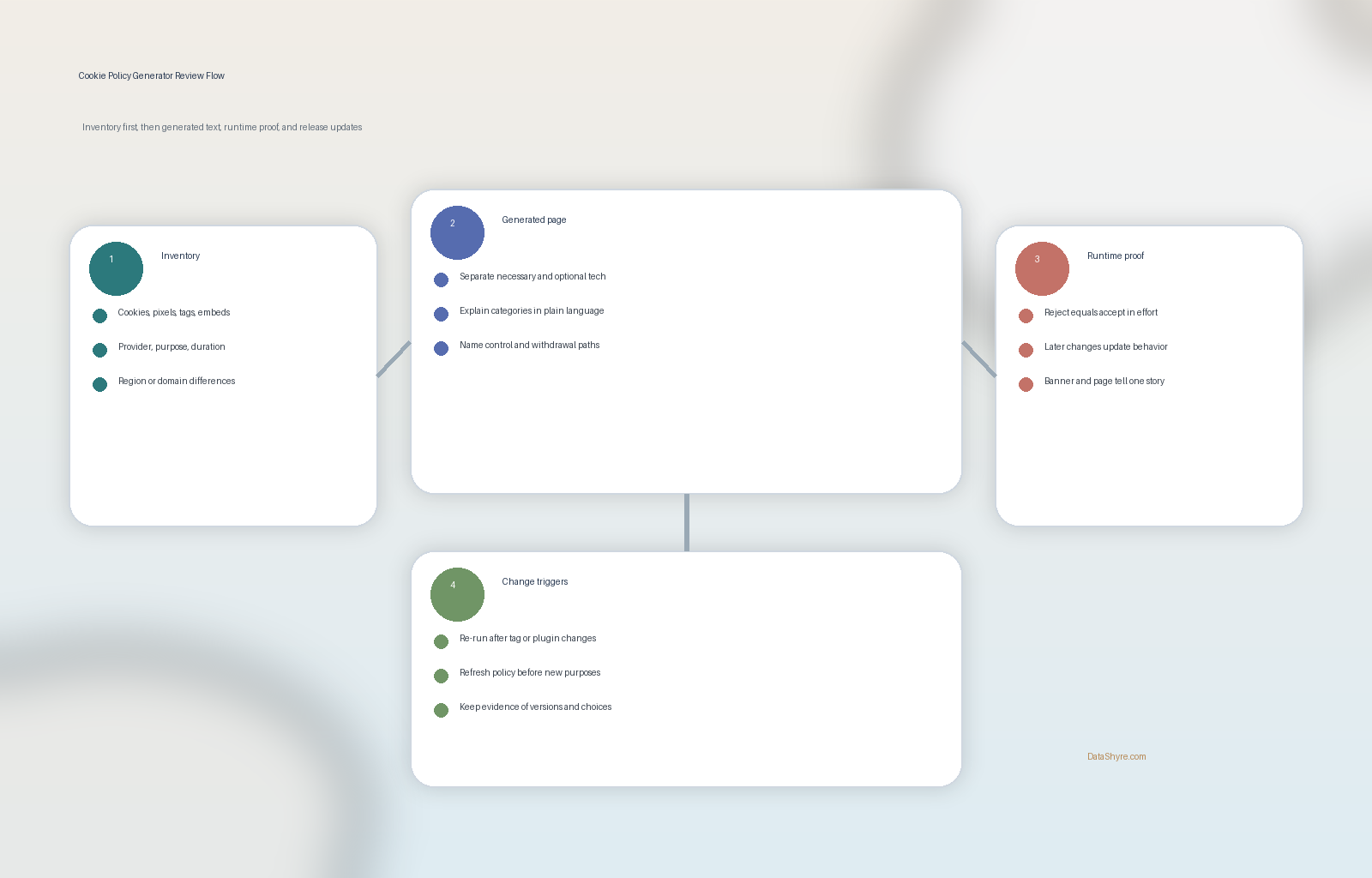
A practical cookies policy generator review for this week
If you were reviewing a cookies policy generator today, use this order:
- inventory the live technologies and related providers;
- separate necessary behavior from optional tracking;
- rewrite vague generated clauses into real categories, purposes, providers, and duration;
- compare the page against the banner, settings panel, reject path, and withdrawal path;
- align it with the broader privacy policy and rights routes; and
- set the next re-review trigger before the next release.
That sequence catches more real problems than polishing the prose first.
FAQ
Is a cookies policy generator enough by itself?
No. A cookies policy generator can help you draft the page faster, but it cannot prove what the live site loads or whether the control layer behaves the way the page describes.
What should a cookies policy generator output include?
At minimum, it should help you describe categories, purposes, providers, duration, consent logic, third-party involvement, and how users can later change or withdraw their choices.
Is a cookies policy generator the same as a privacy policy generator?
No. A cookies policy generator goes deeper on device-level technologies and control paths. A privacy policy generator covers the wider collection, use, sharing, retention, and rights picture.
Bottom line
The best cookies policy generator in 2026 is not the one that writes the smoothest generic draft.
It is the one you treat like a structured starting point while you compare the output against the real inventory, the real banner behavior, the real third parties, and the real update process on the live site.
If that live comparison is weak, the generator has not solved the problem.
The fastest way to judge cookies policy generator is to test it the way a broken deployment would expose it: before consent, after consent, and again after a stack change.
Official sources used
- Your Europe: Online privacy – How to use cookies on your website
- EUR-Lex: Regulation (EU) 2016/679, Article 7
- ICO: Cookies and similar technologies
- ICO: Final storage and access technologies guidance published
- CNIL: Dark Patterns in Cookie Banners: CNIL issues formal notice to website publishers
- California Privacy Protection Agency: What General Notices Are Required By The CCPA?