Accessibility Testing Automation in 2026: 7 Checks Before You Trust the Scan
The real value in accessibility testing automation shows up when you debug it like a live system. A banner can render perfectly and still leak requests, misfire tags, or drift after the next plugin or theme update.
The useful test for accessibility testing automation is whether the live stack behaves correctly before consent, after consent, and after the next deployment. That is how hidden leaks and timing mistakes show up.
That is still exactly where the official sources point. ADA.gov says the Department of Justice does not have one detailed business-web regulation, but current technical standards provide “helpful guidance.” W3C’s Web Accessibility Initiative says “Some accessibility checks just cannot be automated” and also says “Tools cannot check all accessibility aspects automatically.” For state and local governments, the DOJ’s April 20, 2026 interim final rule extended the Title II compliance dates to April 26, 2027 for larger public entities and April 26, 2028 for smaller public entities and special district governments. W3C’s WCAG 2.2 publication history also shows the current Recommendation update dated December 12, 2024.
So the useful 2026 question is not did the scanner return zero issues.
It is does our automation catch the right failures early, and do our manual checks confirm people can still complete the real journeys.
For adjacent context, start with these guides to web accessibility, wordpress accessibility plugin, and website privacy checker. This page stays focused on accessibility testing automation as a release discipline, especially on the pages where users navigate, submit forms, and make privacy choices.
If your team is trying to get accessibility testing automation under control without adding a heavyweight privacy stack, DataShyre can help. DataShyre focuses on data subject request automation that are easier to implement, easier to operate, and easier to trust on a live site. Start with DataShyre’s data subject request automation or book a demo.
If your team wants help turning accessibility testing automation into something more useful than a vanity score, DataShyre can help with implementation reviews, CI-ready QA workflows, consent-interface testing, and production checks that compare the policy promise to the live experience.
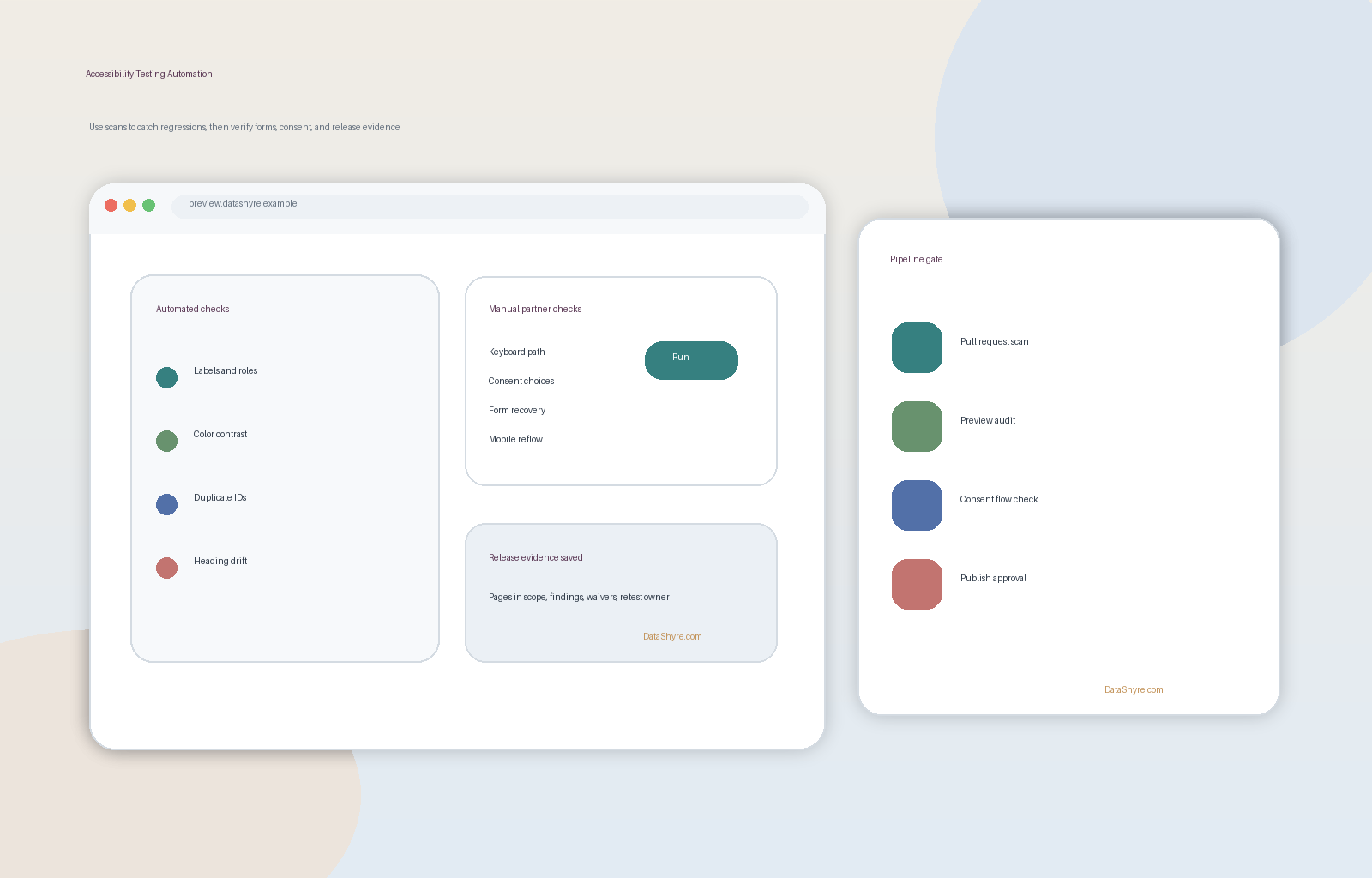
1. Automate the journeys that break revenue, support, and compliance first
The first mistake with accessibility testing automation is aiming it at the easiest pages rather than the highest-risk ones.
That usually means scanning a brochure homepage while ignoring:
- signup and login;
- lead, booking, and checkout forms;
- consent banners and preference centers;
- privacy-request forms;
- account settings and support flows; and
- embedded schedulers, chat, or payment steps.
If those paths fail, the site is not in a good place just because the marketing page score looks clean.
The practical question for accessibility testing automation is whether your scan coverage reaches the journeys where people actually get blocked.
2. Use automation to catch repeatable issues, not to certify the whole experience
This is the line too many teams blur.
Automation is excellent at catching repeatable machine-detectable issues such as:
- missing form labels;
- empty links or buttons;
- color-contrast flags;
- duplicate IDs;
- missing document language; and
- some ARIA misuse.
But W3C is explicit that “Some accessibility checks just cannot be automated.” This is why accessibility testing automation should be treated as a fast filter, not as the final verdict.
You still need human review for things like:
- whether focus order makes sense;
- whether error recovery is understandable;
- whether consent choices are genuinely usable;
- whether alt text is meaningful rather than technically present; and
- whether a real person can finish the task without guessing.
3. Pair the scan with keyboard and screen-reader-adjacent spot checks
If I only had fifteen extra minutes after a scan, I would spend them on operability, not on another dashboard export.
ADA.gov still highlights keyboard access, form clarity, zoom, color cues, and reporting paths as practical accessibility considerations. Those are exactly the places where accessibility testing automation needs a manual partner.
A lightweight post-scan check should verify whether a person can:
- open menus and modals with a keyboard;
- see a visible focus state;
- reject or customize a consent banner without getting trapped;
- submit a form and recover from validation errors; and
- reach help, contact, privacy, or account pages without a mouse.
That is often enough to expose the gap between no critical scan issues and still hard to use.
4. Treat consent banners and privacy forms as accessibility components
This is where privacy and accessibility usually collide.
A lot of automation programs check templates and components but skip the consent layer because it is managed by a vendor or loaded late.
That is a mistake.
Consent interfaces and privacy-request forms are some of the most interaction-heavy parts of the site. A serious accessibility testing automation workflow should include:
- the first-layer banner;
- the preference center or settings modal;
- delete, access, or correction request forms;
- CAPTCHA or anti-spam controls around those flows; and
- the mobile layouts those controls appear on.
If a person cannot refuse tracking, change preferences, or submit a privacy request because the interface is awkward by keyboard or unclear by screen reader, the site has both accessibility and compliance risk.
5. Run automation inside the real delivery pipeline, not as a one-off audit
A lot of teams still run accessibility testing automation like a ceremonial pre-launch step.
That approach misses the real value.
Automation is strongest when it helps catch regressions during ordinary delivery:
- in pull requests;
- in preview environments;
- in CMS workflows before content goes live;
- in scheduled crawls of production;
- after plugin, theme, or component-library updates; and
- after changes to forms, consent tooling, or embeds.
The point is not to create more reports. The point is to make sure the next release does not quietly reintroduce old failures.
6. Include authenticated states, mobile layouts, and third-party surfaces
Many automation setups only test public desktop pages.
That leaves out exactly where a lot of serious breakage lives.
For useful accessibility testing automation, expand coverage to:
- account pages behind login;
- checkout or payment paths;
- mobile breakpoints and zoomed layouts;
- embedded videos, PDFs, maps, and schedulers;
- chat tools and support widgets; and
- region-specific privacy or consent experiences.
W3C’s guidance on evaluation tools also notes that scope varies widely across tools. Some scan one page, while others can check groups of related pages or password-restricted content. That is another reason tool configuration matters almost as much as tool choice.
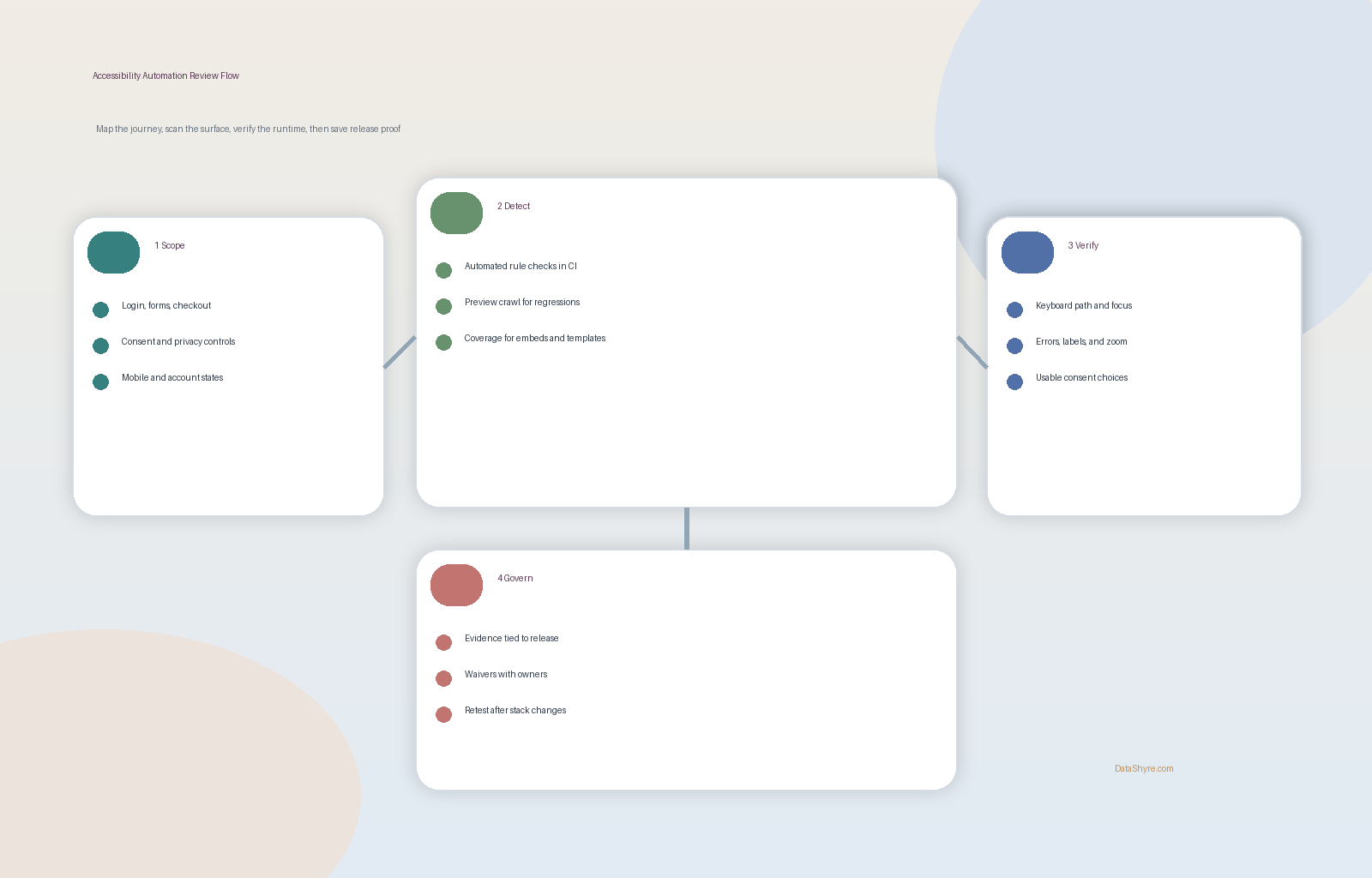
7. Save evidence that explains what the automation checked and what humans verified
The final weak spot is governance.
A green check without context is not much help six weeks later.
Strong accessibility testing automation leaves evidence that answers:
- which pages and journeys were in scope;
- which rules were automated;
- which issues were waived and why;
- which manual checks were run;
- who owns follow-up fixes; and
- which release re-tested the affected experience.
That kind of evidence is more useful than a decorative score because it tells you what the organization actually proved.
A practical automation stack review for this week
If I were tightening accessibility testing automation right now, I would use this order:
- map the five highest-risk journeys;
- make sure automated scans cover those pages and states;
- add manual keyboard and form checks to the same workflow;
- include consent and privacy interfaces explicitly;
- expand coverage to mobile, authenticated pages, and third-party embeds; and
- save evidence that links failures, fixes, and re-tests to a specific release.
That sequence is not flashy, but it tends to move teams from dashboard theater to actual risk reduction.
FAQ
Can accessibility testing automation prove full compliance by itself?
No. W3C is explicit that some checks cannot be automated and that tools cannot determine accessibility on their own. Automation is valuable, but it needs human review to confirm the real experience.
What should we test manually right after the automated scan?
Start with keyboard navigation, visible focus, forms, error recovery, consent choices, and the core user journeys that drive revenue, support, or legal requests.
Does this matter for privacy interfaces too?
Yes. Consent banners, preference centers, and privacy-request forms are often the exact places where users hit modal, focus, labeling, and mobile-layout failures.
Bottom line
The best accessibility testing automation programs in 2026 do not pretend the scanner is the whole answer.
They use automation to catch repeatable failures quickly, then use targeted human checks to confirm the pages that matter still work for real people.
The fastest way to judge accessibility testing automation is to test it the way a broken deployment would expose it: before consent, after consent, and again after a stack change.
Sources
- ADA.gov, Guidance on Web Accessibility and the ADA: https://www.ada.gov/resources/web-guidance/
- ADA.gov, Extension of Compliance Dates for Nondiscrimination on the Basis of Disability; Accessibility of Web Information and Services of State and Local Government Entities: https://www.ada.gov/assets/pdfs/2026-ifr.pdf
- W3C Web Accessibility Initiative, Selecting Web Accessibility Evaluation Tools: https://www.w3.org/WAI/test-evaluate/tools/selecting/
- W3C, Web Content Accessibility Guidelines (WCAG) 2.2 publication history: https://www.w3.org/standards/history/WCAG22/