Terms and Conditions Privacy Policy for Website in 2026: What You Actually Need
The real value in terms and conditions privacy policy for website shows up when you debug it like a live system. A banner can render perfectly and still leak requests, misfire tags, or drift after the next plugin or theme update.
The useful test for terms and conditions privacy policy for website is whether the live stack behaves correctly before consent, after consent, and after the next deployment. That is how hidden leaks and timing mistakes show up.
A terms and conditions page explains the rules for using the site, account, product, checkout flow, or subscription. A privacy policy explains what personal information you collect, why you collect it, who receives it, how long you keep it, what rights people have, and how those rights are exercised.
That distinction matters more in 2026 because official guidance keeps pushing website teams toward specific privacy disclosures, specific rights language, and specific placement. California’s Department of Justice says privacy policies are commonly posted on the website homepage, app landing page, or app download page, and says the policy should be “updated at least once a year.” The California Privacy Protection Agency says the privacy policy should provide a comprehensive description of online and offline information practices and be available through a link with the word privacy in it. The ICO says privacy information must be concise, transparent, and in clear language, and in its current transparency guidance says you must “separate privacy information from terms and conditions.” The FTC adds the blunt enforcement rule: if your company makes privacy promises, it has to “live up to those claims.”
If you want nearby context first, start with these guides to privacy policy template, privacy policy for website, and online privacy policy. This page stays focused on the common website question about whether terms and privacy can be collapsed into one catch-all page.
If your team is trying to get terms and conditions privacy policy for website under control without adding a heavyweight privacy stack, DataShyre can help. DataShyre focuses on consent and preference management that are easier to implement, easier to operate, and easier to trust on a live site. Start with DataShyre’s consent and preference management or book a demo.
If your team needs help turning those pages into a working program instead of a footer ritual, DataShyre can help with data mapping, consent management, and DSR automation. The hard part is rarely publishing two links. The hard part is keeping the privacy language true when forms, vendors, tags, and customer workflows change.
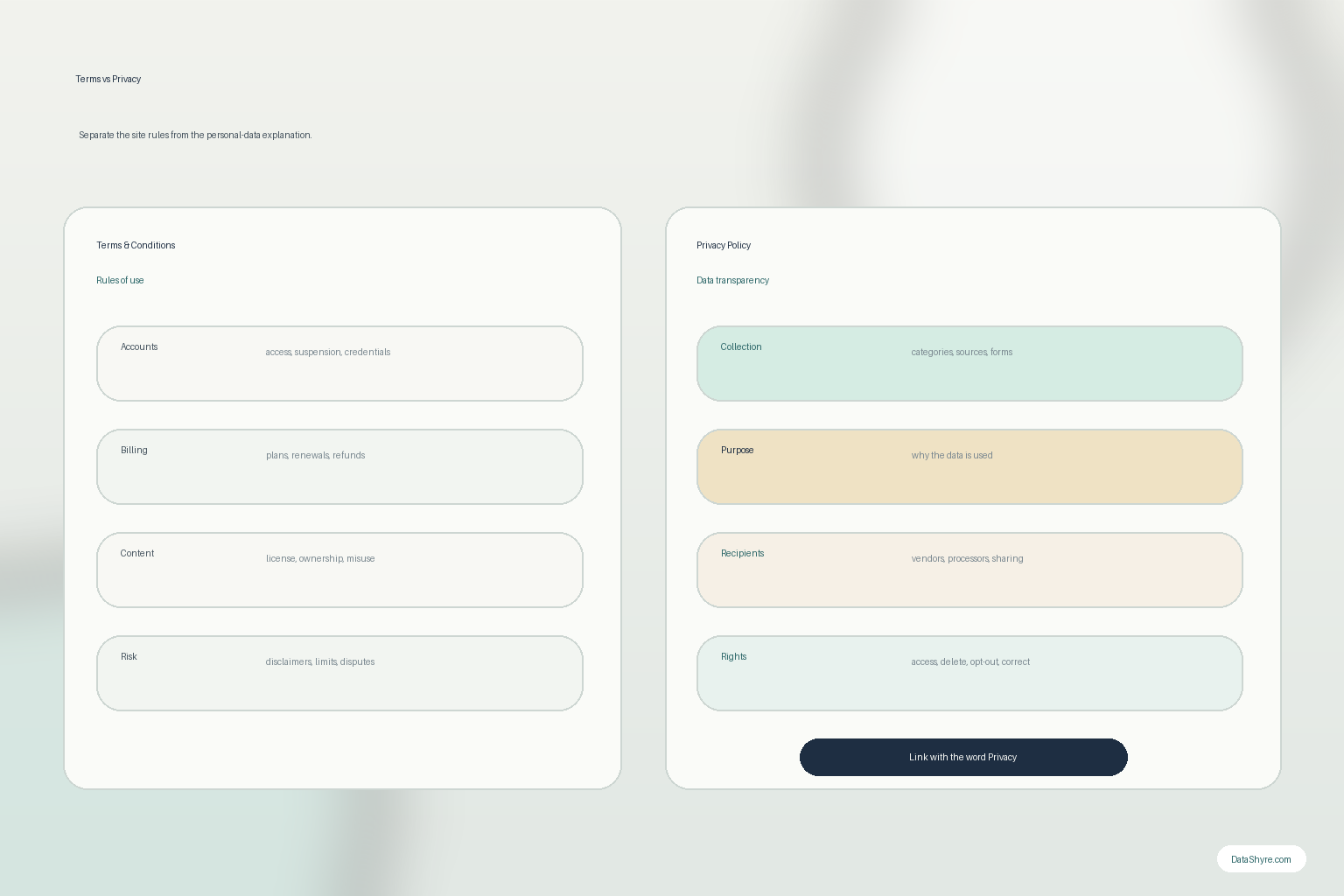
1. Do not use one vague page to do two different jobs
The most common terms and conditions privacy policy for website mistake is combining everything into one legal dump.
That usually creates a page that does neither job well.
Terms and conditions are mainly about the commercial and behavioral rules of the relationship:
- acceptable use;
- account access or suspension;
- billing, refunds, or subscriptions where relevant;
- intellectual property and license terms;
- disclaimers and limitation language.
The privacy policy is different. It is the transparency layer for personal data handling.
So the first check is simple:
if a reader cannot tell where the site rules end and where the personal-data explanation begins, the structure is already weak.
2. Publish the privacy policy where people will actually find it
A terms and conditions privacy policy for website review should not stop at yes, we have both pages.
Placement matters.
California’s DOJ says businesses commonly post privacy policies on the website homepage or on the download or landing page of a mobile app. The CPPA’s current general notice guidance says the link should use the word privacy, such as Privacy Policy or California Privacy Policy. The current CCPA regulations also require the privacy policy to be posted online through a conspicuous link using the word privacy, and for mobile apps the policy must also be reachable through the app’s settings menu.
That means your website should usually expose the privacy policy in obvious places:
- footer or other standard site navigation;
- landing pages or collection points where personal data is requested;
- app download pages or settings if you also run a mobile product;
- any California rights page that points people to the fuller policy.
If the privacy page only exists in a buried help-center corner, the existence of terms and conditions will not save the privacy layer.
3. Make the privacy policy match the live collection map
This is where many terms and conditions privacy policy for website projects fall apart.
The legal pages exist, but the privacy policy still does not describe the real site.
The ICO’s right-to-be-informed guidance says people should be told the purposes of processing, retention periods, recipients, and their available rights. The CPPA’s regulations go further for covered businesses by requiring a meaningful description of categories collected, sources, purposes, categories of third parties, and the rights consumers can exercise.
So before revising the privacy policy, map the live collection points:
- contact, demo, signup, and checkout forms;
- analytics, advertising, and consent tools;
- chat, support, and scheduling widgets;
- CRM or marketing syncs;
- account settings and logged-in product flows;
- embedded video, maps, and other third-party content.
If the privacy page says we may collect information while the live site is clearly collecting named categories through named workflows, the policy is underpowered.
4. Keep privacy disclosures and consent separate from contract acceptance
This is one of the most useful practical checks in a terms and conditions privacy policy for website review.
The ICO’s current transparency guidance says you must “separate privacy information from terms and conditions” and should not use a consent tick box inside the privacy information itself.
That matters because many website teams still bundle several actions into one sentence like:
By creating an account, you agree to our terms, privacy policy, cookies, and marketing updates.
That is sloppy for two reasons.
First, agreeing to site rules is not the same thing as being informed about data handling.
Second, a privacy notice is not the same thing as consent for optional email, marketing, profiling, or similar downstream uses.
So check whether your forms and account flows:
- link clearly to the privacy policy;
- keep terms acceptance separate from optional marketing choices;
- avoid pretending the privacy policy itself is the user’s consent mechanism;
- give just-in-time context near the field or button where data is collected.
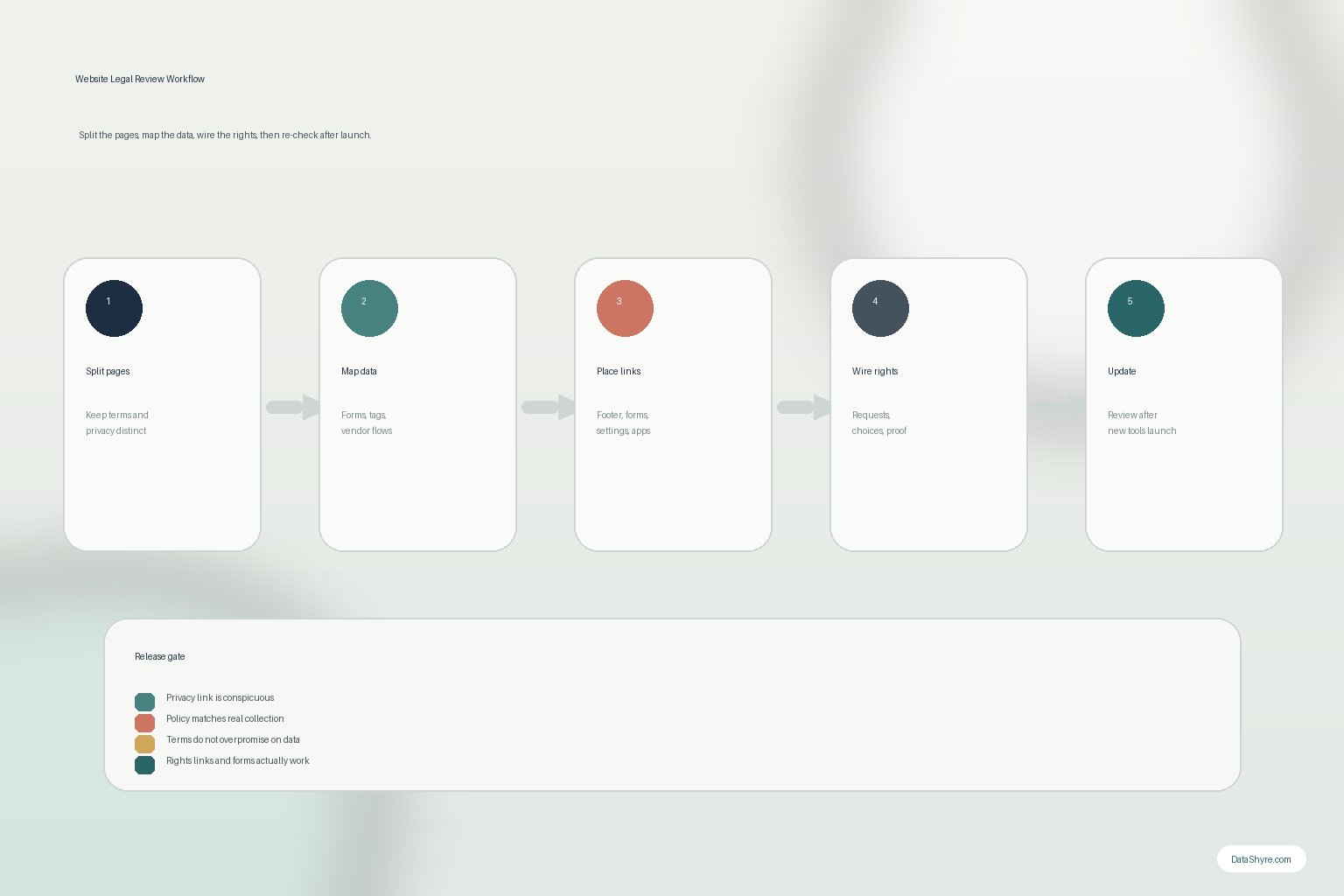
5. Add the rights and links modern California rules expect
For many U.S.-facing sites, this is the highest-risk gap in a terms and conditions privacy policy for website setup.
The CPPA says the privacy policy should describe privacy rights and how to exercise them. Its FAQs also point consumers back to the privacy policy for instructions on submitting requests. And for businesses that sell or share personal information, California requires a clear path for opt-out rights such as Do Not Sell or Share My Personal Information or Your Privacy Choices.
So if California rules apply to your business model, your privacy setup should not stop at the main policy page.
You may also need:
- a California rights section in the privacy policy;
- request-submission instructions;
Your Privacy Choicesor equivalent opt-out paths where required;- links that are easy to find in headers, footers, forms, or app surfaces;
- policy language that matches what the rights tools actually do.
This is exactly where implementation tends to drift. If a vendor like OneTrust or Cookiebot is powering your opt-out or consent layer, the right move is not blind trust in the banner. It is runtime testing plus proof. DataShyre can help audit that wiring and make sure the privacy page, preference center, and downstream suppression actually agree.
6. Let the terms page handle site rules, not privacy promises it cannot keep
A weak terms and conditions privacy policy for website setup often leaks privacy language into the terms page in careless ways.
For example:
- vague claims that data is
securewithout explaining controls elsewhere; - blanket permission language that conflicts with the privacy policy;
- broad rights to use data
for any purposeeven though the privacy page describes narrower uses; - one page saying data can be deleted on request while another page leaves no usable method.
This is where the FTC’s guidance matters. If your company makes privacy promises, it must “live up to those claims.”
So the safe operating rule is:
use the terms page for site and commercial rules, and use the privacy policy for transparent data explanations. Then read both pages together to catch contradictions before they go live.
7. Add update triggers so the two pages do not drift apart
The last terms and conditions privacy policy for website check is operational.
The pages may be accurate today and wrong next month.
California’s DOJ says the privacy policy should be “updated at least once a year.” The ICO says privacy information should be reviewed and, where necessary, updated, and that new uses of personal data should be brought to people’s attention before the new processing begins.
That means your update triggers should include more than an annual calendar reminder.
Review the privacy policy and related links whenever you:
- add a new form, funnel, or signup path;
- install a new analytics, ad-tech, or chat tool;
- change processors, vendors, or sharing behavior;
- add a mobile app or logged-in feature;
- launch a new purpose for collected personal data;
- change how California or other regional rights are handled.
If your team wants the simple version, the right terms and conditions privacy policy for website setup in 2026 is not one giant legal page.
It is:
- a terms page that governs use of the site or service;
- a privacy policy that explains the real data lifecycle;
- collection-point disclosures that support the policy;
- rights mechanisms that match the promises on the page;
- an update workflow that keeps everything aligned after release.
FAQs
Do I need both terms and conditions and a privacy policy on a website?
Usually, yes. The terms page and privacy policy do different jobs. Terms govern use of the service. The privacy policy explains personal-data practices, rights, and required disclosures.
Can I combine terms and privacy into one page?
You can technically place both on one long page, but it is often a bad idea. The stronger pattern is to keep the privacy information distinct, easy to find, and not buried inside contract language.
Is a privacy policy enough if I already have a cookie banner?
The fastest way to judge terms and conditions privacy policy for website is to test it the way a broken deployment would expose it: before consent, after consent, and again after a stack change.
Sources
- California Department of Justice, How to Read a Privacy Policy: https://oag.ca.gov/privacy/facts/online-privacy/privacy-policy
- California Privacy Protection Agency, What General Notices Are Required By The CCPA?: https://cppa.ca.gov/pdf/general_notices.pdf
- California Privacy Protection Agency, CCPA statute and regulations effective January 1, 2026: https://cppa.ca.gov/regulations/pdf/ccpa_statute_eff_20260101.pdf
- FTC, Privacy and Security business guidance: https://www.ftc.gov/business-guidance/privacy-security
- ICO, Right to be informed: https://ico.org.uk/for-organisations/uk-gdpr-guidance-and-resources/individual-rights/individual-rights/right-to-be-informed/
- ICO, How should we tell people what we’re doing?: https://ico.org.uk/for-organisations/uk-gdpr-guidance-and-resources/online-tracking/guidance-for-consumer-internet-of-things-products-and-services/how-should-we-tell-people-what-we-re-doing/
- EUR-Lex, GDPR Articles 12 and 13: https://eur-lex.europa.eu/legal-content/EN/TXT/?uri=celex:32016R0679