What Are Third Party Cookies in 2026? Plain-English Definition, Why They Still Matter, and 7 Live Checks
The real value in what are third party cookies shows up when you debug it like a live system. A banner can render perfectly and still leak requests, misfire tags, or drift after the next plugin or theme update.
The useful test for what are third party cookies is whether the live stack behaves correctly before consent, after consent, and after the next deployment. That is how hidden leaks and timing mistakes show up.
That sounds like a small technical detail.
In real deployments, it is the reason another company can often recognize activity that started on someone else’s website.
That is also why the topic is still alive in 2026. Firefox says cross-site tracking cookies are “disabled by default” for its users, but Chrome’s current approach still has not turned third-party cookies into a historical artifact. Regulators are also still looking at the real tracking purpose, not only the cookie label.
If you want nearby context first, start with these guides to third party cookies, browser cookies, and find tracking cookies. This page stays simpler. It is the what are third party cookies explainer I would use this week before reviewing a banner, a privacy policy, or a live website audit.
If your team is trying to get what are third party cookies under control without adding a heavyweight privacy stack, DataShyre can help. DataShyre focuses on consent and preference management that are easier to implement, easier to operate, and easier to trust on a live site. Start with DataShyre’s consent and preference management or book a demo.
If your team already knows the definition but still cannot prove what happens after reject, accept, opt-out, or browser changes, DataShyre can help with consent management, data mapping, and website privacy checker.
1. Start with the plain-English definition
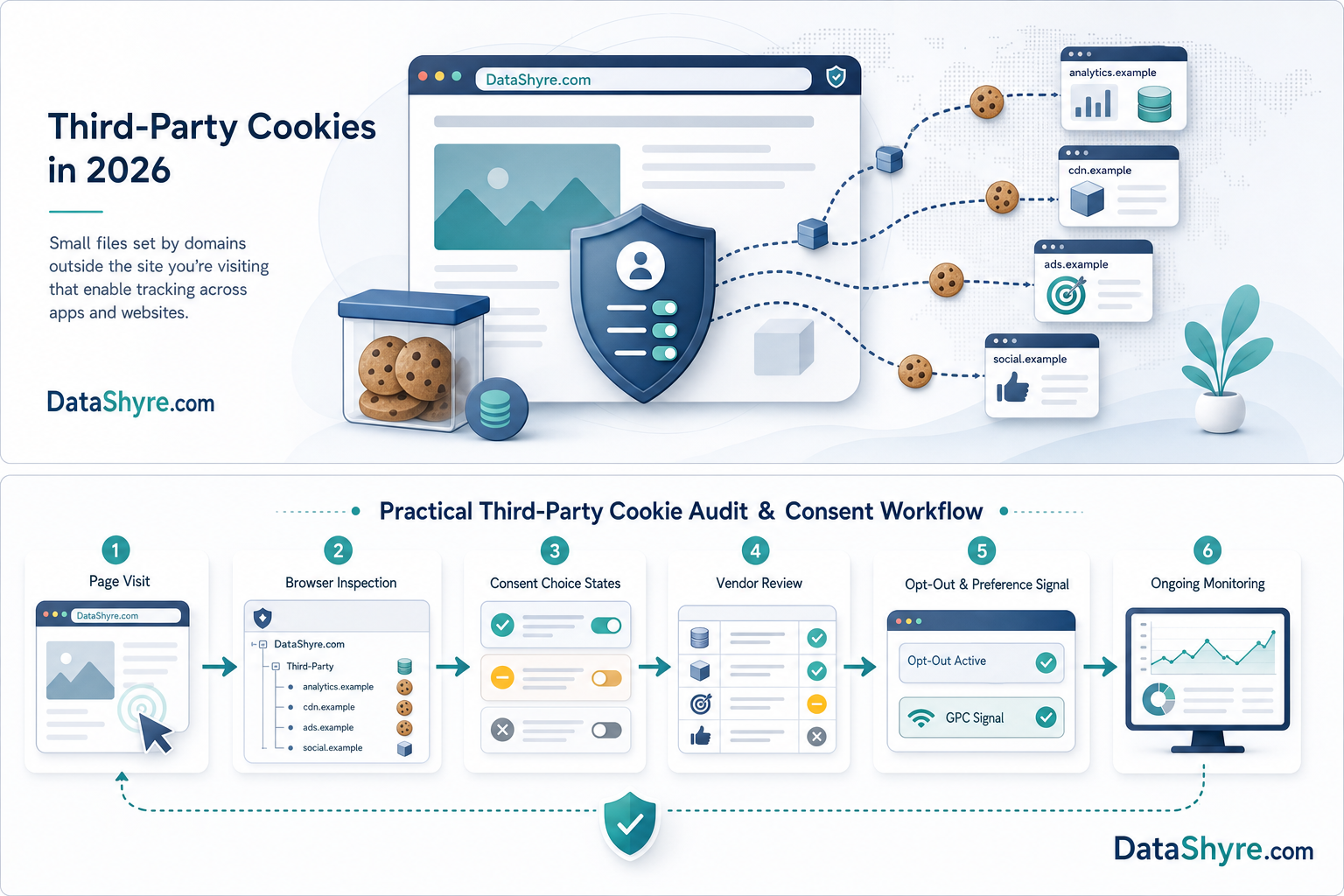
The cleanest answer to what are third party cookies is about who sets the cookie.
Chrome’s developer documentation describes third-party cookies as cookies set by a site different from the current top-level page. Firefox’s support documentation uses nearly the same idea and calls them cookies set by a website other than the one you are currently on.
That means a simple example looks like this:
- a person visits
example.com; - an embedded ad, social widget, video, or measurement tool loads from another company;
- that other company sets or reads an identifier; and
- the identifier may later help recognize activity somewhere else.
So the useful definition is not just another kind of cookie.
It is a cookie that usually signals another party is involved in the page experience.
2. Understand why businesses still use them
People often ask what are third party cookies because they are trying to connect the browser behavior to the business purpose.
That is the right instinct.
The FTC’s current consumer guidance says first-party tracking is when a site tracks activity itself, while third-party tracking is when the site lets another company track the person. The same FTC page says third-party tracking companies can track people across most of the websites they visit.
This is why third-party cookies have historically been used for things like:
- advertising and retargeting;
- cross-site measurement;
- social-media widgets;
- embedded services that need continuity across domains; and
- recommendation or personalization systems tied to outside vendors.
Once you see the purpose, the keyword what are third party cookies becomes much easier to answer honestly. They are not mysterious browser dust. They are a way another company can keep state tied to the visitor across contexts.
3. Do not assume every browser treats them the same way
This is where many outdated articles break.
Firefox’s current support page says cross-site tracking cookies are “disabled by default” for all Firefox users. It also says Firefox includes Total Cookie Protection, which creates a “cookie jar” for every website so cookies stay with the site where they were created rather than following the user across sites in the same way.
Chrome is not the same story.
Chrome’s September 8, 2026 release notes for Chrome 153 say the browser is maintaining its current approach to third-party cookies, and the release notes tie several Privacy Sandbox deprecations to that decision.
The practical takeaway for what are third party cookies is simple:
- browser behavior varies;
- user settings vary;
- mobile app and embedded-webview behavior can vary again; and
- a site that looks clean in one environment may look very different in another.
This is why one screenshot from one browser is not a serious audit.
4. Do not stop at the cookie label
In 2026, what are third party cookies is still a useful question, but it is no longer the only useful question.
The ICO’s finalized 2026 guidance says whether a storage or access technology is classed as first-party or third-party is “not the main consideration” for privacy and data-protection purposes. The same guidance explains that the rules can apply to a broader set of technologies, including scripts, tags, web storage, and fingerprinting-related methods, not only classic cookies.
That matters because a website can reduce obvious third-party cookies while still keeping the same tracking outcome through:
- local or session storage;
- embedded scripts;
- pixels or tags;
- server-side handoffs; or
- other identifiers that keep the same advertising or measurement purpose alive.
So a strong what are third party cookies answer should include a warning: if you only count cookie names, you can still miss the real tracking path.
5. Separate consent and opt-out into different branches
This is where what are third party cookies stops being a browser-only question and becomes a compliance question.
UK and EU branch
The ICO’s current guidance says non-exempt storage and access technologies should not be pre-enabled and that many optional tracking uses still need consent before they run. In plain language, optional advertising or cross-site recognition usually cannot be treated like a necessary session cookie.
California branch
California often changes the practical question from prior consent to notice, opt-out, and signal handling.
The California Department of Justice says the Global Privacy Control is a “stop selling or sharing my data switch” and says covered businesses must honor it as a valid request where the law applies. So if third-party cookies feed advertising, sharing, or cross-context behavioral profiling, the review should test whether the site actually changes behavior after a valid opt-out signal arrives.
This is why copied banner text is not enough. The legal result depends on what the site and its vendors actually do after the person says no.
6. Test the live site instead of trusting the policy alone
When someone asks what are third party cookies, they often really mean:
how do I tell whether my site is still using them in a way that matters?
The answer is a live runtime test.
I would check at least these states:
- first visit with no click at all;
- explicit reject;
- explicit accept;
- category-level choices where available;
- later withdrawal or preference change; and
- browser-level privacy signals such as GPC where the law makes them relevant.
Then compare:
- which cookies appear;
- which outside domains receive requests;
- whether the same vendors still receive identifiers after a negative choice; and
- whether the privacy policy and notice text actually describe that behavior.
That is usually where the real answer to what are third party cookies shows up.
7. Keep one eye on enforcement and one eye on substitute tracking
The latest enforcement signal here is recent.
On October 22, 2026, the CNIL fined FNAC DARTY PARTICIPATIONS ET SERVICES and FNAC DIRECT a total of 7 million euros, and its public write-up says a tracker collecting browsing history for personalized recommendations and algorithm training was used “without the prior consent” of the individuals concerned.
That matters for what are third party cookies because it reinforces two practical points:
- regulators still care about real tracking outcomes; and
- changing the technical wrapper does not erase the consent question if the purpose is still personalization, targeting, or broader profiling.
So the right audit question is not only is this technically a third-party cookie.
It is what information is being stored or accessed, by whom, for what purpose, and what changes after the user refuses.
A practical 7-step review for this week
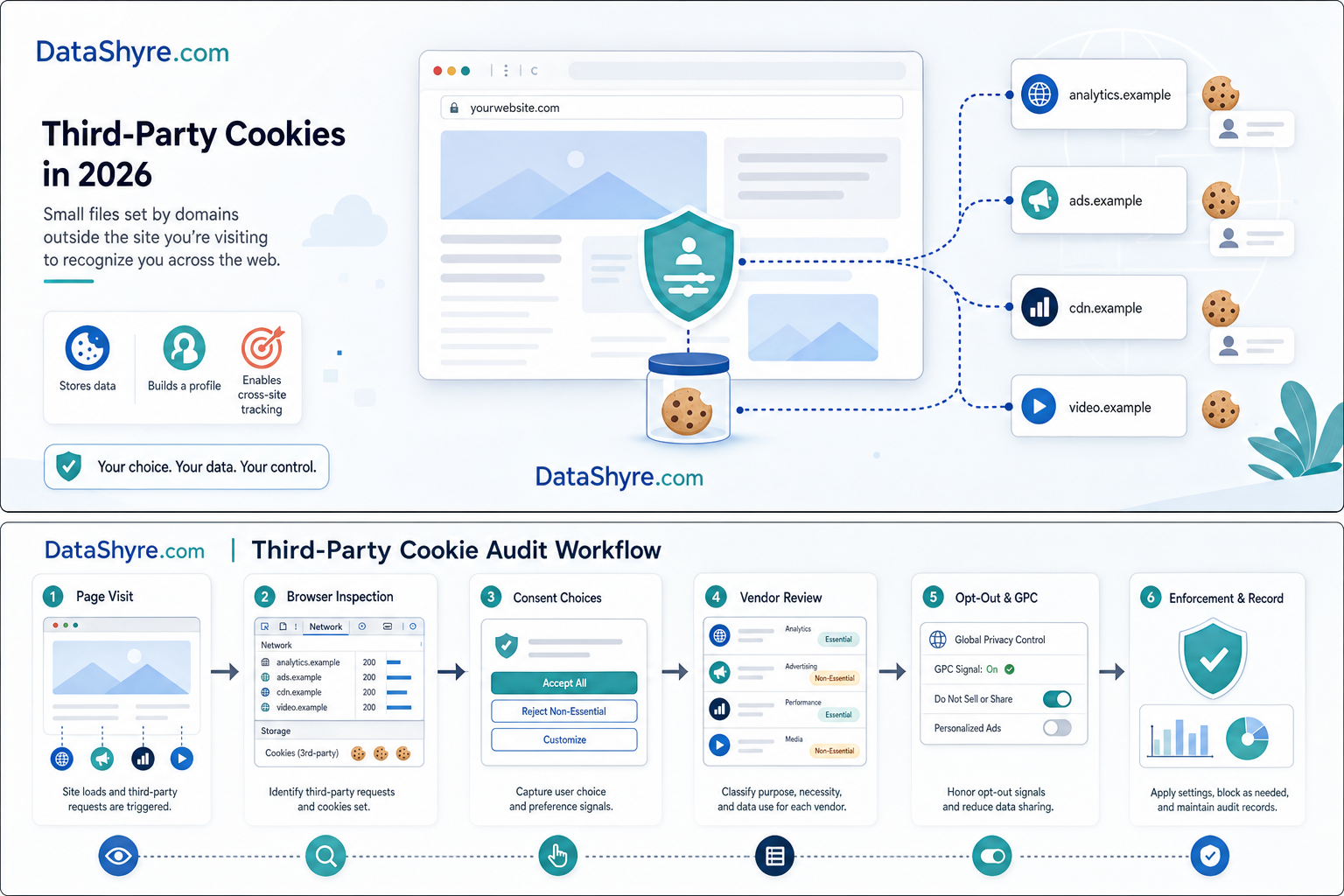
If you were reviewing what are third party cookies on a live site this week, use this order:
- identify every third-party script, embed, and cookie present before any user choice;
- map which outside vendor receives data and why;
- compare Chrome and Firefox behavior instead of assuming one browser tells the whole story;
- separate necessary functions from analytics, advertising, and cross-site recognition;
- test reject, accept, withdrawal, and California opt-out or GPC branches where relevant;
- compare the runtime findings against the notice, banner, and privacy policy; and
- save evidence before the next release changes the result.
That workflow catches more truth than a definitions page alone.
FAQ
What are third party cookies in simple terms?
They are cookies set by a different domain than the main site you are visiting, often so another company can remember or recognize activity across sites or sessions.
Are third party cookies already gone?
No. Browser handling differs. Firefox blocks or isolates more by default, while Chrome’s current approach still has not made third-party cookies disappear across the web.
Are third party cookies always illegal?
No. The real question is what they are used for, which jurisdictions apply, and whether the site honors the required consent, notice, opt-out, or signal-handling rules for that use.
Bottom line
The best answer to what are third party cookies in 2026 is not only cookies from another domain.
It is cookies that usually indicate another company is involved in remembering, measuring, or tracking activity beyond the page the user thought they were visiting.
The fastest way to judge what are third party cookies is to test it the way a broken deployment would expose it: before consent, after consent, and again after a stack change.
Sources
- Chrome for Developers, View, add, edit, and delete cookies: https://developer.chrome.com/docs/devtools/application/cookies
- Chrome for Developers, Chrome 153 release notes: https://developer.chrome.com/release-notes/153
- Firefox Help, Third-party cookies and Firefox tracking protection: https://support.mozilla.org/en-US/kb/third-party-cookies-firefox-tracking-protection
- FTC Consumer Advice, How Websites and Apps Collect and Use Your Information: https://consumer.ftc.gov/articles/how-websites-and-apps-collect-and-use-your-information
- ICO, Guidance on the use of storage and access technologies: https://ico.org.uk/for-organisations/direct-marketing-and-privacy-and-electronic-communications/guidance-on-the-use-of-storage-and-access-technologies/
- California DOJ, Global Privacy Control (GPC): https://oag.ca.gov/privacy/ccpa/gpc
- CNIL, Cookies and mobile application: 7 million euros fine against FNAC DARTY PARTICIPATIONS ET SERVICES and FNAC DIRECT: https://www.cnil.fr/en/sanction-app-cookies-fnac