GDPR Standards in 2026: 7 Practical Standards Businesses Should Still Meet
The real value in gdpr standards shows up when you debug it like a live system. A banner can render perfectly and still leak requests, misfire tags, or drift after the next plugin or theme update.
The useful test for gdpr standards is whether the live stack behaves correctly before consent, after consent, and after the next deployment. That is how hidden leaks and timing mistakes show up.
The real gdpr standards are the operating standards you can still see in the regulation and in regulator guidance: lawful and transparent processing, data minimization, provable records, privacy by design, security appropriate to risk, and rights handling that works in practice.
This is why a serious gdpr standards review is less about slogans and more about evidence. The GDPR’s own text still anchors the basics in Article 5, Article 12, Article 25, and Article 30. The ICO’s current guidance still pushes the same operational themes: your records should be “kept up to date”, your privacy information should stay accurate and understandable, your security should use “appropriate technical and organisational measures”, and rights requests should normally be answered within “one calendar month.”
If you want nearby context first, start with these guides to general data protection regulation, gdpr requirements, and gdpr compliant. This page stays narrower. It is the gdpr standards review I would use this week before calling a privacy program ready for EU-facing work.
If your team is trying to get gdpr standards under control without adding a heavyweight privacy stack, DataShyre can help. DataShyre focuses on consent and preference management that are easier to implement, easier to operate, and easier to trust on a live site. Start with DataShyre’s consent and preference management or book a demo.
If your team is trying to turn broad GDPR obligations into a workable operating system, DataShyre can help with data mapping, consent management, and DSR automation. The gap is usually not knowing the words. It is connecting those words to the actual forms, vendors, systems, and release changes in production.

1. Start with the Article 5 principles, not with vendor marketing
The first gdpr standards mistake is treating the regulation like a feature checklist you can buy.
Article 5 still provides the more useful standard set: lawfulness, fairness, transparency, purpose limitation, data minimization, accuracy, storage limitation, integrity and confidentiality, and accountability.
That changes the review question from do we have a privacy tool to does the business process personal data in a way that actually reflects those principles.
Before you score anything else, check whether the team can explain:
- what personal data is collected;
- why each category is collected;
- where it moves after collection;
- who can access it;
- how long it is kept; and
- how the business proves each answer stays current.
If the team cannot explain those basics, the rest of the gdpr standards discussion becomes theater.
2. Treat records of processing as a living standard, not a paperwork exercise
One of the clearest operational gdpr standards is still Article 30 and the need for “records of processing activities.”
The ICO’s documentation guidance is useful here because it does not frame records as an archive nobody opens. It says records support good data governance, help demonstrate compliance, and should be “kept up to date” so they reflect current processing activities.
That means a real gdpr standards review should verify that the organization can document:
- purposes of processing;
- categories of data subjects and personal data;
- recipients and processors;
- transfers outside the EEA or UK where relevant;
- retention logic; and
- the security measures tied to the processing.
If those records only exist as a stale spreadsheet from last year, the program is already below standard.
3. Make lawful basis and privacy by design part of change management
Many teams talk about gdpr standards as if they apply only at launch.
That is too late.
Article 25 still requires data protection by design and by default. In real deployments, that means privacy review belongs in product changes, new forms, analytics changes, new vendors, AI features, onboarding redesigns, and market expansion work.
The most useful gdpr standards question is therefore not did legal approve the notice once.
It is what happens when the business adds a new use of personal data.
A solid operating standard usually means:
- lawful basis is chosen before release, not after launch;
- optional data fields are challenged before they ship;
- new processors or recipients trigger review;
- new sharing or transfer patterns are documented;
- privacy notices and internal records update alongside the release; and
- the default experience is not more invasive than necessary.
That is what makes privacy by design real instead of decorative.
4. Hold notices to the standard of clear and plain language
Article 12 is still one of the simplest and most demanding gdpr standards in the text: privacy information should be presented using “clear and plain language.”
The ICO’s right-to-be-informed guidance adds the practical reminder that simply listing the Article 13 and 14 items is not always enough to satisfy the wider transparency principle.
So when reviewing gdpr standards, do not only ask whether a privacy notice exists.
Ask whether a normal person can understand:
- who is collecting the data;
- why it is being used;
- what legal basis applies where relevant;
- who receives the data;
- whether international transfers happen;
- how long the data is kept or how the period is decided; and
- what rights and controls the person can actually use.
If the answer lives only in dense footer prose, your transparency standard is weaker than you think.
5. Do not separate minimization, retention, and transfers from the main review
A weak gdpr standards review often spends all its energy on notices and consent banners while ignoring what happens after collection.
That is a mistake because the regulation does not treat collection as the whole problem.
The standards around minimization, storage limitation, and transfer control matter just as much.
A practical review should therefore check whether the business can show:
- why each field on key forms is necessary;
- whether duplicate or unused fields have been removed;
- how retention periods are set and enforced;
- whether archived data is still reachable by teams that no longer need it;
- which vendors receive personal data; and
- what safeguards apply when data moves across borders.
If those questions do not have operational answers, the organization is probably carrying more GDPR risk than the homepage notice suggests.
6. Measure security against actual risk, not generic policy language
The GDPR does not prescribe one fixed technical stack, but it still sets a clear security standard.
The ICO’s current security guidance says personal data must be processed securely using “appropriate technical and organisational measures” and explains that the level of security should be appropriate to the risk.
That is the useful standard.
Not do we have a policy PDF.
For gdpr standards, security review should cover whether the organization can demonstrate:
- access controls tied to real roles;
- asset and system awareness for data-bearing systems;
- vulnerability and patch management;
- encryption where appropriate at rest and in transit;
- logging, monitoring, and incident response; and
- regular testing of whether the controls still work.
If security is described only in abstract language, the privacy standard is not yet operational.
7. Make rights handling a timed service, not a theoretical promise
Some teams pass a gdpr standards review on paper and fail it the first time a real person asks for access, erasure, or objection handling.
This is why rights workflow is one of the clearest maturity tests.
The ICO’s public guidance says organizations must usually respond to data protection rights requests no later than “one calendar month.” Its transparency guidance also says privacy information should be reviewed and updated so it remains accurate and up to date.
So a serious gdpr standards review should test:
- whether users can find the request path easily;
- whether teams can verify identity without creating needless friction;
- whether the workflow reaches every system that holds the data;
- whether objections, deletions, and corrections can be executed consistently;
- whether request outcomes are documented; and
- whether the public notice matches the real request process.
If a rights workflow depends on guessing which inbox might respond, the standard is not met yet.
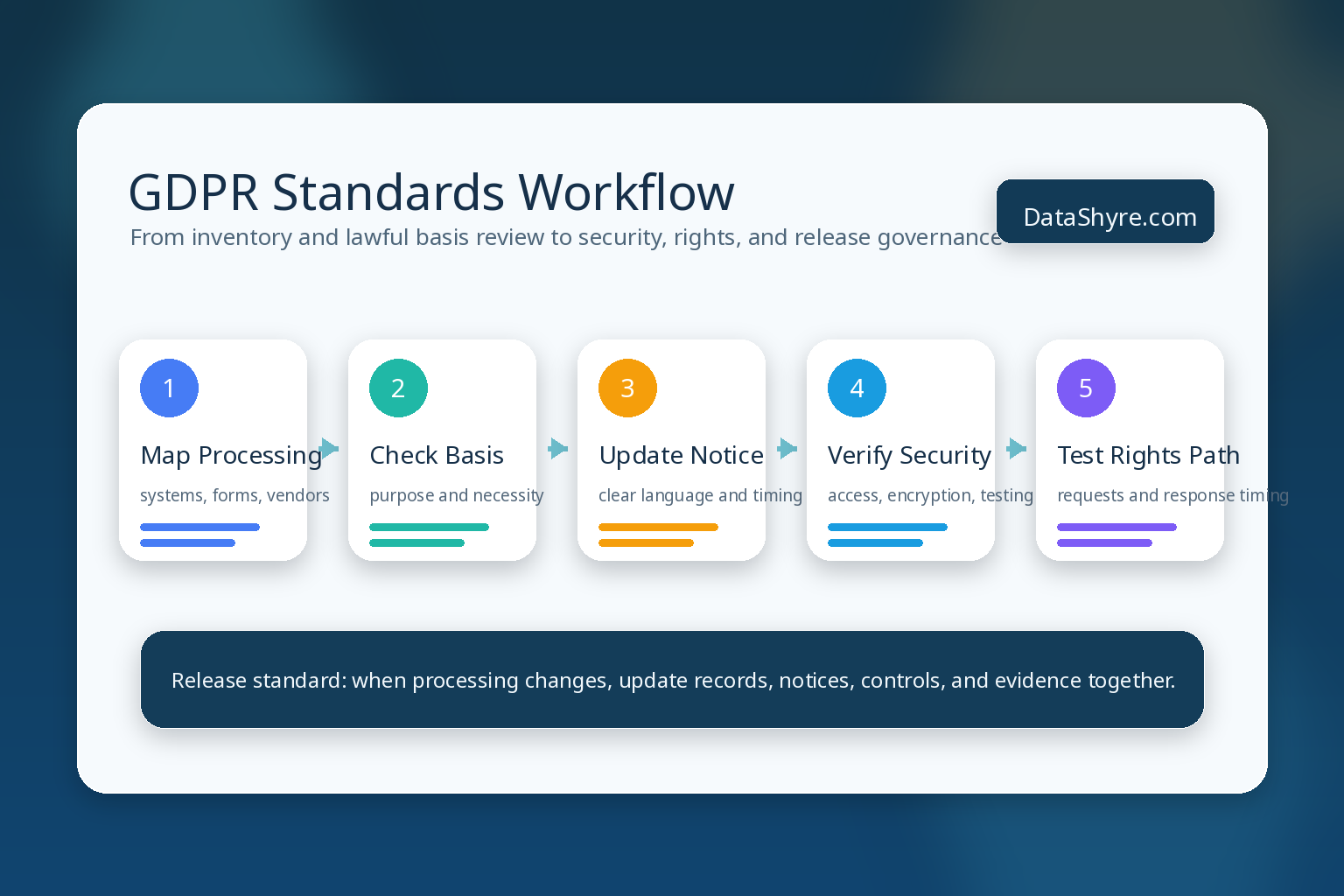
A practical 7-step GDPR standards review for this week
If you were reviewing gdpr standards today, use this order:
- map the real processing and check it against the Article 5 principles;
- confirm that records of processing are current and usable;
- verify lawful basis, purpose logic, and change-management triggers;
- rewrite or simplify any notices that fail the clear-language test;
- check minimization, retention, recipients, and transfer controls;
- test security evidence against the actual processing risk; and
- run a live rights-request drill instead of trusting the written policy.
That order catches more operational weakness than a policy-only audit.
FAQ
Is there an official GDPR certification that proves compliance?
Not for most teams in the simple way people usually mean it. The more useful question is whether your controls, records, notices, security, and rights workflows can be shown to work.
Are GDPR standards mostly about consent banners?
No. Consent can matter, but the broader standards also cover lawful basis, transparency, minimization, retention, security, processor oversight, transfers, and rights handling.
What is the most commonly missed GDPR standard?
Usually it is not the existence of a policy. It is the mismatch between the documented story and the live systems, vendors, and workflows actually processing personal data.
Bottom line
The most useful way to think about gdpr standards in 2026 is not as a fixed badge.
It is as a set of practical operating standards that should still be visible in your records, product changes, notices, security controls, and rights workflow every week.
The fastest way to judge gdpr standards is to test it the way a broken deployment would expose it: before consent, after consent, and again after a stack change.
Sources
- EUR-Lex, Regulation (EU) 2016/679 (GDPR), especially Articles 5, 12, 25, and 30: https://eur-lex.europa.eu/eli/reg/2016/679/oj/eng/
- ICO, Guide to accountability and governance: https://ico.org.uk/for-organisations/uk-gdpr-guidance-and-resources/accountability-and-governance/guide-to-accountability-and-governance
- ICO, Documentation: https://ico.org.uk/for-organisations/uk-gdpr-guidance-and-resources/accountability-and-governance/documentation/
- ICO, Right to be informed: https://ico.org.uk/for-organisations/uk-gdpr-guidance-and-resources/individual-rights/individual-rights/right-to-be-informed/
- ICO, How should we draft our privacy information?: https://ico.org.uk/for-organisations/uk-gdpr-guidance-and-resources/individual-rights/the-right-to-be-informed/how-should-we-draft-our-privacy-information/
- ICO, Security outcomes: https://ico.org.uk/for-organisations/uk-gdpr-guidance-and-resources/security/a-guide-to-data-security/security-outcomes
- ICO, Time limits for responding to data protection rights requests: https://ico.org.uk/for-the-public/time-limits-for-responding-to-data-protection-rights-requests/