Datenschutzerklärung Generator in 2026: 7 Checks Before You Publish Generated Privacy Text
The real value in datenschutzerklärung generator shows up when you debug it like a live system. A banner can render perfectly and still leak requests, misfire tags, or drift after the next plugin or theme update.
The useful test for datenschutzerklärung generator is whether the live stack behaves correctly before consent, after consent, and after the next deployment. That is how hidden leaks and timing mistakes show up.
That is the real job.
Usually, a datenschutzerklärung generator means a tool that drafts a German-language privacy notice or GDPR-oriented website privacy policy.
That can save time.
It cannot verify reality.
The official sources still point in the same direction. GDPR Article 12 requires privacy information to be provided in a concise, transparent, and easily accessible form using “clear and plain language.” The EDPB’s transparency guidance repeats the same standard with the phrase “concise, transparent, intelligible and easily accessible.” The GDPR’s Article 13 disclosure list still expects the notice to cover the purposes of processing, the legal basis, recipients, storage period, and the user’s rights. Germany’s BfDI says that beyond the banner, additional information should be made available, for example “in einer Datenschutzerklärung.” And WordPress keeps the implementation warning simple: starter text may help, but site owners still need to keep the policy “current and accurate.”
If you want nearby context first, start with these guides to privacy policy generator, website privacy policy generator, and gdpr policy generator. This page stays narrower. It is the datenschutzerklärung generator review I would use this week before publishing generated German privacy text on a live site.
If your team is trying to get datenschutzerklärung generator under control without adding a heavyweight privacy stack, DataShyre can help. DataShyre focuses on consent and preference management that are easier to implement, easier to operate, and easier to trust on a live site. Start with DataShyre’s consent and preference management or book a demo.
If your team is using a generator because the stack has already outgrown guesswork, DataShyre can help connect the drafted page to the actual runtime through data mapping, consent management, and DSR automation. The hard part is usually not producing the first paragraph. It is proving that the page still matches your forms, tracking tools, plugins, vendors, and rights workflow after the next release.
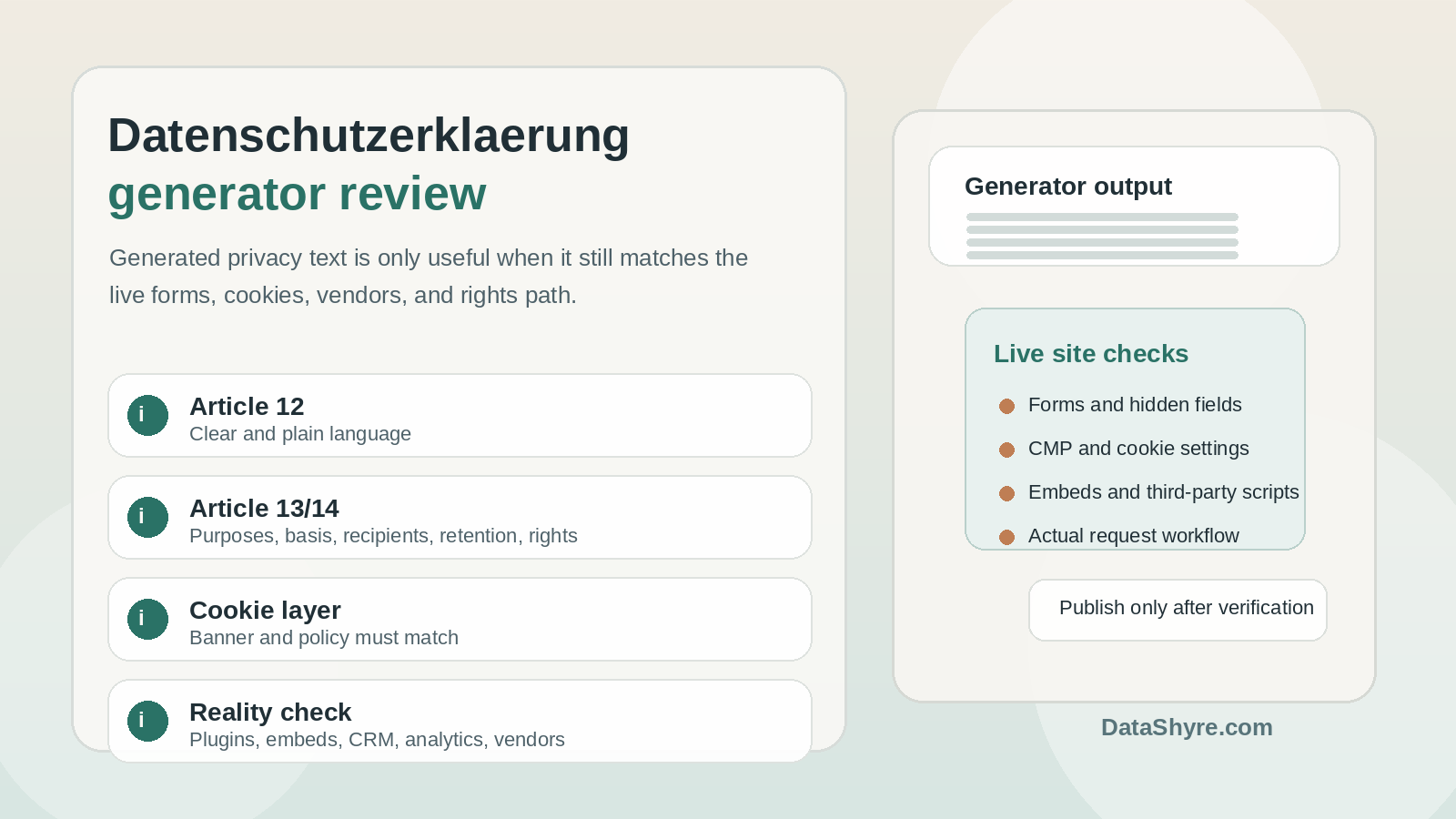
1. Treat the Datenschutzerklärung generator as a drafting tool, not the source of truth
The first datenschutzerklärung generator mistake is assuming the output is authoritative because it looks polished.
It is not.
The tool only knows:
- the answers entered into its questionnaire;
- the template logic it was built around;
- whatever default assumptions it makes about cookies, forms, vendors, or transfers; and
- maybe a partial plugin or CMS context if it is integrated into a platform.
It usually does not know:
- which fields your forms actually send downstream;
- which third-party scripts fire before consent;
- which embedded services receive IP address or behavioral data;
- which CRM, helpdesk, payment, analytics, or email vendors sit behind the visible page; or
- whether the rights path described in the draft still works in production.
This is why a datenschutzerklärung generator should be treated as a structured first draft, not as evidence.
2. Make sure the generated draft actually covers the Article 13 and 14 basics
This is where many generator outputs look serious while still staying too generic.
The GDPR transparency layer is not only about having a page titled Datenschutzerklärung.
It is about whether the page actually tells people what they need to know.
At a minimum, a working datenschutzerklärung generator draft should help you explain:
- who the controller is;
- the purposes of the processing;
- the legal basis for each major processing branch;
- the recipients or categories of recipients;
- the storage period or the criteria used to determine it;
- whether data is transferred outside the EEA and on what basis;
- the rights to access, rectification, erasure, restriction, objection, portability, and complaint; and
- where consent can be withdrawn when consent is the legal basis.
If the generator collapses those items into vague text like we process data to improve our services and comply with legal obligations, the result may sound formal while still being thin where the law expects detail.
3. Do not let the cookie banner stand in for the Datenschutzerklärung
This is a common operational failure.
Teams improve the banner, add a settings panel, and forget that the longer privacy notice still has its own job to do.
The BfDI’s telemedia circular says that beyond the information required in the banner for valid consent, additional information should be provided, for example “in einer Datenschutzerklärung.” It also points to Article 13 GDPR information for processing based on other legal grounds and to information about data-subject rights and contact details.
That means your datenschutzerklärung generator output should not treat cookies as an afterthought.
Check whether the generated page actually explains:
- necessary versus optional technologies;
- analytics, advertising, personalization, support, and embedded-service branches;
- which third parties may receive data through cookies or similar technologies;
- where consent is managed later; and
- whether the privacy notice, cookie policy, and settings panel tell the same story.
If the banner says reject all but the privacy page barely describes the optional tools, the user still does not get a clear picture of what happens after load.
4. Compare the generated text against the live forms, plugins, and vendors
This is where generator copy usually drifts away from reality.
A datenschutzerklärung generator can only describe what someone remembered to enter.
Your live site may also involve:
- newsletter plugins;
- booking tools;
- chat widgets;
- analytics tags fired through a tag manager;
- payment providers;
- embedded maps or video;
- CRM handoffs after form submission; and
- plugins that quietly add their own data collection.
WordPress is especially relevant here because its privacy documentation says the helper can assemble starter text from core, themes, and participating plugins, but it also warns that many sites use third-party tools the helper cannot fully detect. The plugin handbook goes further and says plugins that collect, use, or store user data, or pass it to a third party, should add suggested privacy-policy text.
So if your datenschutzerklärung generator is being used on a WordPress site, compare the draft against:
- the active plugin list;
- any tag-manager container or snippets tool;
- embedded services and iframes;
- form destinations and CRM routes; and
- vendor privacy disclosures that the site is actually relying on.
If this is the layer breaking down, DataShyre can help connect the generated policy to the real runtime and implementation choices instead of leaving it as a template artifact.
5. Write for the real audience, not just for the template
A lot of datenschutzerklärung generator output fails because it sounds legal enough to publish but not clear enough to help a normal person.
That is exactly the risk Article 12 and the EDPB transparency guidance are trying to prevent.
If the site is aimed at German-speaking users, the notice should read like it was written for them, not mechanically translated from a generic English template and padded with abstractions.
So review the draft for:
- sentences that are technically correct but unreadable;
- undefined labels such as
service providersorpartners; - one-size-fits-all legal-basis language pasted across every section;
- cookie or tracking text that hides concrete behavior inside the phrase
usage data; - missing explanation around how users can act on rights or settings later.
A good datenschutzerklärung generator output is not the one with the most clauses.
It is the one a user can actually connect to the site they are using.
6. Test the rights path the page describes
A generated privacy notice often lists rights cleanly and operationalizes them badly.
That is not a writing problem.
It is a workflow problem.
When you review datenschutzerklärung generator output, check whether a user could actually follow the instructions the page gives them:
- Is there a working privacy contact?
- Is the DPO contact included where it should be?
- Is the request path clear for access, deletion, correction, objection, or consent withdrawal?
- Do account holders have an in-product route where relevant?
- Do the privacy page and the actual request-handling process still match?
If the page describes a rights workflow that support, marketing, or product teams are not actually following, the problem is already bigger than the generator.
7. Tie generator output to release management so the page does not go stale
The biggest long-term datenschutzerklärung generator risk is drift.
The page can be accurate on launch day and misleading a month later because:
- a new plugin goes live;
- a form changes;
- a new vendor starts receiving personal data;
- the consent flow changes;
- a new region or language version is launched; or
- retention or transfer logic changes behind the scenes.
This is why generator output should be tied to release work, not only to legal cleanup.
If you were reviewing a datenschutzerklärung generator workflow this week, I would require a recheck whenever the live collection, tracking, sharing, or rights path changes.
A practical Datenschutzerklärung generator review for this week
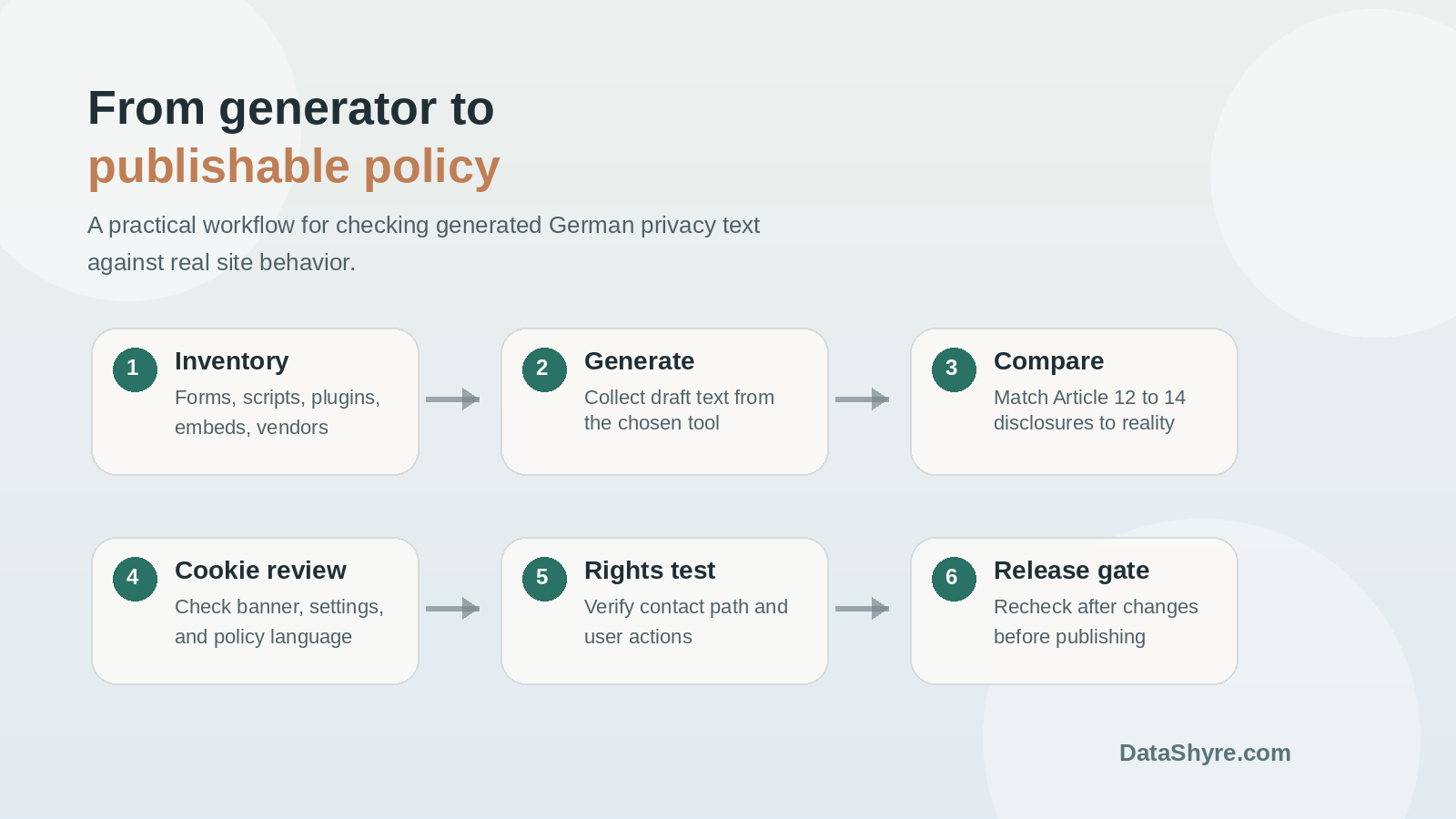
If I were approving datenschutzerklärung generator output today, I would use this order:
- inventory the real forms, cookies, scripts, plugins, and vendors first;
- generate or collect the draft text;
- map the draft against Article 13 and 14 disclosure items;
- compare the page against the banner, settings panel, and cookie disclosures;
- verify the live rights and contact path;
- compare the draft against the real plugins, embeds, and vendor chain; and
- repeat the review whenever the stack changes.
That order usually catches more real problems than polishing the wording first.
FAQ
Is a Datenschutzerklärung generator enough on its own?
No. A datenschutzerklärung generator can speed up drafting, but it cannot verify your live forms, cookies, plugins, vendors, or rights workflow on its own.
What should a Datenschutzerklärung generator output include?
At minimum, it should help you cover controller details, purposes, legal bases, recipients, retention, transfer information, rights, and contact paths in a way that matches the live system.
Can a cookie banner replace the Datenschutzerklärung?
No. The banner handles one part of the consent layer. The datenschutzerklärung generator output still needs to explain the wider processing picture, user rights, and the rest of the disclosures required by the GDPR.
Bottom line
The best datenschutzerklärung generator in 2026 is not the one that produces the fastest legal-looking page.
It is the one you treat as a starting point while you verify GDPR disclosures, cookies, plugins, vendors, and rights workflows against the live system.
If that verification step is weak, the generator has not solved the privacy problem.
The fastest way to judge datenschutzerklärung generator is to test it the way a broken deployment would expose it: before consent, after consent, and again after a stack change.
Sources
- EUR-Lex, Regulation (EU) 2016/679, Articles 12 to 14: https://eur-lex.europa.eu/legal-content/EN/TXT/?uri=CELEX:32016R0679
- EDPB, Guidelines on transparency under Regulation 2016/679: https://www.edpb.europa.eu/system/files/2023-09/wp260rev01_en.pdf
- BfDI, Rundschreiben Telemedien: https://www.bfdi.bund.de/SharedDocs/Downloads/DE/DokumenteBfDI/Rundschreiben/Allgemein/2023/Rundschreiben-Telemedien.pdf
- WordPress.org, WordPress Privacy: https://wordpress.org/documentation/article/wordpress-privacy/
- Developer.WordPress.org, Suggesting text for the site privacy policy: https://developer.wordpress.org/plugins/privacy/suggesting-text-for-the-site-privacy-policy/