Cookie Bot in 2026: 7 Live Checks for Blocking, Withdrawal, and Proof
The real value in cookie bot shows up when you debug it like a live system. A banner can render perfectly and still leak requests, misfire tags, or drift after the next plugin or theme update.
The useful test for cookie bot is whether the live stack behaves correctly before consent, after consent, and after the next deployment. That is how hidden leaks and timing mistakes show up.
The more important difference is this:
the banner preview is not the same thing as the live implementation.
That is the real review standard.
Cookiebot’s current support material still separates scanning, blocking, user controls, consent logging, and cross-domain behavior into different operational layers. Google’s current consent guidance still says the default consent command belongs in place “before any commands that send measurement data.” CNIL still says rejecting cookies should be “just as easy as accepting them.” Taken together, that means a serious cookie bot review is not about whether the banner appears. It is about whether the implementation still behaves correctly on the live site.
If you want nearby context first, start with these guides to Cookiebot, cookie policy, and website privacy checker. This page stays narrower. It is the cookie bot implementation review I would run this week before trusting a production rollout.
If your team is trying to get cookie bot under control without adding a heavyweight privacy stack, DataShyre can help. DataShyre focuses on consent and preference management that are easier to implement, easier to operate, and easier to trust on a live site. Start with DataShyre’s consent and preference management or book a demo.
If your team is trying to decide whether to keep Cookiebot, tighten the implementation, or compare it against larger vendors like OneTrust, DataShyre can help with consent management, runtime privacy testing, and implementation cleanup. The hard part is rarely launching the banner. It is proving that the live site, the consent signals, and the records still match each other after the next release.
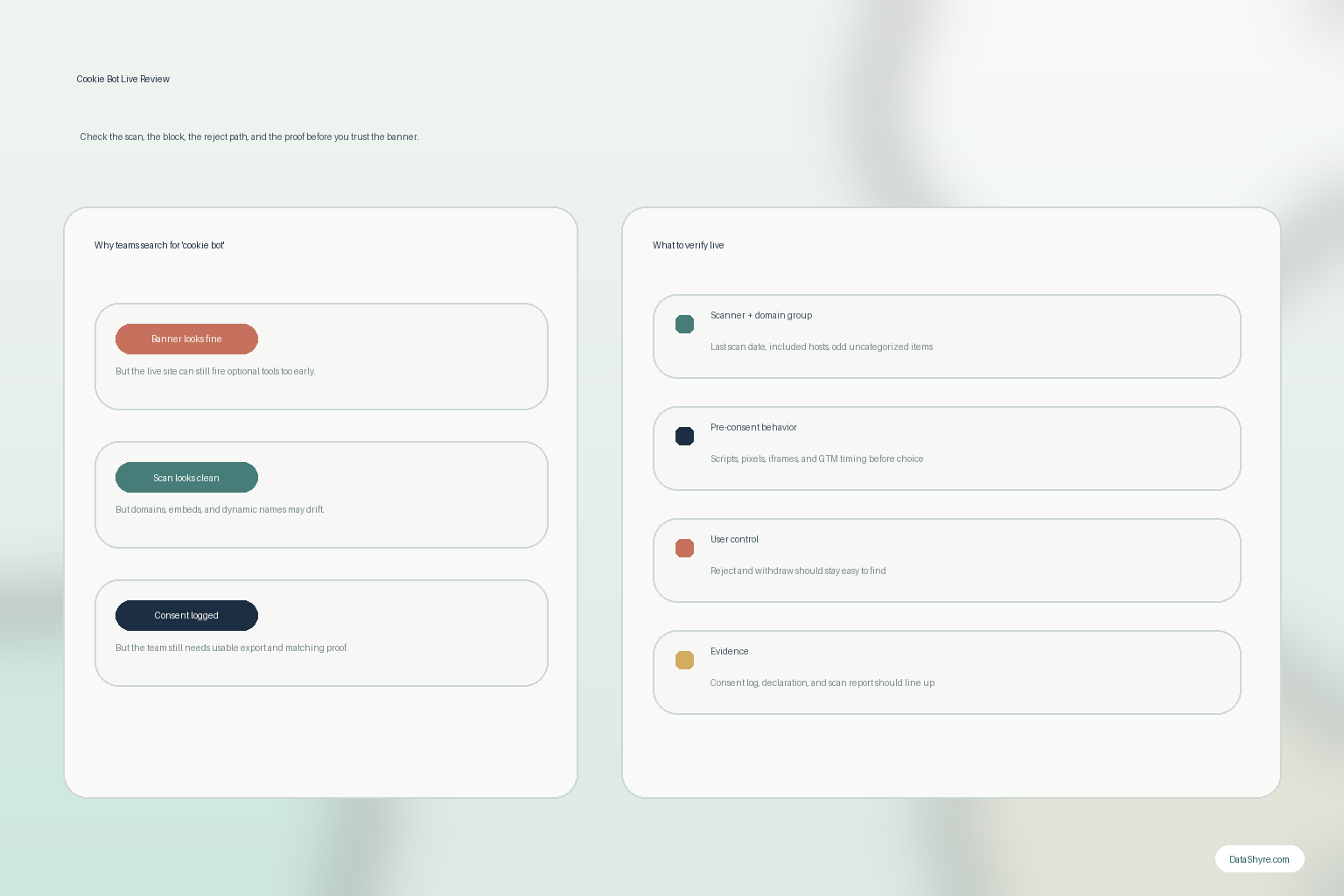
1. Start with the scan date and domain group, not the banner screenshot
The first cookie bot mistake is assuming the homepage banner tells you whether the setup is current.
It does not.
Cookiebot’s support documentation says the first scan runs when you add the domain, and that scans then run automatically every month unless you choose daily scans. Its support glossary also says a domain group is where multiple domains can share the same banner configuration and where cross-domain consent sharing can be enabled.
That makes the first review step simple:
- check when the last scan actually ran;
- confirm which domains and subdomains are in scope;
- look for uncategorized or suspiciously generic findings;
- compare the report against the real stack, not the account settings alone.
If the scan is stale or the domain grouping is incomplete, the cookie bot setup may already be describing the wrong environment.
2. Verify pre-consent blocking on the live page
This is where confidence usually gets overstated.
Cookiebot’s automatic-blocking article says it “blocks all cookies – except those strictly necessary” until a user has provided consent, but the same documentation also says full coverage depends on the scan and analysis of the website.
So the right question is not did we paste the script.
It is:
- what loads before any choice is made;
- which pixels, embeds, scripts, or iframes still bypass the intended branch;
- whether GTM or theme code changes the order of operations;
- whether category mapping still reflects the actual site behavior.
For a real cookie bot audit, I would inspect the no-choice state in the browser first, then compare it against the report and the banner text. If optional technologies load too early, the banner is no longer the real control.
3. Make reject and withdraw paths obvious, not decorative
This is one of the fastest quality checks you can run.
CNIL’s current enforcement messaging still says rejecting cookies should be “just as easy as accepting them.” Cookiebot’s support documentation for the Privacy Trigger says the trigger works as a shortcut to the user’s consent state information on the site, and its withdrawal guidance still points teams toward keeping that change path available after the initial choice.
So a practical cookie bot test should cover four separate moments:
- first visit with no prior choice;
- reject all;
- accept all or selective accept;
- later reopen and withdraw or change the choice.
If refusal is faint, hidden, or more work than acceptance, the design is already risky. If later withdrawal is hard to find, the implementation is weaker than the screenshot suggests.
4. Confirm Google consent timing instead of trusting the connector
This is the highest-value technical check for many cookie bot rollouts.
Google’s current setup guide says the default consent command should run on every page “before any commands that send measurement data” such as config or event. Cookiebot’s consent-management support area also keeps Google Consent Mode as a separate implementation branch, which is a clue by itself: this layer can be misconfigured even when the banner looks correct.
For a meaningful cookie bot review, verify:
- the default denied or granted state on a clean visit;
- the update immediately after the user’s choice;
- whether the update lands before any measurement command fires;
- whether analytics and advertising behavior matches the stated branch.
That matters because a visible banner can still be late.
5. Treat cross-domain consent as a browser-limited branch
This is where a lot of teams over-assume.
Cookiebot’s cross-domain consent documentation says users are asked separately on each domain by default, but that the feature can apply one consent across domains in the same domain group. That same documentation also says Chromium storage partitioning limits sharing, and that consent given on a top-level domain cannot necessarily be shared down to subdomains the way teams expect.
That means cookie bot cross-domain behavior should be treated as a live browser test, not a checkbox.
Check:
- which sites are in the same domain group;
- whether the banner makes multi-domain scope visible to users;
- whether the tested browser actually preserves the intended carry-over;
- what happens after a later withdrawal.
If the organization is relying on a multi-site consent story, this branch deserves direct testing before anyone calls it solved.
6. Make sure the consent log and scan report work as evidence
A strong cookie bot setup is not only about collecting a choice.
It is also about being able to explain that choice later.
Cookiebot’s support articles say website owners can download the consent log from the account and that the log can help demonstrate the existence and attributes of a submitted consent. Its documentation also says the scan report can be matched to the date of consent to show what wording and cookies were in place at that time.
So I would verify whether the team can actually retrieve:
- the relevant consent log export;
- the date range needed for an audit or complaint;
- the matching scan report;
- the declaration or user-facing wording tied to that moment.
If your cookie bot process produces a banner but nobody can pull usable proof a month later, the program is more fragile than it looks.
7. Re-test after release changes instead of trusting the launch state
The biggest long-term cookie bot risk is drift.
Cookiebot’s own materials separate scanning, blocking, consent management, and cross-domain behavior because each can break on its own. A new tag, plugin, script order change, embedded widget, or domain-group adjustment can quietly move the site away from the intended behavior.
That is also where DataShyre can help. If you are running Cookiebot, OneTrust, or another CMP and you want an independent implementation check, DataShyre can help audit the live browser behavior, the policy-to-runtime match, the consent records, and the handoff into privacy operations.
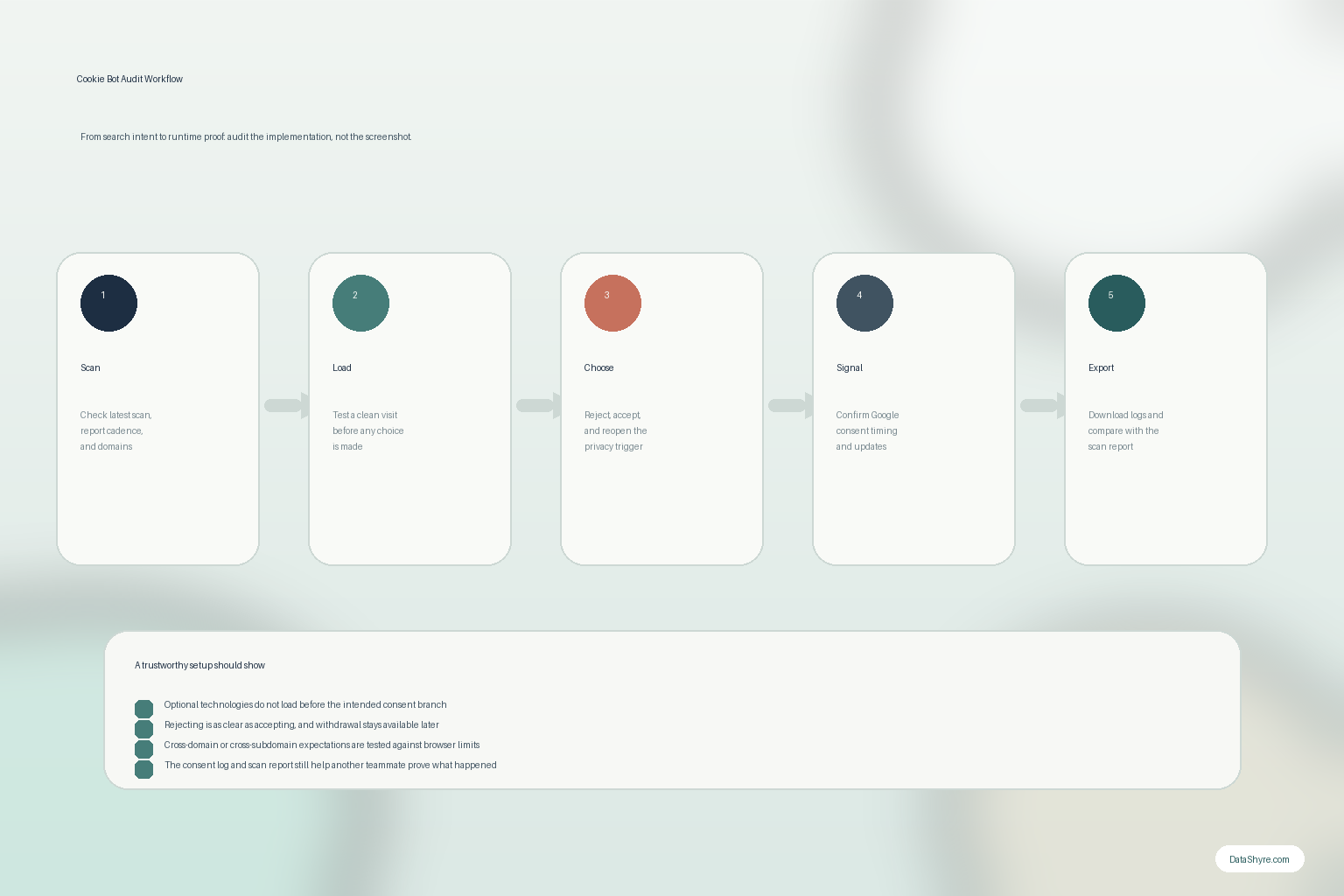
If you were reviewing cookie bot this week, I would do it in this order:
- check scan recency and domain scope;
- inspect the no-choice state in the browser;
- test reject, accept, and later withdrawal;
- confirm Google consent timing;
- test any cross-domain assumptions;
- export logs and related proof;
- repeat after the next meaningful site change.
That order usually surfaces real problems faster than more banner styling work.
FAQ
Is cookie bot the same as Cookiebot?
Usually, yes. Most people searching cookie bot mean Cookiebot by Usercentrics, even if they type the name with a space.
Does Cookiebot automatically make a site compliant?
No. Cookiebot can support scanning, banner controls, blocking, declarations, and consent logging, but the live site still has to behave the way the tool and policy say it behaves.
What is the biggest implementation mistake?
Trusting the banner preview more than the live browser test. Pre-consent firing, weak rejection paths, bad tag order, and missing proof usually show up only in runtime checks.
Bottom line
The best cookie bot setup in 2026 is not the one that looks clean in the admin preview.
It is the one that scans the right scope, blocks optional technologies before choice, keeps reject and withdraw paths easy to use, updates Google at the right time, behaves honestly across domains, and leaves behind proof another teammate can still retrieve later.
If those layers are weak, the banner is not the control.
The fastest way to judge cookie bot is to test it the way a broken deployment would expose it: before consent, after consent, and again after a stack change.
Sources
- Cookiebot Support, Automatic cookie blocking: https://support.cookiebot.com/hc/en-us/articles/360009074960-Automatic-cookie-blocking
- Cookiebot Support, Can you send me the scan report on a certain date?: https://support.cookiebot.com/hc/en-us/articles/360006361234-Can-you-send-me-the-scan-report-on-a-certain-date
- Cookiebot Support, Glossary / Cookiebot terms: https://support.cookiebot.com/hc/en-us/articles/7990384807068-Glossary-Cookiebot-terms
- Cookiebot Support, The Cookiebot CMP Privacy trigger (Cookiebot Admin): https://support.cookiebot.com/hc/en-us/articles/4406571299346-The-Cookiebot-CMP-Privacy-trigger-Cookiebot-Admin
- Cookiebot Support, Where can I find the consent log?: https://support.cookiebot.com/hc/en-us/articles/360003782734-Where-can-I-find-the-consent-log
- Cookiebot Support, Logging and demonstration of user consents: https://support.cookiebot.com/hc/en-us/articles/360003782654-Logging-and-demonstration-of-user-consents
- Cookiebot Support, Cross-domain Consent Sharing in the Cookiebot Admin: https://support.cookiebot.com/hc/en-us/articles/360003792573-Cross-domain-Consent-Sharing-in-the-Cookiebot-Admin
- Google for Developers, Set up consent mode on websites: https://developers.google.com/tag-platform/security/guides/consent
- CNIL, Dark Patterns in Cookie Banners: CNIL issues formal notice to website publishers: https://cnil.fr/en/dark-patterns-cookie-banners-cnil-issues-formal-notice-website-publishers