Website Privacy Policy Generator in 2026: What It Helps With, What It Misses, and 7 Live Checks
The real value in website privacy policy generator shows up when you debug it like a live system. A banner can render perfectly and still leak requests, misfire tags, or drift after the next plugin or theme update.
The useful test for website privacy policy generator is whether the live stack behaves correctly before consent, after consent, and after the next deployment. That is how hidden leaks and timing mistakes show up.
That is the real job.
A website privacy policy generator can help structure the first draft. It can speed up sections, prompts, and clause assembly. But it still cannot confirm what the live site is collecting, where data is flowing, whether the notice appears at the right moment, or whether the rights path the page describes actually works.
The official sources still point in the same direction. California’s Department of Justice says a notice at collection must list the categories of personal information collected and the purposes for using them, and it must link to the privacy policy where consumers can get a “fuller description” of privacy practices and rights. It also says the notice must appear at or before the point of collection. GDPR Article 12 still requires privacy information to be provided using “clear and plain language.” The ICO’s current transparency guidance says you should “know what personal data you have” before drafting privacy information and keep that information under review. The FTC adds the enforcement version plainly: if your company makes privacy promises, it must “live up to those claims.”
And the current enforcement picture makes that operational, not theoretical. On October 29, 2026, California Attorney General Rob Bonta announced a $1.8 million settlement with Lyft, saying consumers had to detour through the privacy policy and extra steps to exercise a right the law guarantees. He called that path “cumbersome and confusing.”
For adjacent context, start with these guides to website privacy policy template, privacy policy template, and website privacy checker. This page stays narrower. It is the website privacy policy generator review I would use this week before publishing generator output on a real site.
If your team is trying to get website privacy policy generator under control without adding a heavyweight privacy stack, DataShyre can help. DataShyre focuses on consent and preference management that are easier to implement, easier to operate, and easier to trust on a live site. Start with DataShyre’s consent and preference management or book a demo.
If your team is using a generator because the site has already outgrown guesswork, DataShyre can help connect the draft to the live stack through data mapping, consent management, and DSR automation. The hard part is rarely producing the first paragraph. It is proving that the policy still matches the forms, scripts, vendors, and rights workflows after the next release.
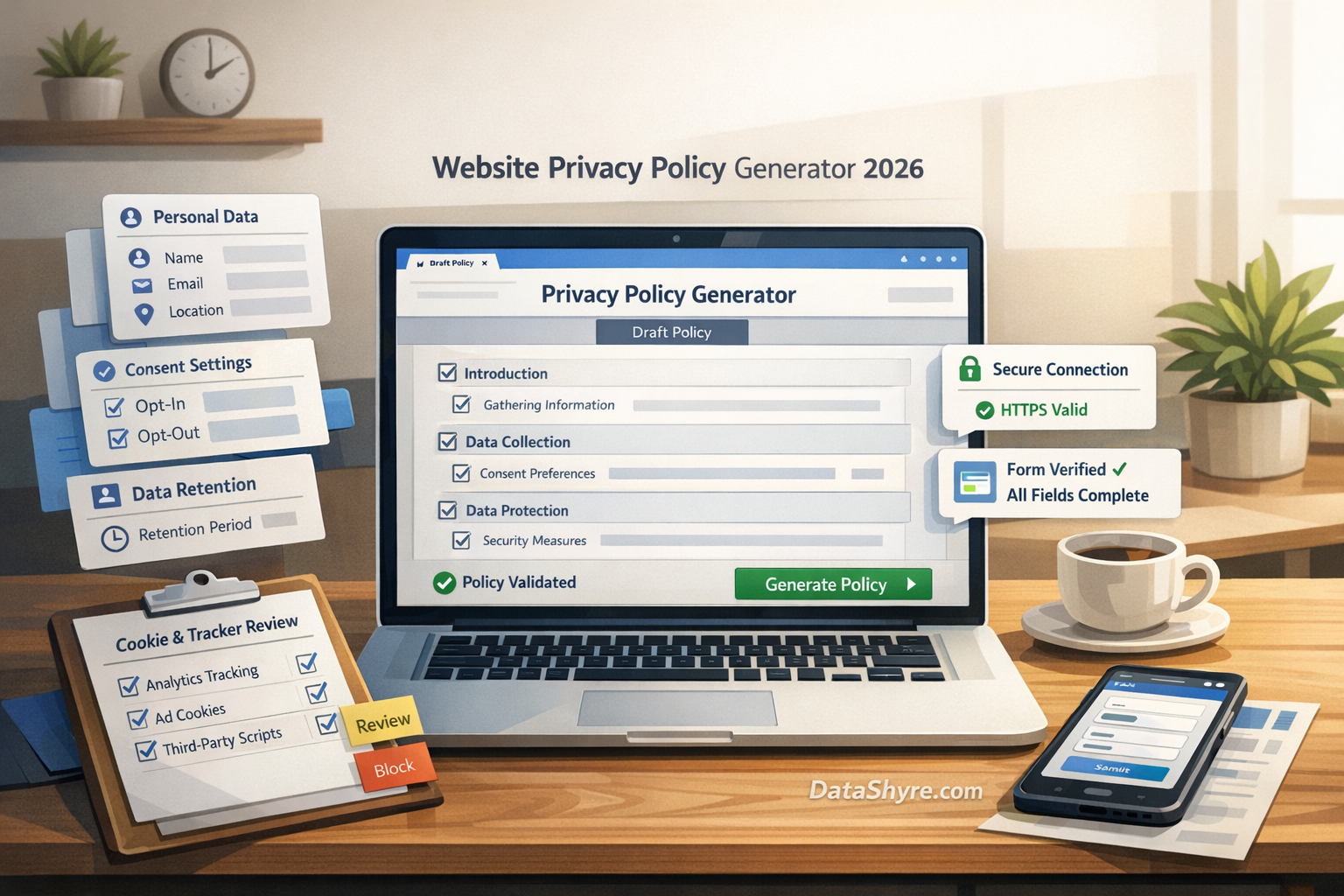
1. Treat the generator as a drafting tool, not the source of truth
The first website privacy policy generator mistake is assuming the generated output is already authoritative.
It is not.
The generator only knows what you tell it, what its template library assumes, and what the product is able to infer. It usually does not know:
- which hidden fields your forms pass downstream;
- which scripts or pixels load through your tag manager;
- which vendors receive identifiers after page load;
- which app or CRM workflows sit behind the website; or
- whether your rights instructions still match the current support process.
This is why the generated page should be treated as a structured draft, not as evidence that the site is actually aligned.
2. Start with the live collection map before you enter anything into the generator
The ICO’s guidance gives the right opening move: “know what personal data you have” before you draft the notice.
That means a serious website privacy policy generator workflow begins with the live collection map, not the product prompt screen.
Before generating or approving text, map at least:
- contact, demo, quote, newsletter, checkout, and support forms;
- account creation, login, and profile-edit flows;
- analytics, advertising, and session-level tracking tools;
- chat widgets, embedded media, schedulers, and maps;
- payment, fraud, CRM, and support vendors; and
- any app or backend process that uses the same customer data later.
If that inventory is incomplete, the website privacy policy generator will produce a polished explanation for an incomplete reality.
3. Make sure the generated policy works with point-of-collection notices
This is one of the most common deployment gaps.
California DOJ’s current CCPA guidance says notice at collection must be provided at or before the point where personal information is collected and must link to the privacy policy for a fuller explanation. That means the policy page and the collection notice are one system, not two separate projects.
So when reviewing website privacy policy generator output, check whether the site also gives short, contextual disclosures near:
- lead forms;
- newsletter signups;
- account registration;
- quote or booking requests;
- checkout or payment steps; and
- any screen where optional marketing uses are introduced.
If the generated policy is accurate but the form that actually collects the data says nothing useful, the user still misses the context when it matters most.
4. Give cookies, pixels, and embedded tools their own honest branch
A weak website privacy policy generator often hides tracking under vague language like usage data or website analytics.
That is rarely enough now.
The generated page should explain, in plain language:
- what cookies or similar technologies are in use;
- whether they are necessary, analytics, advertising, personalization, or support-related;
- which third parties may receive data through them;
- how banner, preference-center, or browser-based choices affect them; and
- where the user can revisit those settings later.
This is also where generated text often drifts from runtime behavior. If the page says users can reject optional tracking, test whether the live site actually honors that promise in the browser. If that branch needs checking, our cookie policy and website privacy checker guides are the better next reads because they focus on what the site really does after load.
5. Make the rights section operational, not decorative
A website privacy policy generator can produce a rights section that looks impressive and still fails the user.
California DOJ says a business privacy policy must include information on consumers’ privacy rights and how to exercise them. The Lyft settlement from October 29, 2026 is a fresh reminder that sending people through a long detour from the privacy policy to the real control path can still be unlawful.
So test whether the generated page clearly tells people:
- which rights apply in the relevant jurisdictions;
- how to submit a request;
- whether account holders have an in-product route;
- where opt-out or consent settings can be changed later;
- whether browser-based signals such as Global Privacy Control are honored where applicable; and
- what happens after the request is submitted.
If the policy promises a clean rights experience but the user has to hunt through three pages, re-enter information, or leave the app or site flow unnecessarily, the website privacy policy generator has described a process that does not really exist.
6. Compare the generated output against actual vendor behavior and site promises
This is the FTC test.
If your company makes privacy promises, it must “live up to those claims.”
That makes a website privacy policy generator review less about tone and more about verification.
Compare the generated text against:
- active form destinations and CRM routes;
- tag manager containers and embedded third-party scripts;
- analytics, advertising, and session replay tools;
- support, scheduling, chat, and payment vendors;
- account settings and preference-management screens; and
- the real support workflow used for rights and privacy requests.
If the generator says data is only shared with service providers but the site is also using ad networks, embedded video platforms, marketing tools, or app-connected partners, the page is already underspecified.
7. Tie the generator to release management so the page does not go stale
The biggest long-term website privacy policy generator risk is drift.
The page may be accurate on launch day and wrong a month later because:
- a new embed is added;
- a new form field is introduced;
- a new analytics or advertising tool goes live;
- a new vendor starts receiving data;
- the consent experience changes; or
- the request-handling workflow changes behind the scenes.
The ICO says privacy information should be kept under review and updated before you start using personal data for a new purpose. California DOJ’s privacy-policy guidance also says the business’s privacy policy should be updated at least once a year. That is the minimum. The better practice is to re-run the website privacy policy generator workflow whenever the collection, sharing, or rights flow changes.
That is also where DataShyre tends to be most useful. If your team is tired of generated text drifting away from the live system, DataShyre can help connect the policy layer to the actual form logic, tracking stack, vendor map, and consent controls.
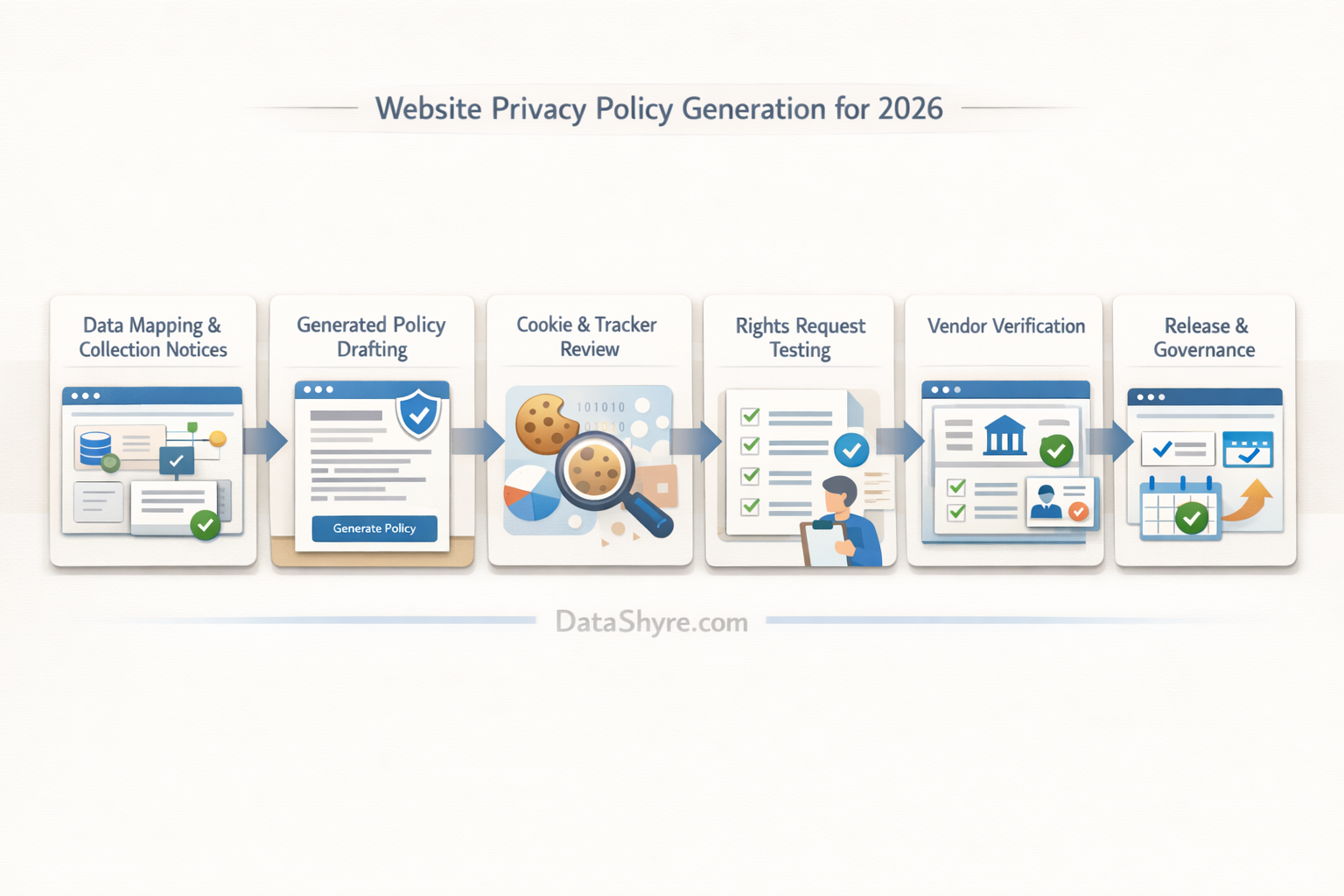
A practical 7-step review for this week
If I were approving website privacy policy generator output today, I would use this order:
- map the live collection points, vendors, and rights paths first;
- generate or assemble the draft text;
- compare the draft against point-of-collection notices and form flows;
- rewrite the cookies and tracking sections so they match runtime behavior;
- test the rights journey the page describes;
- reconcile the page against vendor reality and internal support workflows; and
- trigger a re-review whenever the site or app changes.
That order usually catches more real problems than polishing legal wording first.
FAQ
Is a website privacy policy generator enough on its own?
No. A website privacy policy generator can speed up drafting, but it cannot verify live forms, tracking, vendors, consent logic, or request handling on its own.
Does generated privacy text automatically make a site compliant?
No. The text still has to match real collection, sharing, notice, and rights behavior. If the page and the live system drift apart, the policy becomes misleading.
What is the biggest risk with a website privacy policy generator?
Drift. The generator can create a credible-looking page faster than the team can verify whether the site still behaves the way the page claims.
Bottom line
The best website privacy policy generator in 2026 is not the one that produces the fastest first draft.
It is the one you treat as a starting point while you verify notices, cookies, vendors, rights, and release changes against the live environment.
If that verification step is weak, the generator has not solved the privacy problem.
The fastest way to judge website privacy policy generator is to test it the way a broken deployment would expose it: before consent, after consent, and again after a stack change.
Sources
- California Department of Justice, California Consumer Privacy Act (CCPA): https://oag.ca.gov/privacy/ccpa
- California Department of Justice, How to Read a Privacy Policy: https://oag.ca.gov/privacy/facts/online-privacy/privacy-policy
- California Attorney General Rob Bonta, Lyft CCPA settlement announcement, October 29, 2026: https://oag.ca.gov/news/press-releases/privacy-rights-can%E2%80%99t-be-left-rearview-attorney-general-bonta-secures-18-million
- ICO, How should we draft our privacy information?: https://ico.org.uk/for-organisations/uk-gdpr-guidance-and-resources/individual-rights/the-right-to-be-informed/how-should-we-draft-our-privacy-information/
- ICO, What privacy information should we provide?: https://ico.org.uk/for-organisations/uk-gdpr-guidance-and-resources/individual-rights/the-right-to-be-informed/what-privacy-information-should-we-provide/
- EUR-Lex, Regulation (EU) 2016/679, Articles 12 to 14: https://eur-lex.europa.eu/legal-content/EN/TXT/?uri=CELEX:32016R0679
- Federal Trade Commission, Privacy and Security: https://www.ftc.gov/business-guidance/privacy-security