General Data Protection Regulation in 2026: What the GDPR Still Requires and What Teams Should Check Now
The real value in general data protection regulation shows up when you debug it like a live system. A banner can render perfectly and still leak requests, misfire tags, or drift after the next plugin or theme update.
The useful test for general data protection regulation is whether the live stack behaves correctly before consent, after consent, and after the next deployment. That is how hidden leaks and timing mistakes show up.
The GDPR is still the EU’s main data protection law, and in 2026 the operational basics are still the same: know whether the law applies to you, map each processing purpose to a lawful basis, explain the processing clearly, make rights usable, and prove that the controls behind the policy page actually work.
That is not just theory this year. On March 19, 2026, the European Data Protection Board launched its 2026 Coordinated Enforcement Framework action on compliance with the GDPR’s transparency and information obligations in Articles 12, 13, and 14. So the practical review is not whether the privacy page sounds formal enough. It is whether the organisation can show that its notices, rights handling, retention, vendor setup, and change process still match the live stack.
If you want narrower companion guides first, start with our posts on gdpr compliant privacy notice, gdpr consent requirements, and cookie consent requirements. This page stays broader. It is the working review I would use this week to explain general data protection regulation to an operations, marketing, or product team that needs the real checklist instead of the slogan.
If your team is trying to get general data protection regulation under control without adding a heavyweight privacy stack, DataShyre can help. DataShyre focuses on consent and preference management that are easier to implement, easier to operate, and easier to trust on a live site. Start with DataShyre’s consent and preference management or book a demo.
1. Start with what the GDPR actually covers
The first mistake around general data protection regulation is treating it like a Europe-only website banner rule.
The European Commission’s application guidance says the GDPR applies when:
- a company or organisation processes personal data as part of the activities of an establishment in the EU, regardless of where the processing takes place; or
- a company outside the EU offers goods or services to people in the EU; or
- a company outside the EU monitors the behaviour of people in the EU.
That scope point matters because teams still assume the GDPR stops at the border or only applies to large enterprises.
It does not.
If your product, site, app, or marketing system is aimed at EU users or tracks their behaviour, general data protection regulation can become an operating requirement even if the company itself is established elsewhere.
2. Build from the seven principles, not from a template
The European Commission summarises the GDPR around seven key principles.
Those principles are still the cleanest way to understand general data protection regulation in practice:
- lawfulness, fairness, and transparency;
- purpose limitation;
- data minimisation;
- accuracy;
- storage limitation;
- integrity and confidentiality; and
- accountability.
Most compliance drift happens because teams remember the first six and underinvest in the seventh.
Accountability is the part that turns a legal requirement into evidence. It means the organisation is not only expected to follow the principles. It also has to be able to demonstrate that it follows them through records, vendor controls, notices, retention logic, and repeatable review steps.
This is why general data protection regulation is much bigger than a privacy-policy draft. It is a systems question about how data moves, why it moves, who touches it, how long it stays, and how the organisation proves each choice.
3. Match each processing purpose to the right lawful basis
Another common mistake is treating consent as the default answer to every GDPR question.
The European Commission’s lawful-basis guidance makes the opposite point. Consent is only one possible basis. Depending on the use case, the lawful basis may instead be:
- consent;
- contract;
- legal obligation;
- vital interests;
- public task; or
- legitimate interests.
For a useful general data protection regulation review, do not ask only whether the organisation has a policy or a banner.
Ask whether each major processing purpose has been mapped to the basis it actually relies on.
That usually exposes weak spots fast:
- marketing teams calling everything consent when some operational processing is really contract-based;
- product teams using legitimate interests without documenting the balancing logic;
- privacy pages that list several purposes but never explain which legal basis fits which one; and
- withdrawal flows that only work cleanly when the original basis was actually consent.
If the lawful-basis story is blurry, the rest of the general data protection regulation story is usually blurry too.
4. Treat transparency as an operational control, not a writing exercise
This is the part getting the clearest live enforcement attention in 2026.
The GDPR itself requires information to be given in a concise, transparent, intelligible, and easily accessible form. The EDPB’s 2026 coordinated action is specifically focused on how organisations comply with the transparency and information duties in Articles 12, 13, and 14.
So a strong general data protection regulation program should be able to show:
- what people are told when data is collected directly;
- what people are told when data comes from another source;
- whether purposes, recipients, retention, transfers, and rights are explained in plain language;
- whether important explanations appear at the moment of collection, not only in a buried footer page; and
- whether new processing starts only after the notice layer has been updated.
This is also where many teams quietly fail by writing one elegant privacy policy and assuming the job is done.
The real test is whether the site, app, forms, signup paths, support flows, analytics setup, and vendor handoffs still match that published explanation.
5. Make data-subject rights usable within the real workflow
The rights section of general data protection regulation is where the law becomes visible to the person on the other end.
The European Commission’s guidance on requests from individuals says people may exercise rights such as access, rectification, erasure, portability, and objection. It also says organisations must reply without undue delay and in principle within one month of receiving the request.
That changes what good implementation looks like.
A real general data protection regulation review should confirm:
- there is a working intake path for rights requests;
- the team can verify identity without turning the process into a maze;
- the organisation knows which systems and vendors must be checked when a request arrives;
- consent withdrawal and objection paths connect to the actual processing they are supposed to stop; and
- rejected requests are explained with reasons and complaint options where required.
If the rights section exists on paper but the operations team cannot trace data across tools fast enough to respond, the compliance story is still incomplete.
6. Do not forget the processor, records, and security layer
Many articles about general data protection regulation stop at user-facing notices.
That leaves out the machinery that usually creates the real risk.
The EDPB’s small-business guidance says organisations should keep records of processing activities with the purpose of processing, categories of data, recipients, transfer information where relevant, storage periods where possible, and a general description of security measures. The European Commission’s application guidance also makes clear that SME size alone does not remove GDPR coverage, even though some obligations do not apply in the same way to every organisation.
In real deployments, that means checking whether the organisation can show:
- a record of processing activities where required;
- a clear list of processors and service providers touching personal data;
- retention logic tied to real business and legal needs;
- appropriate technical and organisational security measures; and
- whether a Data Protection Officer is required for the model actually being run.
This is where general data protection regulation turns from awareness into discipline.
If no one knows which vendors receive personal data, where the data leaves the EEA, or how deletion instructions move through the stack, the organisation is relying on hope more than on governance.
7. Watch the areas teams still oversimplify
A broad general data protection regulation review usually has to correct the same myths:
- Cookies are not the whole GDPR. Cookie banners matter, but the GDPR also reaches forms, CRM syncs, support tools, retention, transfers, vendors, and rights handling.
- Small companies are not automatically exempt. The Commission says GDPR application depends on the nature of the activities, not simply the size of the company.
- Non-EU companies are not automatically out of scope. Offering goods or services to people in the EU or monitoring their behaviour can bring the GDPR into play.
- Publishing a policy is not the same as proving compliance. Accountability still requires evidence that the real processing matches the story being told.
- Compliance is not one-and-done. New vendors, new purposes, new forms, and new analytics flows can all make last quarter’s documentation inaccurate.
This is why the best general data protection regulation checklist is not the prettiest one.
It is the one that forces the organisation to compare the law, the notices, and the live systems at the same time.
A practical review order for this week
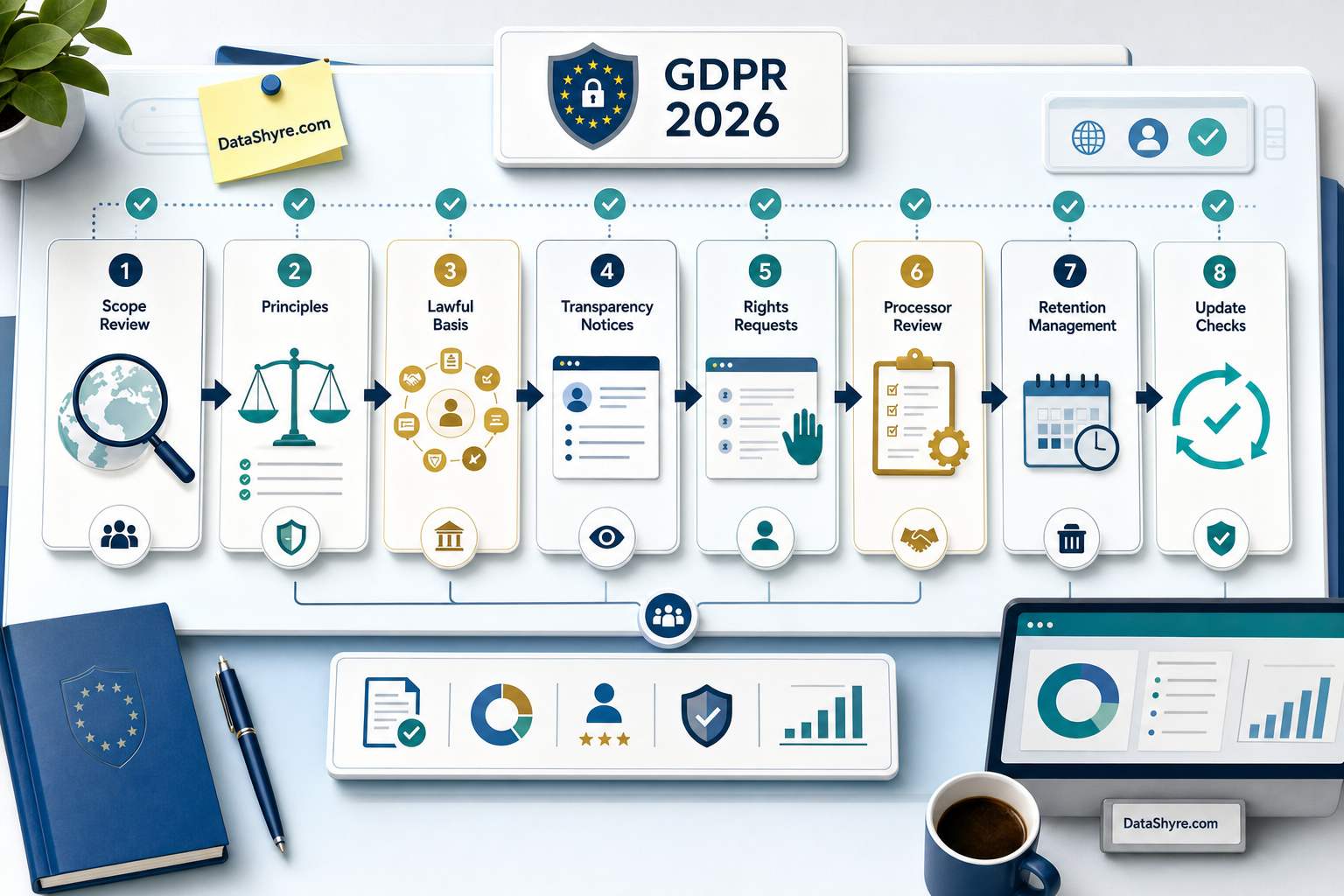
If I were auditing general data protection regulation exposure today, I would use this order:
- confirm whether EU scope is triggered by establishment, offering, or monitoring;
- map the main processing purposes to the seven principles and the actual lawful basis used;
- compare the notice layer to the real collection points and vendor flows;
- test the rights-request path end to end;
- inspect records, processors, transfers, retention, and security ownership; and
- add an update trigger so new processing cannot go live without a fresh privacy review.
That order surfaces more truth than a policy rewrite alone.
Bottom line
The best way to understand general data protection regulation in 2026 is not as a static legal page and not as a cookie-only problem.
It is a working model for how personal data enters the business, why it is used, what rule allows it, what the individual is told, what control the individual keeps, and what evidence the organisation can produce when asked.
The fastest way to judge general data protection regulation is to test it the way a broken deployment would expose it: before consent, after consent, and again after a stack change.
Sources
- EUR-Lex, Regulation (EU) 2016/679 (GDPR): https://eur-lex.europa.eu/eli/reg/2016/679/oj
- European Commission, Application of the GDPR: https://commission.europa.eu/law/law-topic/data-protection/information-business-and-organisations/application-gdpr_en
- European Commission, Principles of the GDPR: https://commission.europa.eu/law/law-topic/data-protection/information-business-and-organisations/principles-gdpr_en
- European Commission, Legal grounds for processing data: https://commission.europa.eu/law/law-topic/data-protection/information-business-and-organisations/legal-grounds-processing-data_en
- European Commission, Dealing with requests from individuals: https://commission.europa.eu/law/law-topic/data-protection/information-business-and-organisations/dealing-requests-individuals_en
- European Commission, Ten years of the GDPR: your data, your rights: https://commission.europa.eu/news-and-media/news/ten-years-gdpr-your-data-your-rights-2026-05-22_en
- European Data Protection Board, CEF 2026 on transparency and information obligations: https://www.edpb.europa.eu/news/cef-2026-edpb-launches-coordinated-enforcement-action-on-transparency-and-information_en
- European Data Protection Board, Data protection guide for small business: https://www.edpb.europa.eu/sme_en