Privacy Policy Template in 2026: What to Add Before You Publish One
The real value in privacy policy template shows up when you debug it like a live system. A banner can render perfectly and still leak requests, misfire tags, or drift after the next plugin or theme update.
The useful test for privacy policy template is whether the live stack behaves correctly before consent, after consent, and after the next deployment. That is how hidden leaks and timing mistakes show up.
A strong privacy policy template is not really a writing shortcut. It is a structure for turning the real data map of the business into a page normal people can understand and your team can keep current when the stack changes.
Current official guidance still pushes in that direction. The California Department of Justice says privacy policies should appear on the website homepage, in-store where relevant, or on the landing or download page of a mobile app, and says the policy should be updated at least once a year. The European Commission’s GDPR guidance says organizations must tell people who is processing the data, why, on what legal basis, what categories are involved, how long the data is kept, who receives it, whether it is transferred outside the EU, and what rights the person has. The ICO’s privacy-information guidance adds the practical part many teams still skip: use layered delivery, headings, short sentences, direct links, and update the notice before new processing begins.
For adjacent context, start with these guides to website privacy checker, gdpr compliant privacy notice, california web privacy law, and ccpa audit checklist. This page is narrower. It is the working review I would use this week before publishing a privacy policy template on a real site.
If your team is trying to get privacy policy template under control without adding a heavyweight privacy stack, DataShyre can help. DataShyre focuses on consent and preference management that are easier to implement, easier to operate, and easier to trust on a live site. Start with DataShyre’s consent and preference management or book a demo.
If your team is trying to turn a privacy policy template into something operational instead of decorative, DataShyre can help. DataShyre focuses on data mapping, consent management, and DSR automation so the page in the footer keeps up with the systems behind it. If you want the short version, book a demo.
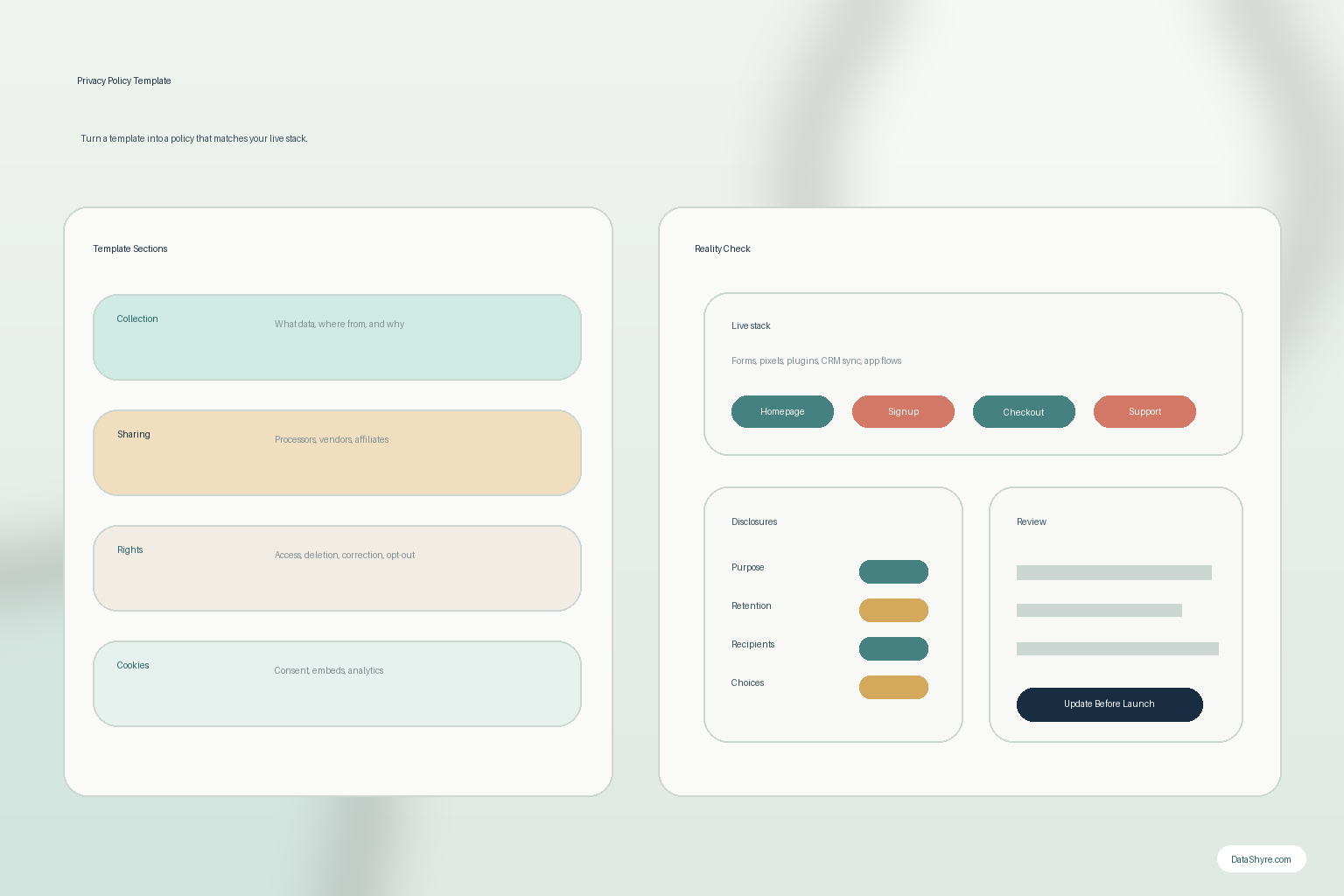
1. Start with the data map, not the template
The first privacy policy template mistake is treating the template as the source of truth.
It is not.
The source of truth is the real processing your business is doing right now:
- what personal data you collect;
- where it comes from;
- why you collect it;
- which tools, vendors, and internal teams receive it;
- how long it is kept; and
- what user choices or legal rights change the downstream behavior.
If you start with the template alone, you usually end up with vague promises like we may collect information to improve our services while the live stack is running analytics tools, ad pixels, signup forms, chat, CRM syncs, payment processors, and support systems that deserve more specific explanation.
This is why the best privacy policy template workflow begins with the data inventory and only then moves into drafting.
2. Cover the sections regulators and platforms still expect
The California DOJ’s consumer guidance says a privacy policy should answer practical questions like what information is collected, how it is collected, why it is collected, how it is used, who gets access, what choices the person has, whether they can review or correct information, what security measures are used, and who is accountable for privacy practices.
The European Commission’s GDPR guidance adds another operational layer. A policy should identify the controller, list purposes, categories of personal data, legal basis, retention period, recipients, transfer information, rights, and any automated decision-making where relevant. If data came from another source, the person still needs to be informed within the timing rules set by GDPR Articles 12 to 14.
WordPress’s own privacy guidance for plugins is useful here because it turns that theory into an editing checklist. Its default privacy-policy questions cover:
- what personal data is collected and why;
- who data is shared with;
- how long data is retained;
- what rights users have;
- where data is sent;
- contact information;
- security and breach procedures;
- what third parties provide data;
- what profiling or automated decision-making occurs; and
- any industry-specific disclosure requirements.
If your privacy policy template does not help your team fill those sections cleanly, the template is too thin.
3. Split purposes and legal bases instead of hiding them in one paragraph
This is where many weak policies still fail.
A privacy policy template should not flatten everything into one generic paragraph that says data is collected for business purposes, service improvement, marketing, and compliance.
Readers need to understand the actual categories of use, such as:
- account creation and authentication;
- order processing or service delivery;
- support and communications;
- analytics and measurement;
- advertising or retargeting;
- fraud prevention and security; and
- legal or regulatory retention duties.
Under the GDPR side of the world, the legal basis question matters too. If consent is the basis for one flow, contract for another, and legal obligation for another, the policy should not blur those together.
A privacy policy template becomes much more credible when each major purpose is paired with the category of data used, the reason for the use, and the relevant control path. That is easier for users to follow and easier for your internal team to update later.
4. Treat cookies, pixels, embeds, and tags as first-class sections
This is one of the clearest gaps between an average privacy policy template and a useful one.
California’s guidance expects the policy to explain how data is collected and used. The ICO’s privacy-information guidance says unexpected uses should be brought clearly to people’s attention, not buried. WordPress’s own privacy checklist explicitly calls out cookies, analytics, and third-party embeds.
In real deployments, that means a strong privacy policy template should explain at least:
- whether the site uses cookies or similar technologies;
- which categories of non-essential tracking are in scope;
- whether third-party embeds or plugins cause extra collection;
- how consent or opt-out choices affect that behavior; and
- where the user can revisit those choices later.
This is also where your policy and consent experience need to agree with each other. If the banner suggests granular categories but the policy only says we use cookies to improve the site, the disclosure layer is lagging behind the runtime layer.
That mismatch is exactly why a website privacy checker is useful before you publish a revised policy.
5. Name the recipients, retention logic, and ownership path
Another common privacy policy template problem is writing as if data disappears into a cloud and takes care of itself.
Users and regulators usually care about the opposite questions:
- who receives the data;
- whether it goes to service providers, advertisers, analytics vendors, or corporate affiliates;
- how long it is kept;
- whether it moves across borders; and
- who answers when something goes wrong.
The California DOJ tells consumers to look for who has access to the information and who is accountable for privacy practices. The European Commission says organizations should tell people about recipients, retention, and transfers outside the EU where relevant.
So a real privacy policy template should push the writer to be concrete. Even if some sections use categories rather than named vendors, the categories need to map to reality. Trusted partners is not a useful category. Payment processors, cloud hosting providers, customer-support tools, and advertising partners are much better starting points.
The same goes for retention. We retain data as long as necessary may be legally familiar, but it should be paired with clearer retention logic where possible.
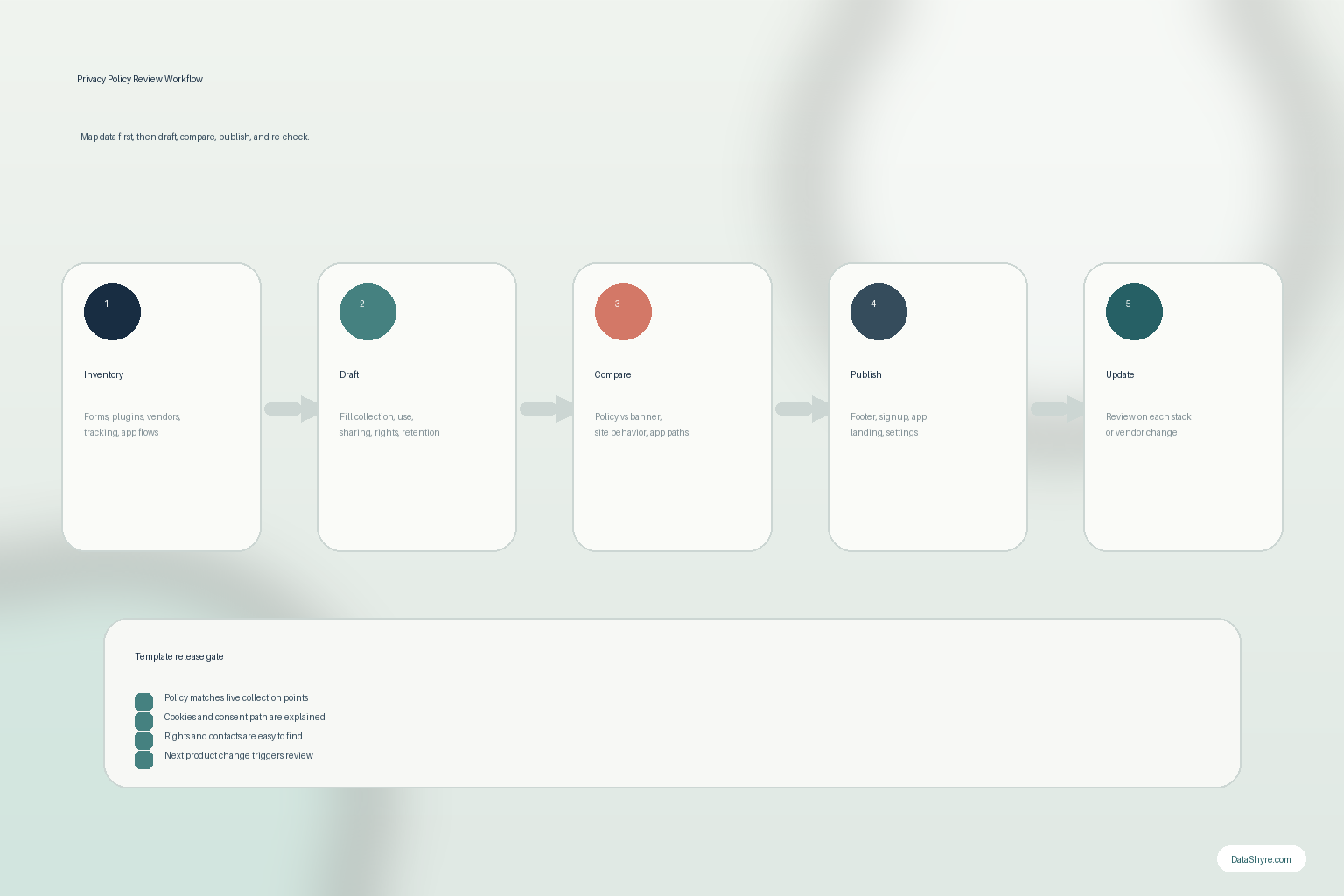
6. Publish the policy in the places people actually enter the journey
The California DOJ points people to privacy policies on website homepages and app landing or download pages. The ICO says privacy information should be easy to access and linked directly, not hidden among unrelated materials.
That should change how you deploy a privacy policy template:
- from the website footer;
- from account-creation and lead-capture flows where collection starts;
- from cookie or privacy-settings entry points;
- from mobile app landing or download paths where relevant; and
- from WordPress or plugin-driven sections that add their own collection behavior.
If the page exists but users only reach it after digging through menus, the policy is present without really being usable.
This is also where WordPress-specific behavior matters. The official WordPress privacy guidance expects plugins that collect or share user data to contribute suggested policy text. If your stack runs through WordPress, your privacy policy template review should check whether plugin-level disclosures were actually folded into the published page.
7. Add an update trigger before the stack changes again
The best privacy policy template is still only a snapshot.
The ICO says privacy information should be reviewed regularly, kept accurate and up to date, and proactively updated before new purposes begin. The California DOJ says the policy should be updated at least once a year. In real deployments, those are minimums, not a full operating model.
The policy should be reviewed when:
- a new plugin, SDK, pixel, or embed is added;
- a new vendor or processor is onboarded;
- a form begins collecting extra fields;
- a new marketing or personalization use case launches;
- a new app surface or region goes live; or
- the consent or rights workflow changes.
That is the part teams skip when they treat a privacy policy template as a one-time deliverable.
A practical review order for this week
If I were rewriting a privacy policy template today, I would use this order:
- map the live data flows first;
- fill the minimum disclosure sections for collection, purposes, sharing, retention, rights, and contacts;
- isolate cookies, tags, embeds, and consent behavior in plain language;
- compare the policy against what the site or app actually does;
- publish the policy where the user journey really starts; and
- tie future product or vendor changes to a required notice review.
That order usually produces a better result than polishing the template language before anyone has checked the real stack.
Bottom line
The best privacy policy template in 2026 is not the one with the most clauses.
It is the one that reflects the real data map, explains collection and purposes clearly, covers cookies and third parties honestly, gives people direct routes to their choices and rights, and gets updated before the next product change quietly makes the page inaccurate.
The fastest way to judge privacy policy template is to test it the way a broken deployment would expose it: before consent, after consent, and again after a stack change.
Sources
- California Department of Justice, How to Read a Privacy Policy: https://oag.ca.gov/privacy/facts/online-privacy/privacy-policy
- California Department of Justice, Online Privacy: https://oag.ca.gov/privacy/online-privacy
- European Commission, Obligations under the GDPR: https://commission.europa.eu/law/law-topic/data-protection/information-business-and-organisations/obligations_en
- European Commission, Information for individuals: https://commission.europa.eu/law/law-topic/data-protection/information-individuals_en
- ICO, How should we draft our privacy information?: https://ico.org.uk/for-organisations/uk-gdpr-guidance-and-resources/individual-rights/the-right-to-be-informed/how-should-we-draft-our-privacy-information/
- WordPress Developer Resources, Suggesting text for the site privacy policy: https://developer.wordpress.org/plugins/privacy/suggesting-text-for-the-site-privacy-policy/