GDPR Consent Requirements in 2026: Complete Compliance Guide
The real value in gdpr consent requirements shows up when you debug it like a live system. A banner can render perfectly and still leak requests, misfire tags, or drift after the next plugin or theme update.
The useful test for gdpr consent requirements is whether the live stack behaves correctly before consent, after consent, and after the next deployment. That is how hidden leaks and timing mistakes show up.
If you want nearby context first, start with these guides to cookie consent requirements, GDPR cookie consent examples, and consent management platform best practices. This page is the live review I would use this week before signing off on any GDPR consent requirements implementation.
If your team is trying to get gdpr consent requirements under control without adding a heavyweight privacy stack, DataShyre can help. DataShyre focuses on consent and preference management that are easier to implement, easier to operate, and easier to trust on a live site. Start with DataShyre’s consent and preference management or book a demo.
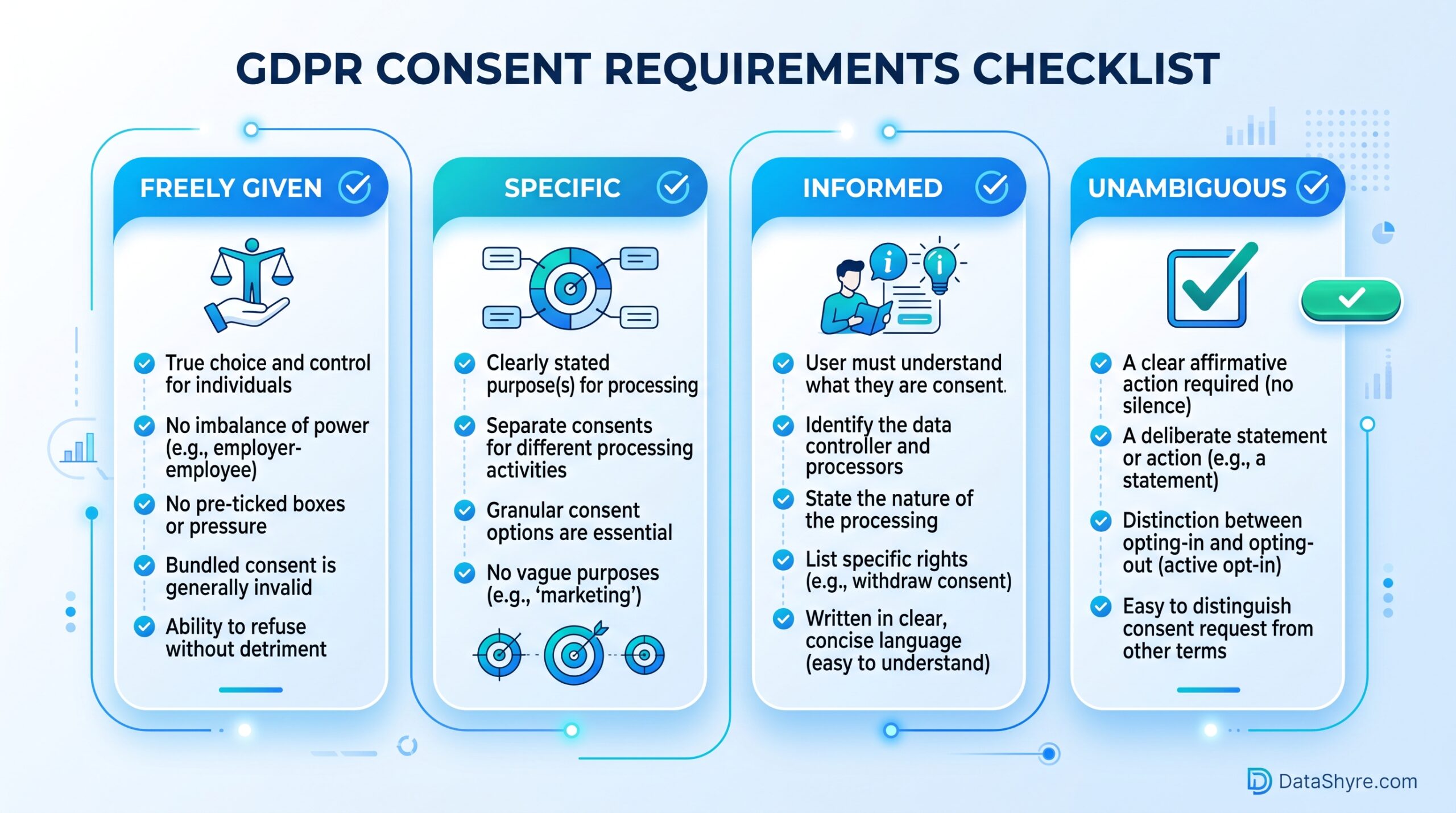
The four pillars, operationalized
The GDPR does not define consent by a single test. Article 4(11) and Article 7 together require all four conditions to be met simultaneously. A failure on any one pillar invalidates the entire consent.
1. Freely given
Consent is not freely given if the data subject has no genuine choice, cannot refuse or withdraw without detriment, or if consent is bundled with non-negotiable terms for a service that does not strictly require that processing.
The EDPB has clarified that “cookie walls” — making access conditional on consent to non-essential cookies — invalidate consent. The 2024 EDPB opinion on “consent or pay” models reinforced this: any fee or friction must not effectively hinder a free choice.
In real deployments, this means:
- No pre-ticked boxes for any non-essential purpose.
- A “Reject All” option as prominent as “Accept All” on the first layer.
- No negative consequences for refusing (no degraded service, no dark patterns).
- Separate consent requests for separate purposes — no bundled “agree to all” for analytics, advertising, and social media combined.
2. Specific
Vague or catch-all purposes do not satisfy the specificity requirement. If you process data for multiple purposes, you need separate consent for each. The European Commission emphasizes that purposes must be clearly defined and distinct.
For cookie banners, this translates to granular category controls:
- Functional / Strictly necessary — no consent needed (legal basis: contract or legitimate interest).
- Analytics / Measurement — separate consent.
- Marketing / Advertising — separate consent.
- Personalization — separate consent if distinct from analytics.
A single “We use cookies to improve your experience” notice fails specificity. The notice must name the purpose, the controller, and any third parties.
3. Informed
The data subject must receive comprehensive and clear information before consenting. The European Commission and EDPB both require this information to be in plain language, easily accessible, and distinguishable from other terms.
At minimum, the first-layer banner or notice must convey:
- Identity of the data controller (and joint controllers, if any).
- Specific purposes for each category of processing.
- Types of personal data involved.
- The right to withdraw at any time.
- Whether data will be shared with third parties and who they are.
- Any automated decision-making or profiling.
- For international transfers: the absence of adequacy decisions and the safeguards used.
The EDPB’s 2026 guidelines on scientific research introduced “broad consent” and “dynamic consent” as valid mechanisms for research where purposes evolve, but only with additional safeguards (pseudonymisation, ethics oversight, ongoing transparency). This does not extend to commercial marketing or analytics.
4. Unambiguous
Consent requires a clear affirmative act. Silence, pre-ticked boxes, inactivity, or continued browsing do not qualify. The EDPB Guidelines 05/2020 explicitly state that “actions such as scrolling or swiping through a webpage do not meet the criteria for unambiguous consent.”
For cookie banners, the operational test is simple:
- Open a fresh session.
- Click nothing.
- Navigate to another page.
- Verify that no non-essential cookies, pixels, scripts, or fingerprinting technologies have fired.
If they have, the consent mechanism is not compliant.
Special consent categories in 2026
Explicit consent for special category data
Article 9 GDPR requires explicit consent for processing special categories of personal data (health, biometric, genetic, racial/ethnic origin, political opinions, religious/philosophical beliefs, trade union membership, sex life/sexual orientation). Explicit consent demands a very clear, direct statement — typically a separate signed statement or a distinct, granular toggle labeled precisely for that purpose.
The EDPB’s 2026 guidelines on scientific research (Guidelines 1/2026, adopted April 16, 2026) clarify that broad consent may be used in research contexts, but only with defined research areas, pseudonymisation, and ethical oversight. This is a narrow exception, not a general relaxation.
Children’s consent
For information society services offered directly to children, Article 8 GDPR sets the age of consent at 16, though member states may lower it to 13. Below that age, consent must be given or authorised by a parent/guardian, and the controller must make reasonable efforts to verify that authorisation. The 2026 enforcement climate treats age verification as a live compliance gap.
Cross-border transfers
Consent can be a legal basis for international transfers under Article 49(1)(a) GDPR, but the EDPB’s 2025 guidelines on data transfers to third-country authorities stress that consent is often inappropriate or insufficiently robust for sensitive cross-border sharing, especially where government access is a risk. Consider Standard Contractual Clauses or adequacy decisions instead.
Practical checklist for 2026 implementations
Use this list when reviewing a banner, preference center, or consent API:
First layer (banner/notice)
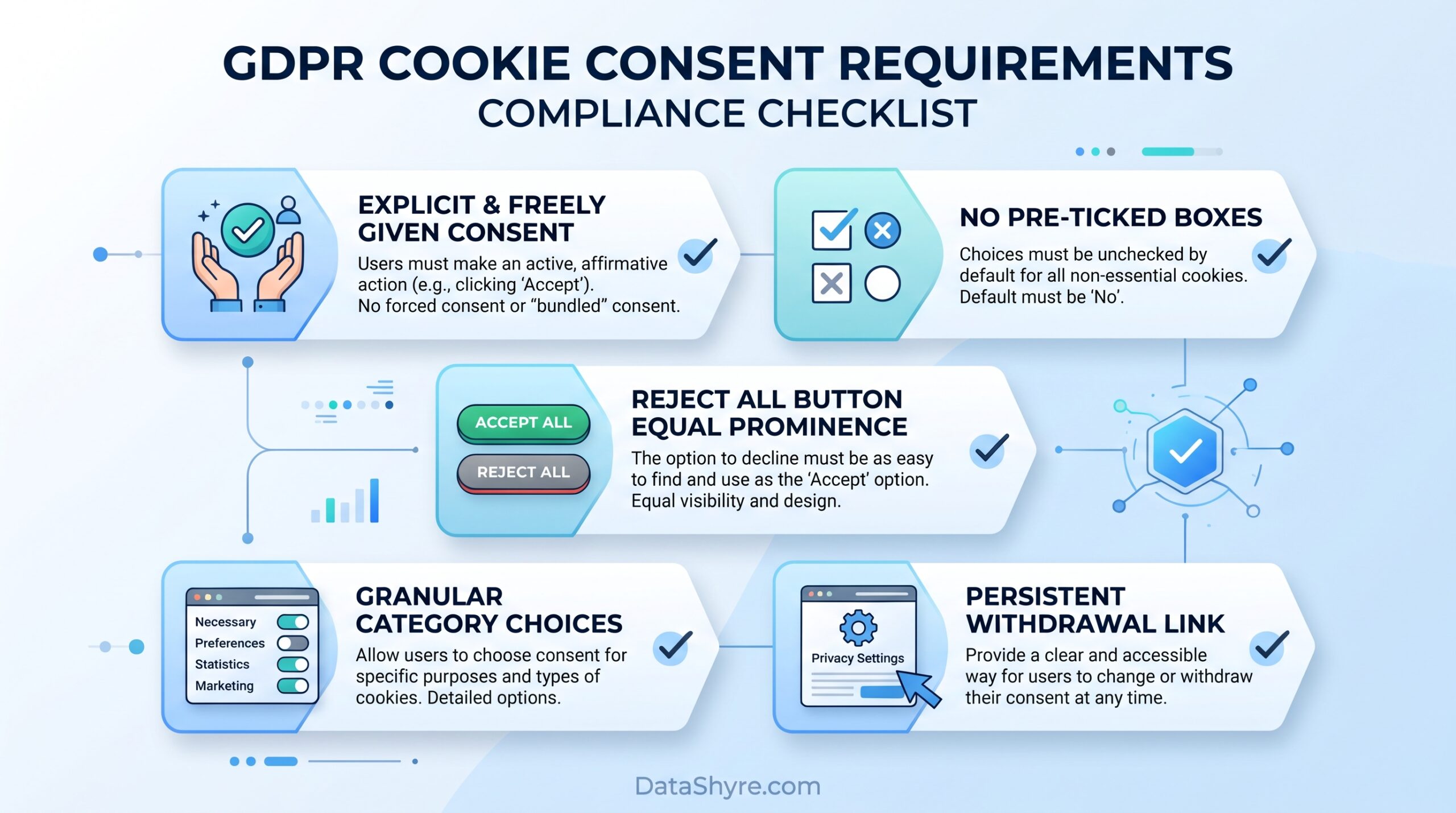
- [ ] “Accept All” and “Reject All” buttons equally prominent (same size, color weight, position).
- [ ] No pre-ticked boxes for any non-essential category.
- [ ] Purpose descriptions in plain language (not “legitimate interest” jargon).
- [ ] Controller identity visible or one click away.
- [ ] Link to full cookie/privacy notice and preference center.
- [ ] No cookie wall — content accessible without non-essential consent.
Second layer (preference center)
- [ ] Granular toggles for each purpose/category.
- [ ] All non-essential toggles off by default.
- [ ] Third-party identities listed per category.
- [ ] Save button stores choices and propagates to downstream systems.
- [ ] Persistent “Cookie Settings” / “Privacy Choices” link in footer and banner.
Runtime enforcement
- [ ] Non-essential tags, pixels, SDKs blocked before any consent.
- [ ] Consent state updates immediately on accept/reject/withdrawal.
- [ ] Google Consent Mode v2 default states set before measurement commands.
- [ ] No bypass via custom code, server-side routing, or third-party widgets.
- [ ] Behavior consistent across desktop, mobile, AMP, and logged-in states.
Records & proof
- [ ] Timestamped record per event: user/device ID, choice, notice version, purpose.
- [ ] Withdrawal events logged with same granularity.
- [ ] Records link notice version to the exact text shown at collection time.
- [ ] Retention period aligned with accountability principle (Article 5(2) GDPR).
Withdrawal & ongoing control
- [ ] Withdrawal as easy as giving consent (same number of clicks, same visibility).
- [ ] Preference center accessible from every page.
- [ ] Re-prompting logic disciplined after a decline (no nagging).
- [ ] California GPC / opt-out signals handled as a separate branch where applicable.
2026 enforcement signals to watch
- EDPB Coordinated Enforcement Action 2026 — focus on transparency (Articles 12, 13, 14). If your consent notice cannot connect to the actual runtime behavior, the proof trail is thin.
- EDPB Guidelines 04/2026 on Administrative Fines (adopted Sept 17, 2026) — five-step methodology with a strong presumption in favor of fining for non-minor infringements.
- ICO Storage and Access Technologies Guidance (finalized April 29, 2026) — scope covers cookies, tracking pixels, scripts, device fingerprinting, and similar technologies.
- CNIL Dark Pattern Enforcement — ongoing formal notices for banners where rejection is harder than acceptance.
- CPPA Dark Pattern Advisory — California requires “symmetrical choices” and clear privacy controls.
Bottom line
The GDPR consent requirements in 2026 are not new, but the standard for proving compliance is higher. A consent program that cannot demonstrate freely given, specific, informed, and unambiguous consent — with records that survive the next tag-manager change — is not production-ready.
Build the consent layer as an operating control, not a UI widget. Route decisions by legal basis before asking. Keep non-essential technologies off until the affirmative act. Make refusal as real as acceptance. Archive proof that another person can verify six months from now.
The fastest way to judge gdpr consent requirements is to test it the way a broken deployment would expose it: before consent, after consent, and again after a stack change.
Sources
- European Commission, Legal grounds for processing data: https://commission.europa.eu/law/law-topic/data-protection/information-business-and-organisations/legal-grounds-processing-data_en
- European Commission, Information for individuals: https://commission.europa.eu/law/law-topic/data-protection/information-individuals_en
- European Data Protection Board, Guidelines 05/2020 on consent: https://www.edpb.europa.eu/our-work-tools/general-guidance/gdpr-guidelines-recommendations-best-practices/guidelines-052020-consent_en
- European Data Protection Board, Guidelines 1/2026 on scientific research (adopted April 16, 2026): https://www.edpb.europa.eu/news/edpb-adopts-guidelines-processing-personal-data-scientific-research-purposes_en
- European Data Protection Board, Guidelines 04/2026 on administrative fines (adopted Sept 17, 2026): https://www.edpb.europa.eu/news/edpb-publishes-guidelines-application-power-impose-administrative-fines_en
- European Data Protection Board, CEF 2026 transparency action: https://www.edpb.europa.eu/news/cef-2026-edpb-launches-coordinated-enforcement-action-transparency-and-information_en
- UK Information Commissioner’s Office, Consent guidance: https://ico.org.uk/for-organisations/uk-gdpr-guidance-and-resources/lawful-basis/a-guide-to-lawful-basis/consent/
- UK Information Commissioner’s Office, How to obtain, record and manage consent: https://ico.org.uk/for-organisations/uk-gdpr-guidance-and-resources/lawful-basis/consent/how-should-we-obtain-record-and-manage-consent/
- UK Information Commissioner’s Office, Final storage and access technologies guidance (April 29, 2026): https://ico.org.uk/about-the-ico/media-centre/news-and-blogs/2026/04/final-storage-and-access-technologies-guidance-published/
- UK Information Commissioner’s Office, Guidance on the use of storage and access technologies: https://ico.org.uk/for-organisations/direct-marketing-and-privacy-and-electronic-communications/guidance-on-the-use-of-storage-and-access-technologies/
- CNIL, Dark patterns in cookie banners: https://www.cnil.fr/en/dark-patterns-cookie-banners-cnil-issues-formal-notice-website-publishers
- California Privacy Protection Agency, Enforcement Advisory No. 2024-02: https://cppa.ca.gov/pdf/enfadvisory202402.pdf
- Google for Developers, Set up consent mode on websites: https://developers.google.com/tag-platform/security/guides/consent
- GDPR text, Article 4(11), Article 7, Article 8, Article 9: https://gdpr-info.eu/
—
Published: October 26, 2026. Updated using current official regulator, government, and platform materials available at publication time.